St. Ursula
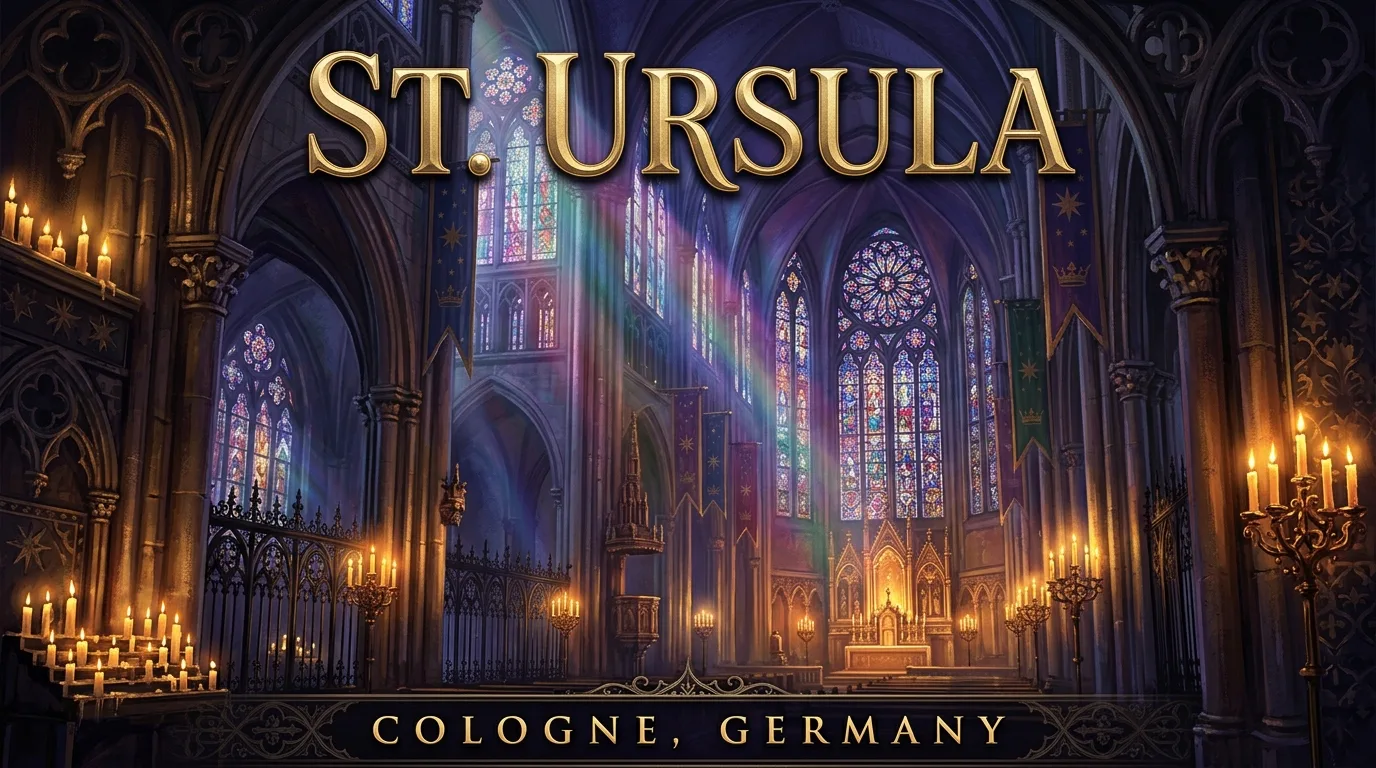
St. Ursula is one of the twelve great Romanesque churches that still define the medieval skyline of Cologne, standing at the heart of the Altstadt-Nord district that is often called the Ursulaviertel after its patron saint. From the outside, the pale brick and stone structure gives little away, yet inside, twelfth-century Romanesque masonry meets a thirteenth-century Gothic choir flooded with light and a Baroque tower cap added in the 1680s, a combination found nowhere else among Cologne's historic churches. St. Ursula owes much of its international renown to the Golden Chamber, a small walk-in reliquary room whose walls are entirely covered with human bones arranged into elaborate patterns. Since 1920 the church has held the rank of a minor basilica, and it remains the living center of the Ursula cult, a devotion that ties the legend of a martyred virgin and her companions directly into the civic history and coat of arms of Cologne.
History of St. Ursula
The building history of St. Ursula begins in the second quarter of the twelfth century, when a three-aisled Romanesque hall basilica with galleries was raised on a site that had already served as a late-antique burial ground and an early focus of Ursula veneration. The consecration of a Cordula altar in 1135 is generally cited as the earliest documented evidence of construction on the site. In the thirteenth century the chapter decided to extend the building in the new Gothic idiom: the present choir, pierced by eleven tall windows that later earned it the nickname of a glass shrine, was built between roughly 1247 and 1267, though it was only taken into full liturgical use in the second half of the fourteenth century. The west tower that now dominates the silhouette received its distinctive curved Baroque cap only in the 1680s, a much later addition layered onto the medieval core without displacing it. St. Ursula suffered severe bomb damage during the Allied air raids on Cologne in 1942, and the subsequent reconstruction stretched from 1949 into the early 1970s, with conservators working to preserve as much original fabric as possible. Pope Benedict XV had already elevated the church to the rank of a minor basilica in 1920, confirming its supra-regional importance for the Ursula cult. As one of the twelve great Romanesque churches of Cologne and the shrine of one of the city's three patron saints, alongside the Three Kings and St. Gereon, St. Ursula still holds a firm place in the city's religious and civic memory, a legacy echoed in the eleven flames on Cologne's coat of arms, which recall the legend of the martyred virgins.
Highlights of St. Ursula
The architectural quality of St. Ursula becomes apparent the moment one steps into the nave: the flat-ceilinged, three-aisled hall basilica with its groin-vaulted side aisles still follows the principles of Rhenish Romanesque architecture, while the Gothic choir, pierced by eleven slender windows, introduces a deliberate stylistic contrast and achieves a luminous, almost glass-walled quality rarely matched elsewhere in Cologne. The west tower, crowned by its curved Baroque cap from the 1680s, adds yet another, much later layer to the medieval structure and makes the church instantly recognizable from a distance across the Altstadt-Nord skyline.
The true centerpiece and unique selling point of St. Ursula, however, is the Golden Chamber, a small walk-in room endowed in 1643 by the donors Johann Krane and Verena Hegemihler. All four walls of this chamber are covered edge to edge with human bones arranged into elaborate ornamental patterns, inscriptions, and symbols, and it is widely considered the largest mosaic ever assembled from human skeletal remains. This extraordinary decoration is complemented by numerous reliquary busts dating from the thirteenth to the eighteenth century, richly dressed sculptures that house skull and bone relics and line the walls of the chamber in rows. Between 1972 and 1978 the Golden Chamber underwent a thorough restoration that recovered the original brilliance of its gilded fittings and Baroque frames. The room is directly tied to the Ursula legend: many of the bones are believed to originate from the late-antique burial ground over which the church itself was built, and over the centuries they came to be interpreted and artfully displayed as relics of the legendary eleven thousand virgins. For visitors, the Golden Chamber offers a rare and strikingly intact example of Baroque memento-mori aesthetics that carries both art-historical and cultural significance reaching well beyond Cologne.
Opening Hours, Tickets & How to Get to St. Ursula
Because St. Ursula remains an active parish church, visiting times are shaped primarily by the community's schedule of Masses and other liturgical celebrations. Outside of services, the main body of the church is generally open during the day for quiet visits and prayer, although exact hours can vary by season, day of the week, and the current calendar of events. Visitors are advised to check the notices posted at the church or to contact the parish office directly before planning a visit, both to avoid disturbing services and to avoid an unnecessary trip. The Golden Chamber, for conservation and security reasons, is not permanently open to walk-in visitors; it is typically shown as part of a guided visit or by prior arrangement through the parish, and a small donation toward the chamber's upkeep is customary when visiting. Travelers who want to see the Golden Chamber without rushing should build in enough lead time to arrange access in advance, and may also consider joining a guided city tour of Cologne that includes the site.
Getting to St. Ursula is straightforward, since the church sits centrally in the northern part of Cologne's old town. From Cologne's main railway station, Ursulaplatz is only a short walk away, and the area is also well served by tram and bus stops around Ebertplatz, from which the church can easily be reached on foot. Drivers will mainly find paid public parking and multi-story car parks in this densely built inner-city neighborhood.
Attractions Near St. Ursula
The neighborhood around St. Ursula is one of the most historically dense quarters in Cologne. Just a short walk away stands the Romanesque church of St. Kunibert directly on the banks of the Rhine, whose soaring Gothic choir and vivid stained glass make it one of the most striking of Cologne's twelve great Romanesque churches and an obvious complement to a visit to St. Ursula. In the other direction lies the lively Eigelstein quarter, with its narrow streets, independent shops, and the medieval Eigelsteintorburg, one of the surviving gates of Cologne's historic city fortifications. Also within easy walking distance is the Romanesque basilica of St. Gereon, famed for its unique ten-sided dome, an architectural form found in no other church in the city. Heading further south from St. Ursula quickly brings visitors to Cologne's main railway station and, right next to it, Cologne Cathedral, making it easy to combine a walk between the city's great Romanesque churches and its Gothic cathedral into one compact tour of Cologne's religious architecture.
Where to stay in Cologne, Germany
Compare current hotel prices and find the right place to stay.