St. Severin
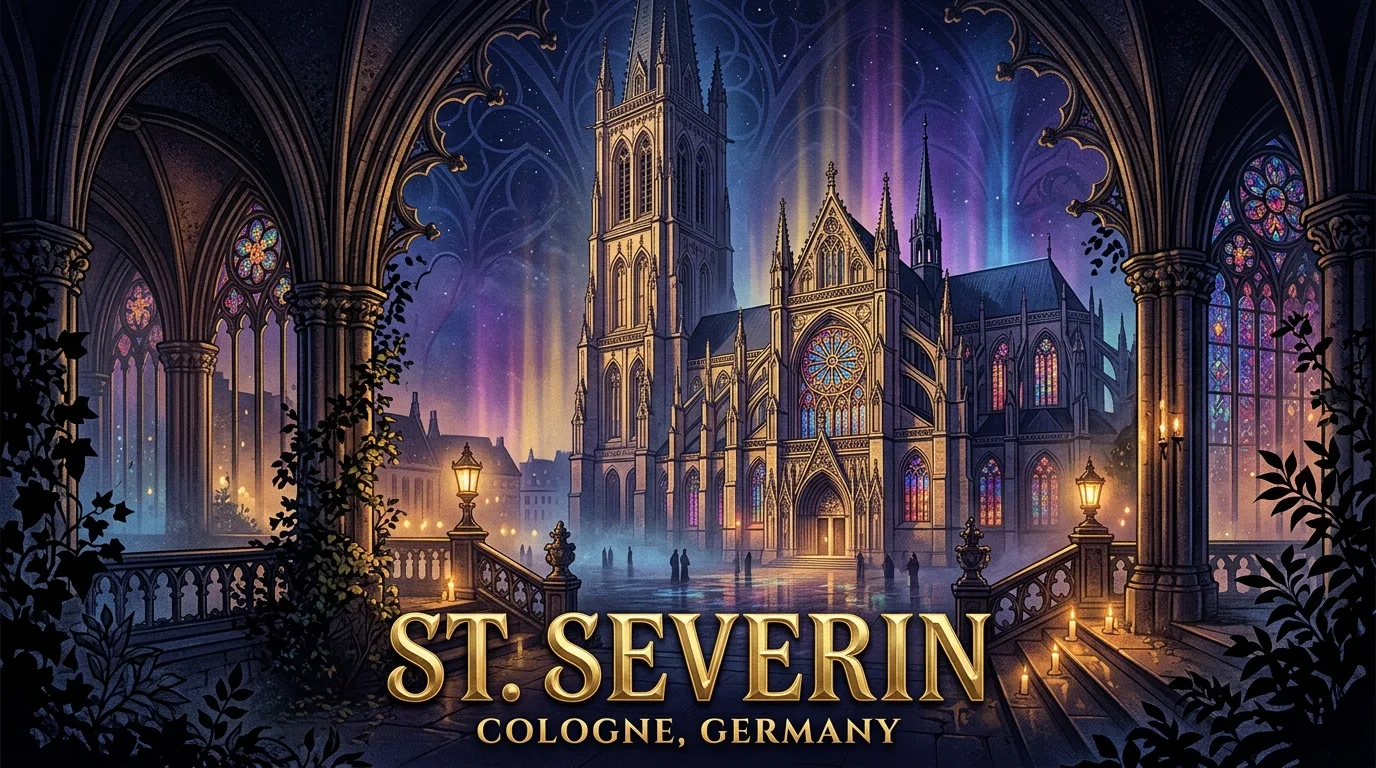
St. Severin, at the heart of Cologne's Südstadt district, ranks among the city's oldest Christian places of worship and rises above a late Roman burial ground that already contained early Christian graves and a small cult building as far back as the 4th century. The Romanesque parish church is named after Saint Severin, the third recorded bishop of Cologne, who died around the year 400 and whose relics are still venerated here today. Over more than a millennium and a half, a modest late antique hall church gradually grew into today's three-aisled Romanesque basilica crowned by a late Gothic spire, its construction history reading almost like a stratified record of Cologne's urban past. As patron saint of Cologne and of weavers, Saint Severin continues to be honored each year during the traditional Severinusfest, a festival featuring a relic procession through the Südstadt.
History of St. Severin
The history of St. Severin begins long before the church itself was founded, since the site served as a burial ground in Roman times along the road leading south to Bonn, outside the ancient city wall. In the 4th century, a small rectangular hall building with an apse facing west was erected here, later extended with side rooms in the 5th and 6th centuries, making it one of the earliest Christian cult buildings within Cologne's urban area. According to tradition, Pope Leo III even visited the grave of Saint Severin in 799 and expressed his veneration for the third bishop of Cologne, who had died around the year 400. A first western extension of the church took place before 866, and in 1043 the hall crypt that survives to this day was solemnly consecrated. The eastern part of today's basilica was completed in the 13th century, and the southern section was finished around 1300, giving the characteristic three-aisled layout essentially the form it retains today. In 1393, the original Romanesque west tower was demolished to make way for a more representative replacement, which was only completed as a late Gothic tower in the 16th century; around 1500 the intricate net vault above the nave was also added. During the Second World War, St. Severin suffered severe damage between 1942 and 1945, with the vaults of the crossing, the nave, and the tower largely destroyed; reconstruction stretched over a decade and a half, with the interior restored by 1950, the tower's structure stabilized by 1955, and the spire fully rebuilt by 1961.
Highlights of St. Severin
Among the most impressive furnishings of St. Severin is the late 13th-century choir stalls, whose intricate carvings rank among the oldest surviving choir stalls in the Rhineland. Directly in front of them lies a remarkable 12th-century floor mosaic of black-and-white marble, decorating the space between the seating rows and ranking among the rare surviving Romanesque floor coverings in Cologne. The choir area also preserves 14th-century wall paintings which, together with the altar wings by the so-called Master of St. Severin - named after his principal work housed in this very church - depict striking images of saints and offer a rare glimpse into Cologne's late medieval panel painting tradition. Yet the spiritual heart of the church is the crypt containing the grave and relics of Saint Severin: when the Severinsschrein (reliquary shrine) was opened in 1999 as part of a scientific investigation, radiocarbon dating confirmed that the roughly 1,600-year-old bones inside could indeed date from around the year 400; the head and upper body were missing, however, and the surviving bones were wrapped in precious oriental silk textiles from Central Asia that had originally reached Cologne via long-distance trade routes in the 4th or 5th century - an extraordinary archaeological find documenting late antique Cologne's close ties to long-distance commerce. Beneath the church, guided tours organized together with Cologne's Domforum also allow visitors to see remains of the early Christian burial ground and the foundations of earlier church buildings. The ornate late Gothic spire and the delicate net vault above the nave, dating from around 1500, round out the architectural picture and make St. Severin one of the most impressive Romanesque church buildings in Cologne's Südstadt.
Opening Hours, Tickets & How to Get to St. Severin
St. Severin is an active Catholic parish church where services are held regularly; exact Mass times vary from week to week and are published in the parish's current weekly bulletin, available via the parish website. The parish office inside the church, reachable at the address Im Ferkulum 29, is open to visitors and parishioners Mondays from 9 a.m. to noon, Tuesdays from 10 a.m. to noon and 2:30 to 4:45 p.m., Wednesdays from 9 a.m. to noon, Thursdays from 9 a.m. to noon and 2:30 to 4:45 p.m., and Fridays from 9 a.m. to noon. Outside of service times, the church is generally open during the day for quiet visits, and visitors interested in a deeper look at the crypt and the archaeological findings can join public guided tours organized in cooperation with Cologne's Domforum. Admission to the church itself is free of charge; guided tours may carry a small fee. Getting to Severinstraße in Cologne's Südstadt is convenient via KVB tram lines 15, 16, and 17, which stop at several points along Severinstraße and near Chlodwigplatz, as well as numerous bus routes. From Cologne's main railway station, the church is about 20 minutes away by tram or roughly a 25-minute walk through the old town. Drivers will find parking in the garages around Chlodwigplatz, though spaces are limited in the densely built Severinsviertel neighborhood.
Attractions Near St. Severin
Severinstraße, which takes its name directly from the church, is one of the liveliest and most traditional shopping and nightlife streets in Cologne's Südstadt, inviting visitors to browse small boutiques, cafes, and typical Cologne pubs. Just a few minutes' walk south lies Chlodwigplatz with its historic Severinstorburg, another surviving gate tower of Cologne's medieval city wall that is architecturally closely linked to St. Severin. Heading north, visitors reach Cologne's old town with its city hall, the Gürzenich, and the historic Rhine riverfront within about ten to fifteen minutes, while to the west, Vorgebirgspark offers expansive green space and a quiet contrast to the urban bustle. The Rhine riverside itself, with its promenades and views across to Deutz, is also within comfortable walking distance. The lively Severinsviertel neighborhood surrounding the church is considered one of Cologne's most popular residential and nightlife districts, offering numerous restaurants, wine bars, and small galleries for a relaxed end to the visit.
Where to stay in Cologne, Germany
Compare current hotel prices and find the right place to stay.