St. Maria im Kapitol
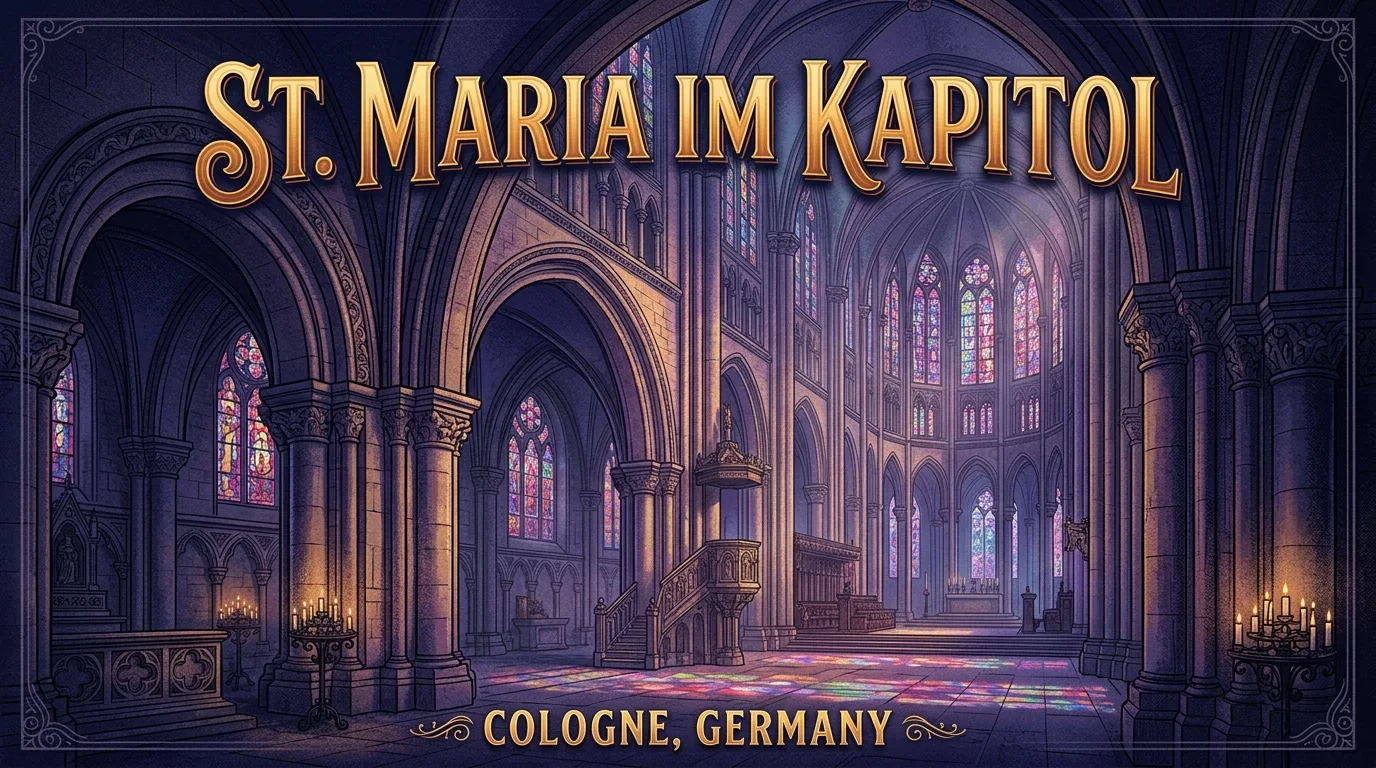
St. Maria im Kapitol is considered the largest and oldest of Cologne's twelve great Romanesque churches, standing in the Kapitol quarter of the city's Südstadt district just a short walk from the Rhine riverbank. Its name reflects the history of the site: the basilica rises directly above the foundations of a Roman capitol temple once dedicated to the Capitoline Triad. At roughly 100 metres long and about 40 metres wide, St. Maria im Kapitol is not only the largest but, with roots reaching back to the early Middle Ages, also one of the most historically layered churches in the city. The building is especially famous for its impressive trefoil choir, modelled on the Church of the Nativity in Bethlehem, as well as for its precious, thousand-year-old wooden door carved with biblical relief scenes. Anyone wanting to experience Cologne beyond the cathedral will find in St. Maria im Kapitol one of the city's most authentic historical sites.
History of St. Maria im Kapitol
The history of St. Maria im Kapitol reaches back to Roman antiquity: a capitol temple once stood on this site, measuring roughly 33 by 29.5 metres and surrounded by an extensive temple precinct of about 97 by 69 metres. After the end of Roman rule, Plectrude, widow of the Frankish majordomo Pepin of Herstal, had a proprietary church built on the ruins of the ancient capitol; she was buried there after her death around the year 718, and her grave slab survives in the church to this day. The Romanesque church that stands today was largely built between 1040 and 1065, incorporating parts of the ancient temple walls as the foundation for the nave. In 1170 the three characteristic west towers were added, giving the façade the unmistakable profile it still has today. Over the centuries, St. Maria im Kapitol developed into an important collegiate foundation for canonesses and remained a key spiritual centre of Cologne's Südstadt. Like almost all of Cologne's major churches, St. Maria im Kapitol suffered severe destruction during the Second World War; the extensive reconstruction stretched over several decades and was only completed with a comprehensive restoration of the interior in 1984. Today the basilica stands as an impressive example of how Roman, early medieval and High Romanesque building phases overlap on a single site.
Highlights of St. Maria im Kapitol
The outstanding architectural feature of St. Maria im Kapitol is its monumental trefoil choir at the eastern end of the church, whose ground plan deliberately follows the model of the Church of the Nativity in Bethlehem, creating a close link to the pilgrimage traditions of the Holy Land. At roughly 100 metres long and about 40 metres wide, the basilica is the largest of Cologne's twelve Romanesque churches, a scale felt especially in its wide, light-filled nave. Among the most precious artworks inside is the famous wooden door dating from between 1049 and 1065, carved with 26 relief panels depicting scenes from the life of Jesus, and ranking among the most important surviving examples of medieval woodcarving in Europe. Equally striking is the so-called Gabelkreuz, an expressive crucifix predating the 14th century that depicts the suffering of Christ with unusually stark realism and ranks among the earliest examples of this type of cross north of the Alps. The grave slab of Plectrude, the church's founder, still recalls the Frankish origins of the site and links it directly to Cologne's early history in the 8th century. Beneath the present-day church floor, remnants of the ancient Roman capitol temple's walls remain visible, uncovered during archaeological investigations and offering visitors a rare direct glimpse into Cologne's Roman past. The three distinctive west towers from 1170 still shape the skyline of the Südstadt district today, making the silhouette of St. Maria im Kapitol recognisable from a distance. Together, these elements combine to form a building that uniquely layers Roman, early medieval and High Romanesque history in a single place.
Opening Hours, Tickets & How to Get to St. Maria im Kapitol
St. Maria im Kapitol is located at Kasinostraße 6, 50676 Köln, in the heart of the Kapitol quarter in the Südstadt district, just a short walk from the Rhine riverbank. The church is generally open to visitors on most days of the week: Monday to Thursday typically from 9 a.m. to 6 p.m., Friday and Saturday from 9 a.m. to 5:30 p.m., and Sunday from 1 p.m. to 6 p.m. During major Cologne events such as November 11th celebrations, the Carnival season or Christopher Street Day, as well as during services, the church may be temporarily closed. Admission is free and no ticket is required, though donations toward the upkeep of the historic building are welcome. Group visits and guided tours should be arranged in advance with the parish office. It is also worth noting that, due to its historic fabric, the basilica is not wheelchair accessible. Getting there is straightforward, as St. Maria im Kapitol lies within walking distance of Cologne's old town and the riverbank; several light-rail and bus lines stop nearby, for example at Heumarkt or Severinstraße, from where the church is just a few minutes on foot. Drivers will find some public parking in the surrounding streets but should be aware of Cologne's low-emission zone regulations for the city centre.
Attractions Near St. Maria im Kapitol
Its location in the Kapitol quarter makes St. Maria im Kapitol an ideal starting point for a walk through Cologne's Südstadt and old town. Just a few minutes away lies Heumarkt with its historic townhouses, from where the city hall and the MiQua Jewish museum are also within reach. Right on the Rhine riverbank, also within walking distance, stands the Hohenzollern Bridge with views of Cologne Cathedral, which can be reached on foot in roughly 15 to 20 minutes. The Romanesque church of Groß St. Martin, with its distinctive four-towered crossing, is also just a few minutes away and pairs well with a visit to St. Maria im Kapitol, since both churches share a similar trefoil choir design. Heading south, visitors can also reach St. Georg and St. Severin, two more of Cologne's twelve great Romanesque churches, making it possible to dedicate an entire afternoon to Romanesque architecture. Anyone looking for a break afterwards will find plenty of small cafés and traditional brewery pubs tucked into the surrounding streets of the Südstadt.
Where to stay in Cologne, Germany
Compare current hotel prices and find the right place to stay.