St. Gereon
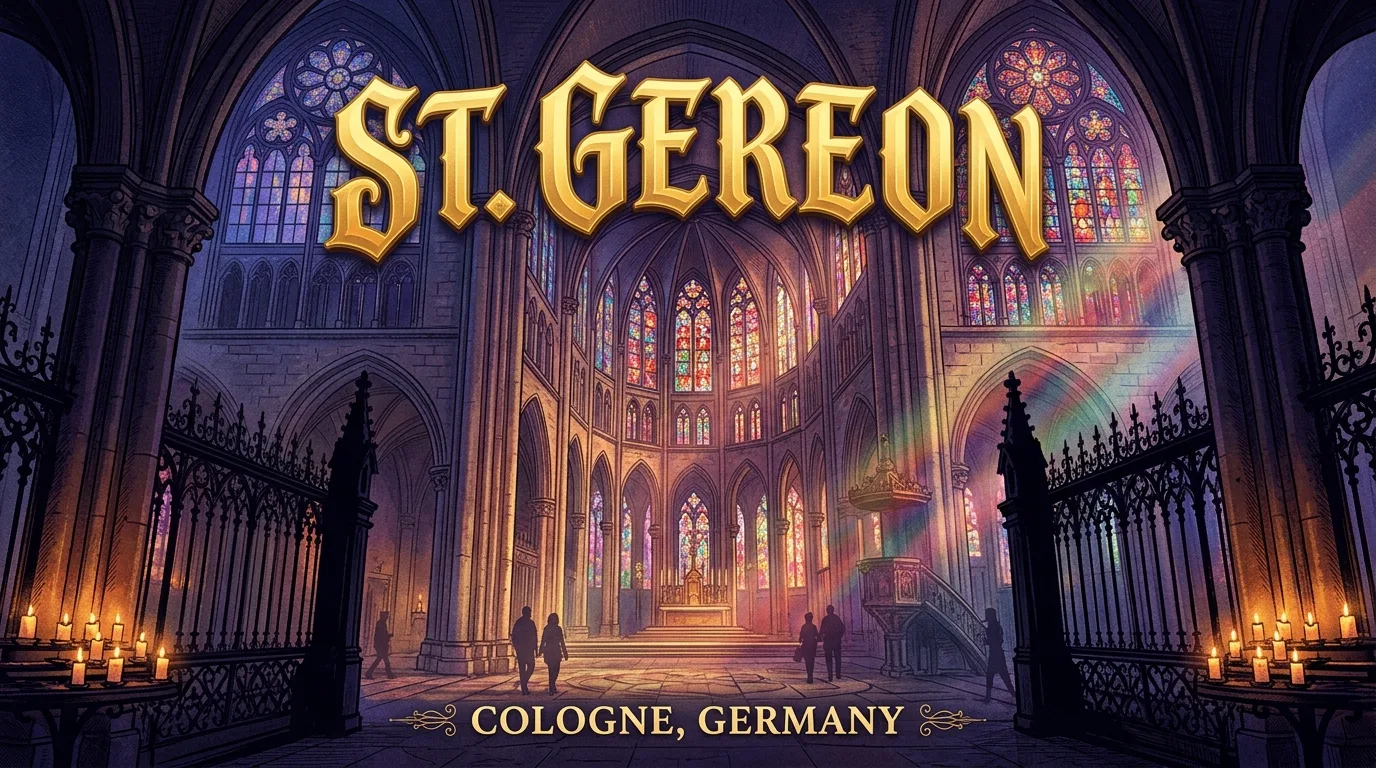
St. Gereon ranks among the most important and most unusual of Cologne's twelve great Romanesque churches, standing in the Altstadt-Nord district just a short walk from Cologne's main railway station. Even from the outside, the basilica stands out for its extraordinary ground plan: a ten-sided (decagonal) domed structure built around a late antique oval core dating back to the 4th century. This unique fusion of late Roman antiquity, Romanesque solidity and early Gothic engineering makes St. Gereon one of the most architecturally significant sacred buildings north of the Alps. Inside, visitors encounter an imposing domed space, vivid modern stained-glass windows, and precious medieval art treasures that date back to the Ottonian era. Anyone interested in Cologne's urban history, early Christian architecture, or simply a quiet and awe-inspiring sacred space will find in St. Gereon a place where centuries of European history unfold within a remarkably compact footprint.
History of St. Gereon
The history of St. Gereon begins in the second half of the 4th century, when an oval structure with four conches and a semicircular apse was built on a late antique burial ground northwest of the Roman city wall. The dome of this original building measured roughly 23.70 by 19.80 metres and was richly decorated with marble cladding and mosaics; historians believe the structure originally served as the mausoleum of a wealthy early Christian family. The first documented mention of a church dedicated to Saint Gereon on this site dates to the year 612. Around 800, Archbishop Hildebold had a rectangular choir added, and between 1060 and 1062 Archbishop Anno II commissioned a new, elongated choir. In 1121 the bones of Saint Gereon were officially recognised as relics, further strengthening the church's role as a pilgrimage site, and between 1151 and 1156 Archbishop Arnold extended the choir further eastward. The decisive architectural transformation took place between 1219 and 1227, when the late antique oval building was reinforced, encased and converted into a decagon, raised with Gothic galleries and crowned with a central dome. This dome is still regarded as one of the largest domes built in the West between the Hagia Sophia in the 6th century and Florence Cathedral in the 15th century. In 1920 St. Gereon was elevated to the status of minor basilica by Pope Benedict XV. The church suffered severe damage during the Second World War, leaving it in acute danger of collapse by 1952; extensive structural stabilisation work carried out between 1968 and 1985 ultimately preserved this unique building for future generations.
Highlights of St. Gereon
The outstanding feature of St. Gereon is undoubtedly its monumental decagon, whose domed interior spans 21 metres in length and 16.9 metres in width, making it one of the largest free-standing medieval dome structures north of the Alps. Visitors entering the nave stand beneath an immense Gothic vault that rests directly on the walls of the late antique original building - a preserved wall height of around 16.50 metres from before the Middle Ages remains visible today, identifiable by the bricked-up window openings of the ancient conches. This direct dialogue between late Roman antiquity and High Gothic architecture is unique in Germany. Among the other highlights is the church's rich collection of post-war stained glass: following the massive destruction of the Second World War, artists Georg Meistermann and Wilhelm Buschulte created striking colourful window cycles that give the basilica a modern, light-filled character and form an appealing contrast with centuries-old masonry. Musically, the building is home to an organ built by Ernst Seifert in 1898, which is still regularly heard during services and concerts. Two medieval treasures of international art-historical importance are closely linked to St. Gereon: the so-called Sacramentary of St. Gereon, a lavishly illuminated manuscript created around the year 1000 featuring ten images depicting the history of salvation, now held at the National Library in Paris, and the eleventh-century Cloth of St. Gereon, considered one of the oldest surviving European tapestries, whose fragments are today scattered across museums in Nuremberg, Berlin, Lyon and London. The crypt and the still clearly recognisable floor plan of the ancient structure are further details that attentive visitors can discover. For anyone interested in architecture, St. Gereon is therefore not merely a church but a walkable history book of late antiquity, Romanesque and Gothic design.
Opening Hours, Tickets & How to Get to St. Gereon
St. Gereon stands on Gereonskloster street in the Altstadt-Nord district and belongs to the Catholic parish of St. Gereon, which also oversees the nearby churches of St. Aposteln, St. Michael and St. Alban. Its exact address is Gereonskloster 2, 50670 Köln. The church is generally open to visitors free of charge during the day outside of service times, and donations toward the upkeep of this historic building are welcome. Because visiting hours differ from the pastoral office's administrative hours and can vary depending on services, concerts or restoration work, it is advisable to check current times on the parish's official website at stgereon.de or to contact the pastoral office by phone before visiting. No admission ticket is required to view the church. Getting to St. Gereon by public transport is straightforward: from Cologne's main railway station it is roughly a 15 to 20 minute walk, while several light-rail and bus lines stop at Ebertplatz or Christophstraße/Mediapark, both just a short walk from the church. The central location also makes the church easy to reach by bicycle. Drivers will find several public parking garages in the surrounding area, for example near Mediapark or close to Venloer Straße, since the Altstadt-Nord district itself offers only limited street parking. Visitors wishing to combine their trip with a wider tour of Cologne's Romanesque churches can easily continue on foot, as several of the twelve great Romanesque churches lie within the old city ring.
Attractions Near St. Gereon
Several of Cologne's most important sights lie within easy reach of St. Gereon, making it simple to combine a visit to the basilica with a longer walking tour of the city centre. Around one and a half kilometres away rises the world-famous Cologne Cathedral, with its striking Gothic towers and status as one of Europe's most visited sacred buildings. Along the way, or in the immediate vicinity, lies the trendy Belgisches Viertel (Belgian Quarter), known for its cafés, boutiques and lively street-art scene around Brüsseler Platz. Also within walking distance are Friesenplatz and Rudolfplatz, home to the Hahnentor, one of the last surviving medieval city gates of Cologne. Toward the Rhine, it is worth detouring to the Museum Ludwig and the Museum of Applied Arts, while media enthusiasts can visit the modern Mediapark quarter, only a few minutes' walk from St. Gereon. Several of Cologne's other eleven great Romanesque churches, such as St. Kunibert near the riverbank, are also easily reachable on foot from here, allowing for an individually tailored tour of the city's Romanesque heritage.
Where to stay in Cologne, Germany
Compare current hotel prices and find the right place to stay.