Severinstorburg
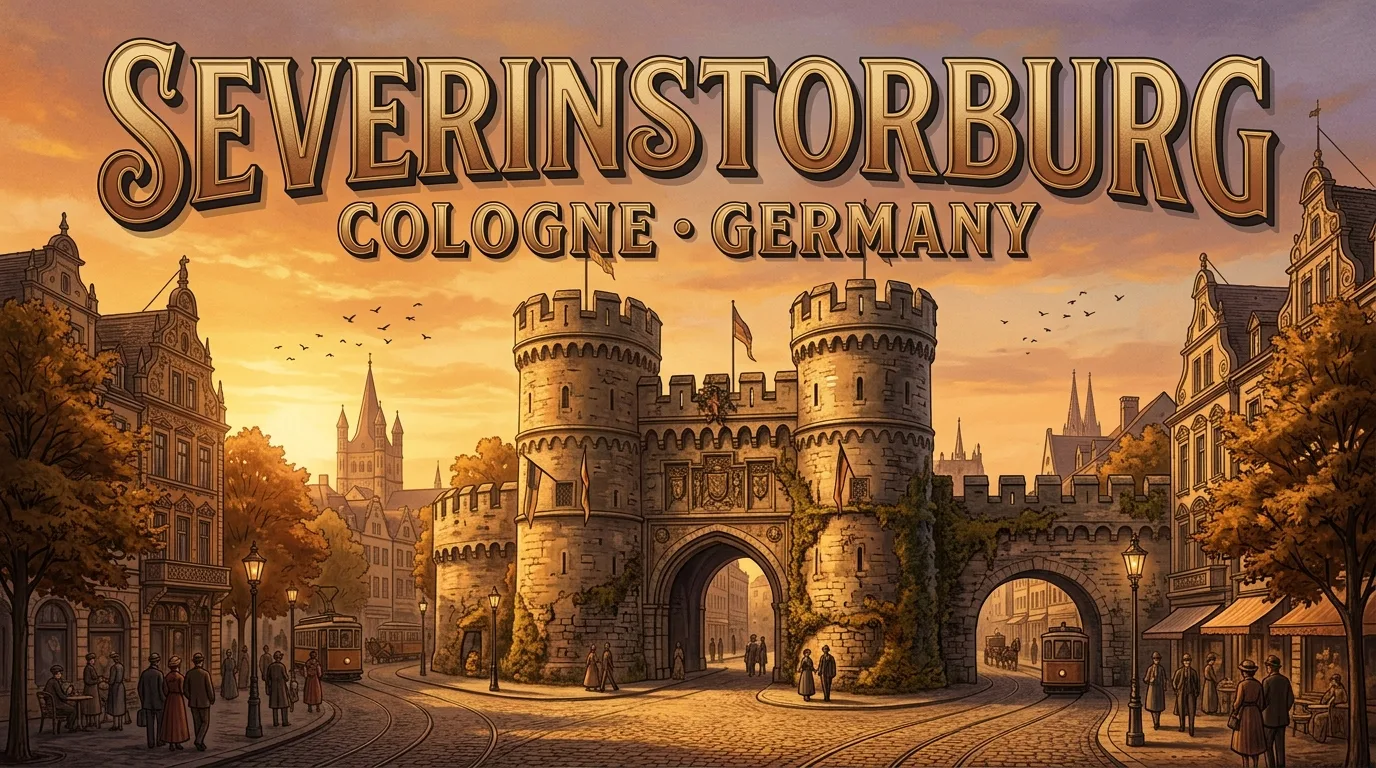
On the lively Chlodwigplatz in Cologne's Südstadt district, in the area locals affectionately call the Vringsveedel, stands the Severinstorburg, one of only four surviving defensive towers from Cologne's medieval city fortifications. Anyone strolling across the square today, past cafés, small boutiques and the tram line that cuts straight through the middle of it all, cannot miss this sturdy structure of pale trachyte and tuff stone, which for centuries served as the city's southern gate and guarded the road toward Bonn and the many Rhineland monasteries further south. The Severinstorburg is far more than a stone witness to the past: it has stories to tell of imperial visits and medieval tournaments, of destruction and reconstruction, of shifting museum uses, and ultimately of weddings and the boisterous spirit of Cologne's Carnival. For visitors who want to experience an authentic, down-to-earth side of Cologne beyond the usual Old Town tourist trail, Chlodwigplatz and its gate tower make a rewarding starting point, not least because of the lively atmosphere of the surrounding neighborhood, which has kept its distinctly local Cologne character to this day.
History of Severinstorburg
The origins of the Severinstorburg date back to the first half of the 13th century, when Cologne, riding a wave of economic prosperity, built an ambitious new city wall roughly 9.5 kilometers long with twelve major gate towers, making it briefly the largest fortified city north of the Alps. The Severinstorburg guarded the important trade route heading south toward Bonn and the numerous monasteries along the Rhine, and it was built accordingly strong: an asymmetrical, hexagonal main tower of tuff stone, crowned by a crenellated roof platform, rises above a rectangular base that houses the actual four-story gate passage. Two smaller, two-story flanking towers, known as Eckwarten, were added on the outward-facing side and only received their now-iconic cone-shaped roofs in the 17th century. Around 1400, gun chambers were incorporated into the structure, an early sign of the changing military technology of the era.
The gate was not purely military in character; it was also the setting for courtly events of regional importance. In 1235, Isabella of England, the newly married consort of Emperor Frederick II, entered the city through this very gate with a magnificent retinue. In 1327, an eight-day tournament was held here in honor of the future Emperor Louis IV. When the medieval city wall was demolished starting in 1881 to make way for growing traffic and urban expansion, the Severinstorburg lost its original military function but survived as one of the few remaining relics of the old fortifications. It subsequently served a succession of civilian purposes: first as a natural history museum, then as a hygiene museum, and during the Nazi era it was used for Hitler Youth activities. Since 1979, the gate tower has housed a community center with rooms available for rent.
Highlights of Severinstorburg
Architecturally, the Severinstorburg impresses above all through its unusual, asymmetrical shape: unlike many symmetrically designed gate towers, the hexagonal main tower follows an idiosyncratic layout that emerged over centuries of construction and modification, giving the building its unmistakable character. The crenellated roof platform, from which guards once kept watch over the southern approach to the city, is clearly visible from outside and offers a vivid impression of medieval defensive architecture. The two cone-roofed Eckwarten on the outward side, whose distinctive silhouette has defined the building's appearance since the 17th century, give the structure an almost fairy-tale-like profile that sets it apart from the more austere, square gate towers found in other cities.
Particularly appealing is the contrast between the fortified stone and the vibrant everyday life that unfolds around Chlodwigplatz today: trams on lines 15 and 16 rattle past just steps away, market stalls, cafés, and the typical Cologne corner pubs of the Vringsveedel line the adjoining streets, and on sunny days locals gather on the steps and benches surrounding the historic structure. Inside, the Severinstorburg actually hosts civil wedding ceremonies, since the City of Cologne officially uses part of the premises as a registry office annex for marriages, an unusual but very popular setting for couples who want a historic backdrop for the biggest day of their lives. Since May 2023, the Carnival society KG Ponyhof e.V. has also been permanently based in the tower, bringing genuine Cologne Carnival energy to the building during the festive season. The immediate surroundings reward a second look too: the façades of the neighboring late-19th-century buildings, the square's small green spaces and its central monument together form a cohesive, photogenic ensemble that brings Cologne's history and present-day life together in a single, compact setting.
Opening Hours, Tickets & How to Get to Severinstorburg
The Severinstorburg is primarily a freely accessible outdoor landmark: Chlodwigplatz, and with it the exterior of the tower, can be viewed year-round, around the clock, free of charge, with no fixed visiting hours and no admission fee for the façade. The interior, however, is not set up as a conventional museum; it is used by the City of Cologne as a registry-office wedding room and by the Carnival society KG Ponyhof e.V., so access to the inside is generally limited to booked events, weddings, or club activities rather than open to casual walk-in visitors. Anyone wishing to view the interior or hold a wedding ceremony there should contact Cologne's registry office (Standesamt) or the relevant society directly in advance.
Getting there is straightforward: the "Chlodwigplatz" stop is served directly by Stadtbahn lines 15 and 16 and sits just a few steps from the building. From Cologne's Old Town and the main train station, the tower is reachable in roughly ten to fifteen minutes by tram, or alternatively via a scenic 20-minute walk along Severinstraße, which also offers a good glimpse into the character of the Südstadt district. On-street parking exists in the surrounding streets, though, as in most of central Cologne, the Südstadt is dominated by residents-only parking zones, so visitors arriving by car should expect to spend some time looking for a spot.
Attractions Near Severinstorburg
The area around the Severinstorburg, the beloved Südstadt neighborhood known locally as the Vringsveedel, rewards an extended walk. Just a few minutes away stands the Severinskirche, one of Cologne's twelve great Romanesque churches and the namesake of the district. Heading toward the Rhine, a roughly ten-minute walk brings visitors to the Ulrepforte, another surviving fragment of the medieval city fortifications that today serves as an event venue and plays a central role in Cologne's Carnival traditions. A little further north, right on the riverbank, stands the Bayenturm, a striking defensive tower that once formed part of the fortifications facing the Rhine.
Following the river further leads to the lively Rheinauhafen district with its unmistakable Kranhäuser crane-shaped office buildings on former harbor grounds, as well as the Chocolate Museum, which vividly presents the history of chocolate complete with tastings. Heading north toward the Old Town, visitors pass the Severinsbrücke bridge with its distinctive yellow pylon before reaching, after a short walk, the Alter Markt square and the Romanesque church of Groß St. Martin. The Südstadt district itself is also known for its varied dining scene, independently run shops, and a young, creative crowd that gives the historic Chlodwigplatz a thoroughly modern, lived-in atmosphere all its own.
Where to stay in Cologne, Germany
Compare current hotel prices and find the right place to stay.