Schokoladenmuseum
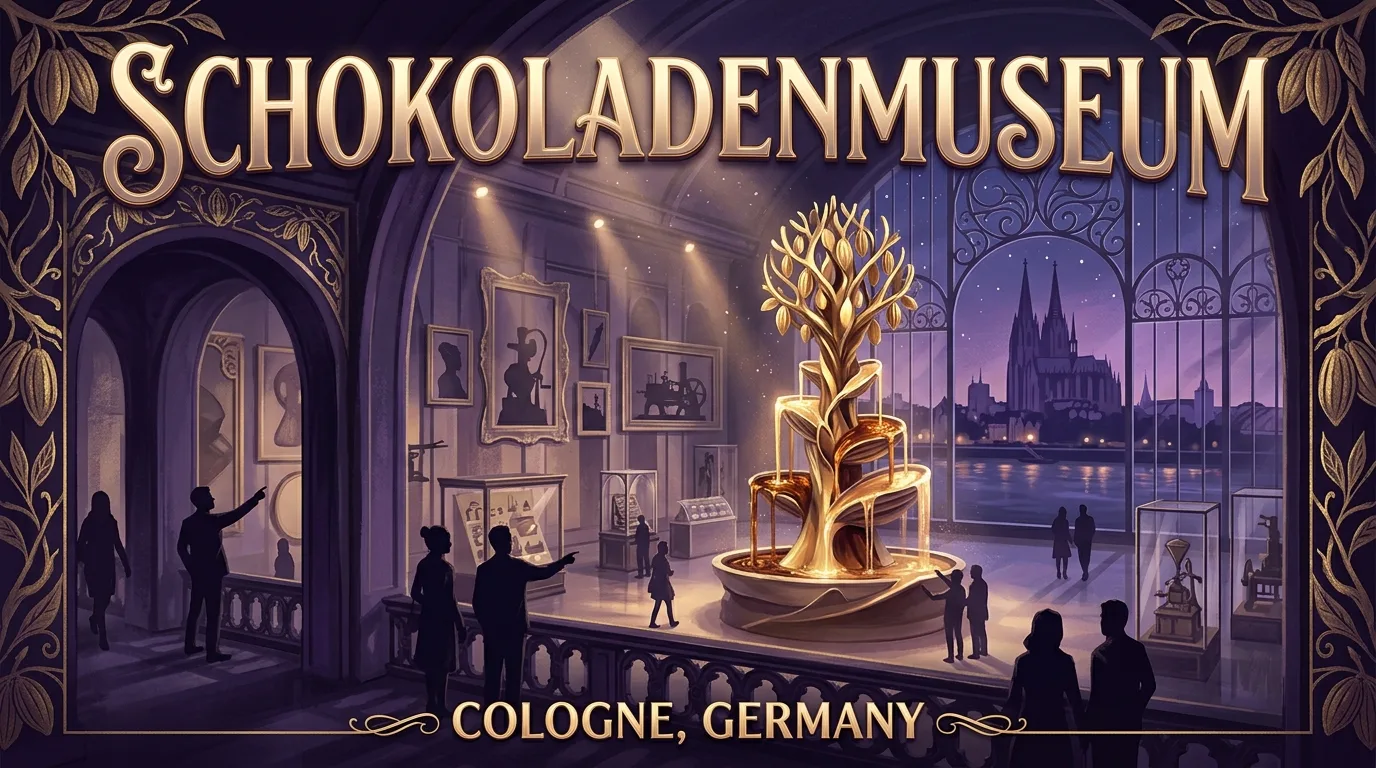
Right on the Rhine, in the picturesque Rheinauhafen with its glass-fronted Kranhäuser towers, stands the Schokoladenmuseum - a museum that already looks like a glass ship from the outside and houses one of the largest thematic exhibitions on the history of chocolate anywhere in the world. Visitors follow the journey of the cocoa bean from its origins among the Maya and Aztecs to industrial chocolate production, encounter a tropical greenhouse with real cacao trees, and finish by sampling freshly made chocolate straight from a working production line. The museum was founded in 1993 by Cologne chocolate manufacturer and collector Hans Imhoff, who wanted his life's work to make the centuries-old connection between Cologne and the chocolate industry - embodied above all by the Stollwerck brand - tangible for the public. Since opening, the museum has regularly ranked among the city's most visited attractions and is especially popular with families.
History of the Schokoladenmuseum
The history of the Schokoladenmuseum is inseparable from the history of Cologne's chocolate industry. In the 19th century, Cologne grew into an important center of confectionery production, driven above all by the Stollwerck company, founded in 1839, which rose to become one of Europe's largest chocolate manufacturers through industrial production methods and inventive marketing ideas, including early chocolate vending machines installed at railway stations. Cologne entrepreneur Hans Imhoff, who took over and restructured the then-insolvent Stollwerck company in the 1970s, subsequently began assembling an extensive collection on the cultural history of chocolate - ranging from historic packaging and advertising material to machinery and ethnographic objects from cocoa-growing regions in Central and South America. In 1993, he opened the present-day Schokoladenmuseum on an artificial peninsula in the Rheinauhafen, whose glass, ship-like architecture deliberately echoes the harbor setting and the historical importance of the Rhine for trading cocoa and sugar. Since opening, the museum has been expanded and modernized several times, including a walk-through section on the history of cocoa cultivation and a complete, publicly visible chocolate production line. With the Stollwerck brand having passed to international corporations and through a close partnership with the Swiss manufacturer Lindt, which maintains the museum's well-known golden chocolate fountain, the institution today serves both as a memorial to Cologne's industrial history and as a lively showcase of the global chocolate business.
Highlights of the Schokoladenmuseum
The tour begins in a tropical greenhouse where real cacao trees grow under glass - a rare sight in Central Europe that makes the botanical foundations of chocolate tangible and explains why cacao can traditionally only be grown within a narrow belt around the equator. From there, the route leads through a cultural-history section illustrating the ritual significance of cacao among the Maya and Aztecs, who knew the drink as "Xocolatl" and used it in religious ceremonies, before Spanish conquerors brought the bean to Europe in the 16th century. A dedicated area is devoted to chocolate's European refinement: from the first drinking chocolates at the Spanish and French courts to the invention of solid chocolate bars in the 19th century, driven significantly by entrepreneurs such as Cologne's own Stollwerck factory. For many visitors, however, the undisputed centerpiece is the glass chocolate factory at the heart of the museum: a working production line lets guests watch live as chocolate bars are cast, decorated, and packaged, and at the end of the line visitors get to sample chocolate fresh off the belt, still slightly warm. Equally popular is the large, golden chocolate fountain supplied by the Swiss manufacturer Lindt, where thin wafer sticks can be dipped into flowing liquid chocolate. Rotating special exhibitions also shine a light on individual aspects of the chocolate world, such as the history of packaging design, famous advertising campaigns, or the challenges of fair trade with cocoa farmers in West Africa and Latin America. Children can enjoy their own interactive stations, including one where they can cast their own small chocolate figures.
Opening Hours, Tickets & How to Get to the Schokoladenmuseum
The Schokoladenmuseum is open all seven days of the week from 10 a.m. to 6 p.m.; last admission is one hour before closing, and the production line stops running about 30 minutes before the museum closes. Admission is tiered by day of the week: adults pay 17.50 euros on weekdays and 19 euros on weekends and public holidays. For children and teenagers under 18, the price is 10 euros on weekdays and 11.50 euros on weekends, with children under six admitted free. Seniors pay 16 or 17 euros respectively, and students and trainees pay 14 or 15 euros. Families will want to look at the family ticket, priced at 35 euros on weekdays and 38 euros on weekends. Visitors with disabilities receive a reduced rate of 11 or 12.50 euros, and companions with the appropriate certification are admitted free of charge. Tickets can be reserved in advance through the museum's online shop, which is particularly advisable given the high visitor numbers on weekends and during school holidays. The museum is located in the Rheinauhafen and can be reached from Cologne's old town with a pleasant roughly 15-minute walk along the riverside promenade; several bus lines also stop near the Schokoladenmuseum, and parking is available nearby.
Attractions Near the Schokoladenmuseum
The Rheinauhafen itself is one of the most architecturally striking corners of Cologne: the three distinctive Kranhäuser, with their slightly tilted glass facades, have shaped the skyline since the 2000s and form an appealing contrast with the harbor's historic architecture. Along the waterfront promenade, numerous cafés and restaurants invite visitors to linger with a view of the Rhine. A short walk upstream leads toward the Severin Bridge and on into the southern old town with its narrow lanes and traditional brewery pubs. Walking downstream toward the city center, it takes about twenty minutes on foot to reach Alter Markt and the historic city hall. For a view from the opposite bank of the Rhine, a short ferry ride or a trip on the cable car is worthwhile, offering an impressive view of Cologne's skyline with the cathedral in the background on a clear day. The German Sport & Olympic Museum is also just a few minutes' walk away and combines well with a visit to the Schokoladenmuseum.
Where to stay in Cologne, Germany
Compare current hotel prices and find the right place to stay.