Schnütgen Museum
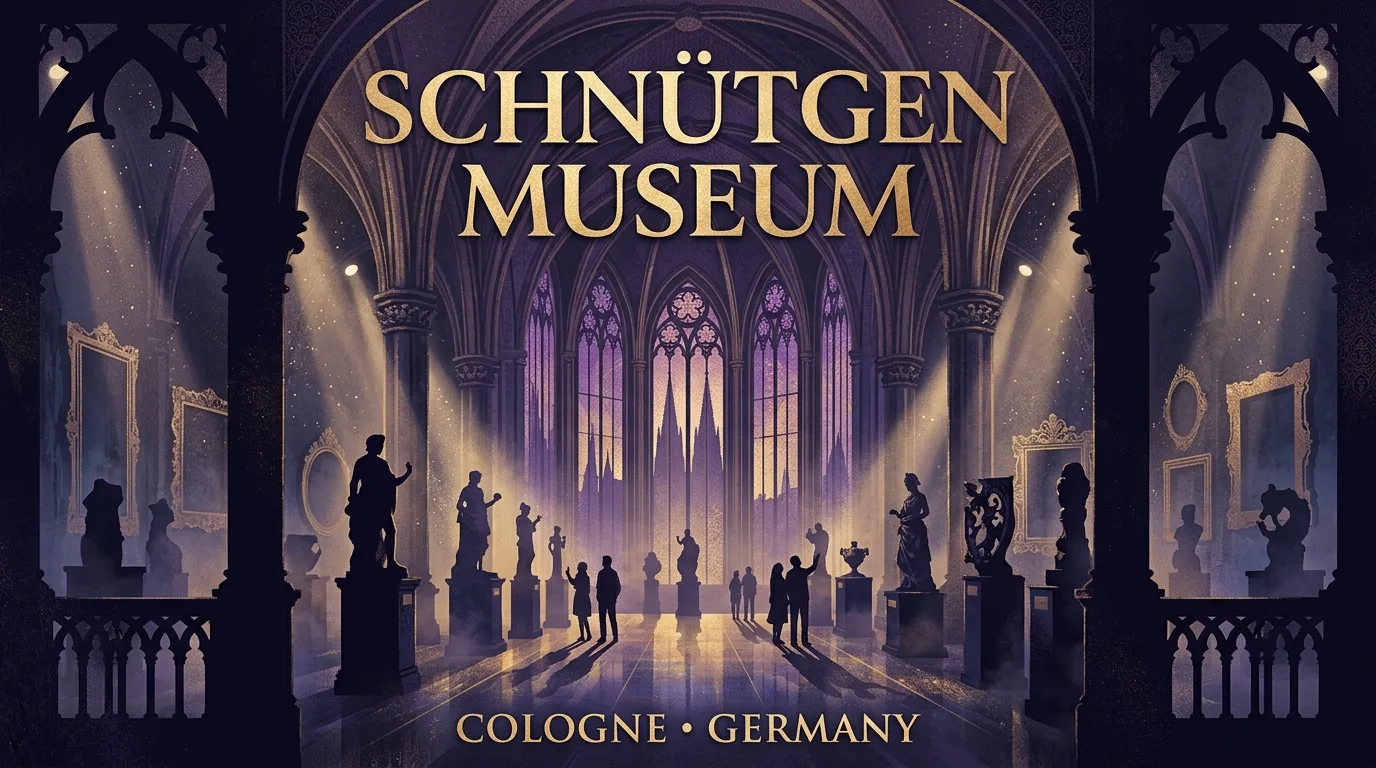
On Cäcilienstraße, in the heart of the so-called Kulturquartier am Neumarkt, the Schnütgen Museum holds one of the most important collections of medieval Christian art in Europe. The heart of the museum is the Romanesque Cäcilienkirche, a 12th-century church and one of Cologne's twelve great Romanesque churches, where the exhibits take on an extraordinary, almost sacred presence. The collection traces back to Cologne cathedral canon Alexander Schnütgen (1843-1918), who donated it to the city of Cologne in 1906, and today comprises sculpture, goldsmith work, ivory carvings, liturgical textiles and stained glass from the early Middle Ages to the early modern period. After a turbulent history spanning several locations, the near-total destruction of its original building during the Second World War, and an approximately eight-year reconstruction, the Schnütgen Museum today occupies a three-part building ensemble combining the historic church, a 1950s brick annex, and a light-filled new wing that connects it directly to the neighbouring Rautenstrauch-Joest-Museum.
History of Schnütgen Museum
The history of the Schnütgen Museum begins with its namesake, Alexander Schnütgen, who was born in 1843 in Steele an der Ruhr, studied theology, and was ordained a priest in 1866. As a cathedral vicar and later canon of the Cologne archdiocese, he developed a passionate habit of collecting medieval church art, founded the "Zeitschrift für Christliche Kunst" in 1888, and served for decades on the board of the Diocesan Museum, founded in 1853. On 14 April 1906, Schnütgen informed Cologne's mayor of his intention to donate his extensive private collection to the city; the city council accepted the gift and decided to build an annex to the existing Kunstgewerbemuseum on Hansaring. This annex, designed by architect Franz Brantzky in Romanesque and Gothic forms, opened on 26 October 1910, with Fritz Witte as its first curator and later director. In 1918 the institution was named "Schnütgen-Museum," the same year Alexander Schnütgen died. In 1931 the museum transferred its 123-painting collection to the Wallraf-Richartz-Museum and in return received important works such as figures from the high altar of Cologne Cathedral. In 1932 the museum separated from the Kunstgewerbemuseum and moved into the former monastery of St. Heribert in Köln-Deutz, but was evacuated after the outbreak of war in 1939 - a fortunate decision, since the building on the Deutz bank of the Rhine was completely destroyed in 1945, while the relocated collection survived the war almost unscathed. On the recommendation of architect Karl Band, the museum was housed in the Romanesque Cäcilienkirche, newly reconsecrated in 1956; the Schnütgen-Museum reopened there as the first Cologne museum to do so after the war, and German federal president Theodor Heuss called it "the most beautiful museum in Germany." Following a renaming to "Museum Schnütgen" in 2000, a renovation from 2001 to 2003, and a further roughly eight-year reconstruction culminating in a joint reopening with the neighbouring Rautenstrauch-Joest-Museum on 22 October 2010, the museum took on its present form; since 2012 Moritz Woelk has led the collection as its fifth director.
Highlights of Schnütgen Museum
The greatest highlight of the Schnütgen Museum is its building itself: the Romanesque Cäcilienkirche, whose origins date back to the 8th century and whose present three-aisled form largely dates from the 12th century. The original Cäcilientympanon from the north portal, one of the major works of Romanesque stone sculpture in the Rhineland, is now displayed inside the museum, while a copy has been placed at the portal itself. Together with the neighbouring parish church of St. Peter, St. Cäcilien forms Cologne's only surviving double-church complex. Among the collection's outstanding pieces is the crucifix torso from St. Georg, dating from the final third of the 11th century, which has been one of the museum's key works since 1921, alongside figures from the high altar of Cologne Cathedral, the so-called Parler bust and the Heribertkamm comb, all acquired in 1931. The modern extension, opened in 2010 and designed by architects Schneider + Sendelbach, provides additional exhibition space especially for stone sculpture and medieval stained glass, while the so-called Bandbau from the 1950s now houses a careful presentation of light-sensitive textiles and gives access to the tranquil Cäciliengarten. The collection further includes precious ivory carvings, liturgical goldsmith work and reliquaries from the early Middle Ages to the early modern era. Rotating special exhibitions explore individual aspects of the collection in greater depth, currently the show "Licht in dunklen Zeiten" ("Light in Dark Times"), with future presentations such as "Drachen. Mythos und Wirklichkeit" ("Dragons. Myth and Reality") already announced. A free audio guide, accessible via QR codes with visitors' own smartphones, accompanies guests through the permanent exhibition.
Opening Hours, Tickets & How to Get to Schnütgen Museum
According to the official museum website, the Schnütgen Museum is open Tuesday to Sunday from 10 am to 6 pm, Thursdays until 8 pm, and on the so-called KölnTag - the first Thursday of the month, holidays such as 1 May excepted - even until 10 pm. On public holidays such as Good Friday, Easter Monday, Ascension Day, Whit Monday or Corpus Christi, the regular hours of 10 am to 6 pm apply, while the museum is closed entirely on 11 November, Christmas Eve, Christmas Day, New Year's Eve, New Year's Day, and during Weiberfastnacht and Rosenmontag; it is always closed on Mondays. Admission to the collection costs 6 euros, or 3.50 euros at the reduced rate; particularly worthwhile is the combined ticket with the neighbouring Rautenstrauch-Joest-Museum for 10 euros, or 7 euros reduced, since both institutions share the same building complex. Groups of ten or more pay 3.50 euros per person. Free admission is granted to, among others, children under six accompanied by an adult, pupils, trainees, Cologne residents under 18, and holders of the Köln-Pass or an ICOM card. For repeated museum visits in Cologne, the city's MuseumsCard is also worth considering, covering admission to all nine municipal museums as well as local public transport. The museum is located at Cäcilienstraße 29-33, 50667 Köln; the main entrance is in the shared foyer of the extension building connecting it to the Rautenstrauch-Joest-Museum. The nearest stop is Neumarkt, just two stops from the main station or cathedral, served by light-rail lines 1, 3, 4, 9, 16 and 18 as well as bus lines 136 and 146. Drivers are best served by the Q-Park Stadtmitte car park directly beneath the museum at Cäcilienstraße 29.
Attractions Near Schnütgen Museum
The Schnütgen Museum's location in the Kulturquartier am Neumarkt places it right next to numerous other attractions. Within the very same building complex stands the Rautenstrauch-Joest-Museum with its important ethnological collection, which pairs perfectly with a visit thanks to the combined ticket. Via the Hohe Straße and Schildergasse pedestrian zones, Cologne Cathedral, the Museum für Angewandte Kunst Köln - MAKK, Kolumba and the Römisch-Germanisches Museum in Altstadt-Nord are all just a few minutes away. Museum Ludwig and the Wallraf-Richartz-Museum on the Rhine, closely connected to the Schnütgen Museum through the exchange of artworks in 1931, are also within a short walk. Visitors wishing to explore the area around Neumarkt further will find numerous cafés and shops there, as well as a pleasant starting point for a walk to the Rhine promenade with views of the Hohenzollern Bridge.
Where to stay in Cologne, Germany
Compare current hotel prices and find the right place to stay.