Schloss Wahn
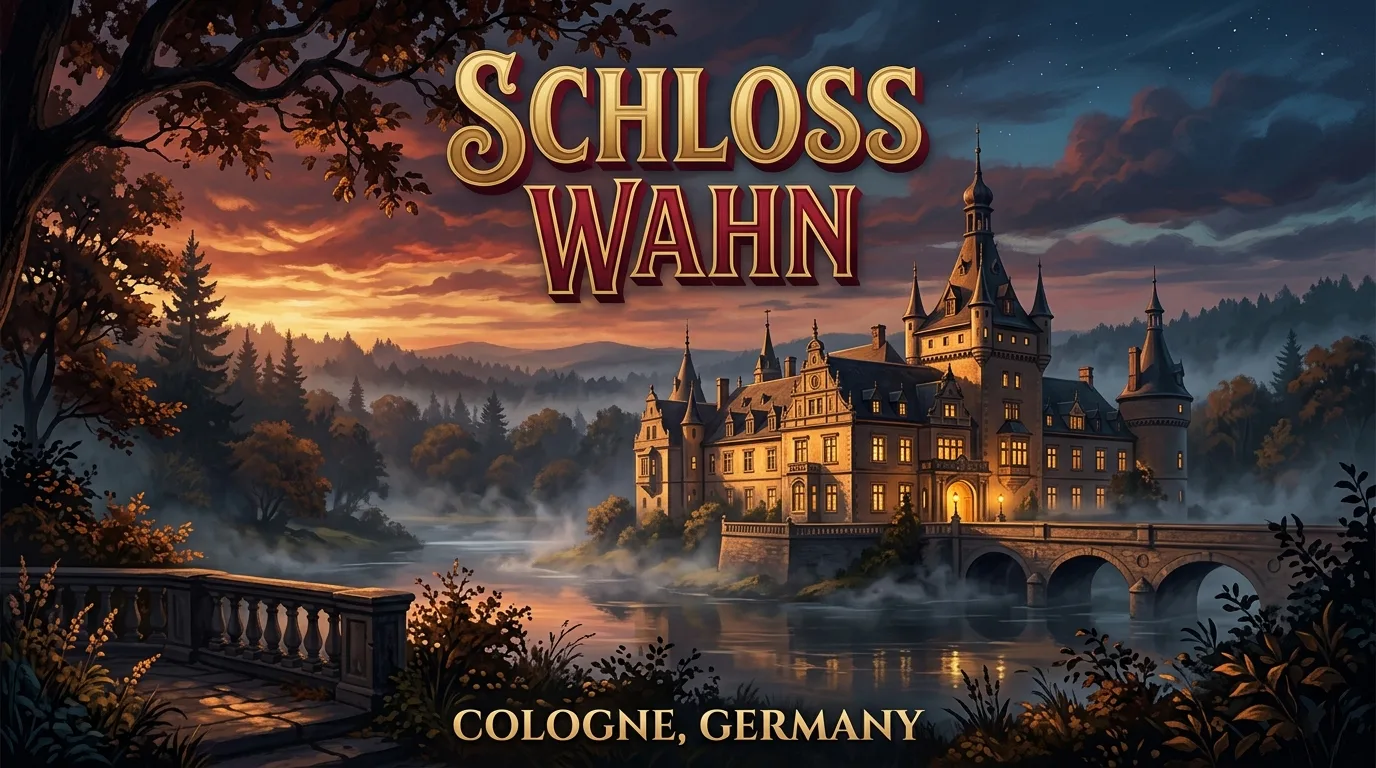
Schloss Wahn sits in Cologne's southeastern Porz district, directly bordering the vast heathland of the Wahner Heide, and ranks among the best-preserved Baroque estates in the greater Cologne area. The four-wing complex, fronted by its characteristic moat, was built on the foundations of a medieval moated castle and transformed in the 18th century into a representative manor house modeled on the French maison de plaisance. Unlike many comparable estates in the Rhineland, Schloss Wahn is not a static museum piece but remains in active use today: for decades it has housed one of Europe's most significant theatre-studies collections, functions as a civil registry office for weddings, and provides the setting for academic events held by the University of Cologne. Visiting Schloss Wahn therefore means experiencing not only architectural history but a living piece of cultural life, embedded within one of the largest continuous natural landscapes on the edge of a major German city.
History of Schloss Wahn
The first documented mention of Schloss Wahn dates to 1358, when the estate belonged to the Revelen family. At that early stage it was a classic medieval moated castle (Wasserburg) with a residential tower, gatehouse, encircling moat, and an outer bailey - a construction type common throughout the water-rich Rhineland as protection against attackers. In the 15th century ownership passed to the von Loë family, before the von Zweiffel family took over the estate in 1522. The 16th century brought turbulent times: in 1588, amid the armed conflicts of the period, the castle was plundered and damaged by passing mercenary troops, a fate shared by many Rhenish noble estates during this unsettled era. Stability only returned in 1685 with the von Schall family. It was under the Counts of Schall, between 1753 and 1757, that the decisive architectural transformation took place: the old moated castle was rebuilt as a unified, four-wing palace in the Late Baroque style. The architect responsible was Johann Georg Leydel, a collaborator of the celebrated Baroque master builder Balthasar Neumann - a connection still visible today in the elegant, French-inspired design language of the complex. Remarkably, despite its representative appearance, Schloss Wahn always retained an agricultural function as well, combining the character of a maison de plaisance with that of a working estate farm. In 1785 ownership passed to the Heereman von Zuydtwyck family, before the Freiherren von Eltz-Rübenach acquired the property in 1820 - a family that remains connected to Schloss Wahn to this day. The Second World War left considerable damage to the building, which was only repaired in 1964 through a comprehensive renovation of the main house. In 1988 the coach house and administrative wing were expanded, giving the complex its present functional form. Schloss Wahn has been a protected historical monument since November 9, 1982, recognition of its outstanding architectural significance for the Cologne region.
Highlights of Schloss Wahn
The central highlight of Schloss Wahn has, since 1955, been the Theatre Studies Collection of the University of Cologne, which found a new home here after the university had already taken over the estate as tenant in 1947. With around 100,000 volumes of theatre literature and extensive European theatrical materials dating back to the 16th century, it ranks among the largest and most important specialist collections of its kind in Europe. Among the collection's treasures are the estates of Munich comedian Karl Valentin and of Willy Millowitsch, the Cologne puppet-theatre and stage patriarch whose name is inseparable from the city's beloved Hänneschen-Theater. The extensive archive of the Hänneschen-Theater itself, as well as materials documenting theatrical life during the war years, are also preserved here and accessible for research. Inside, the surviving ceremonial rooms are architecturally striking: the Vestibule as a welcoming entrance hall, the light-filled Garden Hall overlooking the park, the elaborately decorated Chinese Room with its exotic furnishings, the Refectory, the Pompeian Room with echoes of Roman antiquity, the Music Room, and the elegant Viennese Room. This sequence of rooms conveys an immediate sense of what noble residential and representative life looked like in the 18th-century Rhineland. Since 2008 the Garden Hall has also been used for civil wedding ceremonies, and since 2007 the castle has housed a branch of the Cologne-Porz registry office, allowing couples to marry in genuinely historic surroundings - a feature that makes Schloss Wahn one of the most romantic wedding venues in the greater Cologne area. From the outside, the estate impresses with its clear, symmetrical four-wing layout, the moat still recalling its medieval origins, and the expansive parkland that merges directly into the adjoining Wahner Heide. For architecture and history enthusiasts, the view of the Baroque façade from the access avenue alone makes for a rewarding photo opportunity, while nature lovers appreciate the combination of historic fabric and open heathland scenery.
Opening Hours, Tickets & How to Get to Schloss Wahn
Schloss Wahn is located in the Wahn district within Cologne's Porz borough, just a few kilometers from Cologne Bonn Airport. Because the estate is used primarily by the University of Cologne for the Theatre Studies Collection as well as for weddings and private events, there is no regular museum-style opening schedule with fixed daily hours. The exterior grounds, including the moat, the access avenue, and the park edge, can be viewed year-round, while access to the historic interior rooms and the theatre collection is generally arranged in advance, tied to specific events, or offered through separate opening dates set by the university. Anyone wishing to use the collection for research purposes or to plan a wedding ceremony in the Garden Hall should check the castle's official website directly and get in touch early, since room capacity is limited and weekends during wedding season are in particularly high demand. There is no classic admission fee for viewing the exterior; individual charges apply instead for events, weddings, and guided tours, which are arranged directly with the castle administration. Getting there is straightforward: by car, Schloss Wahn is easily reached via the A59 and A3 motorways and the access road to Cologne Bonn Airport, with parking available nearby. By public transport, the Wahn district is served by the S-Bahn line S13 to the Köln-Wahn station, from which the castle is just a few minutes' walk away; bus routes operated by the Rhein-Sieg transport association (VRS) also serve the surrounding area. Visitors wishing to combine their trip with time outdoors can pick up hiking trails into the Wahner Heide directly from the castle grounds.
Attractions Near Schloss Wahn
The immediate surroundings of Schloss Wahn are dominated by the Wahner Heide, one of the largest and ecologically most valuable heath and woodland areas in North Rhine-Westphalia, stretching across several thousand hectares between Cologne and Siegburg and popular with hikers and nature photographers for its open heathland, juniper stands, and rare plant and animal species. Marked trails lead directly from Schloss Wahn into this protected landscape. Also close by is the Forstbotanischer Garten Köln (Cologne Forest Botanical Garden), an expansive, park-like area featuring numerous native and exotic tree species, ideal for a quiet stroll after touring the castle. History-minded visitors can additionally make a short detour to nearby Gut Leidenhausen, another former manor estate on the edge of the Wahner Heide that today serves as an environmental education center and excursion destination. Those continuing their trip toward the Rhine can reach the center of Porz with its riverside promenade in around ten to fifteen minutes by car, from where Rhine river cruises also depart. Cologne's city center, with its cathedral, old town, and famous Rhine bridges, is reachable from Schloss Wahn in roughly 20 to 25 minutes by car or S-Bahn, making it easy to combine a visit to the castle with a day trip into downtown Cologne. Air travelers also have the opportunity to pair a visit to Schloss Wahn with a stopover near Cologne Bonn Airport, making the estate an appealing destination for a brief cultural break.
Where to stay in Cologne, Germany
Compare current hotel prices and find the right place to stay.