Schildergasse
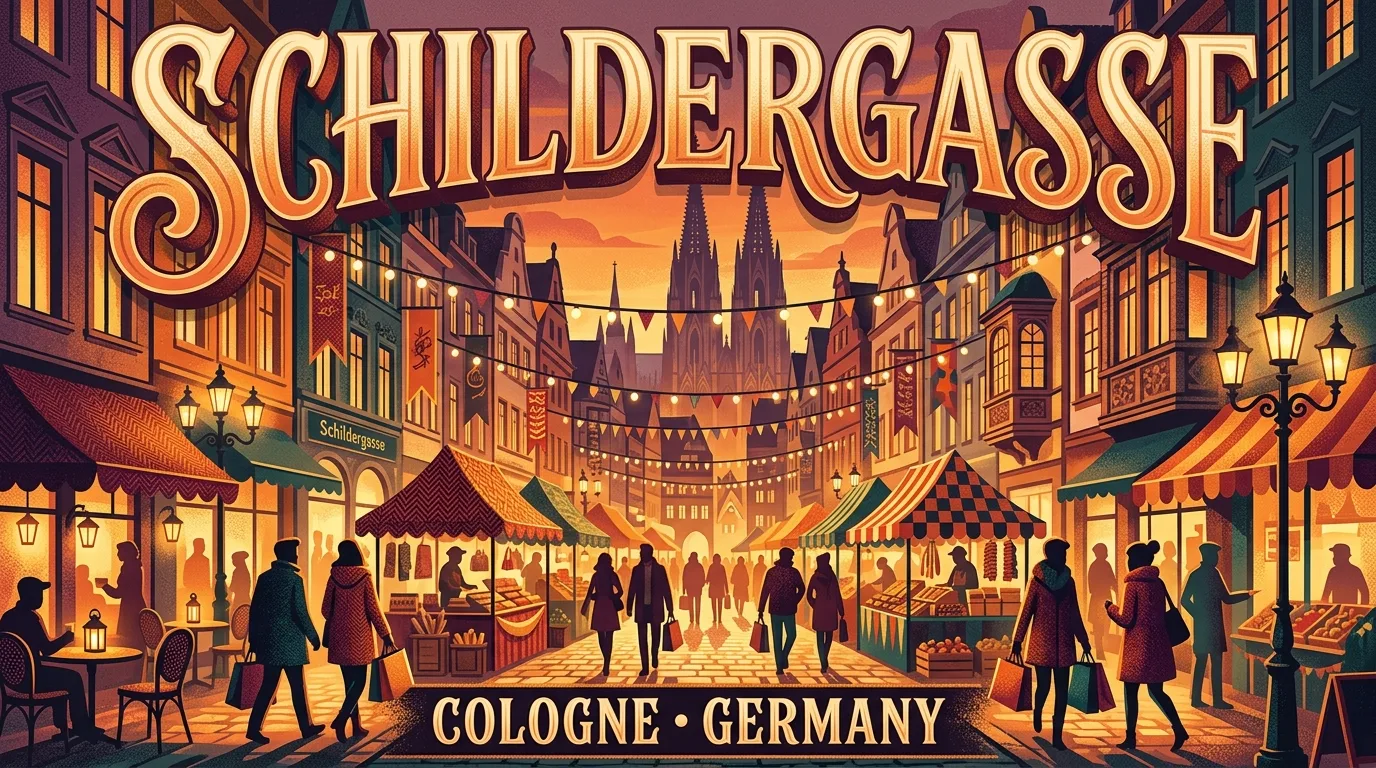
Anyone strolling through Cologne's city centre will almost inevitably end up on Schildergasse, one of the busiest and best-known shopping streets in Germany. The roughly 500-metre pedestrian zone runs on a west-east axis between Neumarkt and Hohe Straße, and together with the latter it forms the backbone of Cologne's retail scene. Large fashion chains, department stores, electronics retailers and international flagship brands line the street shoulder to shoulder, while street musicians, cafés and the occasional promotional stand add to the bustling urban atmosphere. According to a widely cited GfK survey, up to 13,000 people pass through the street every hour at peak times, earning it a reputation as one of the most frequented shopping streets in Europe. Schildergasse is therefore far more than a simple retail strip: it is a meeting point for locals and visitors from around the world, an urban pulse between tradition and consumption, and a street that has shaped Cologne's city life for centuries.
History of Schildergasse
The origins of Schildergasse date back to Roman times, when the street formed part of the Decumanus Maximus, the central east-west axis of the Roman city of Colonia Claudia Ara Agrippinensium. This ancient main route shaped the city's layout for centuries and remained one of the most important trade and traffic arteries within the city walls throughout the Middle Ages. The street took its present name in the medieval period from the sign and coat-of-arms painters, or "Schilder- und Wappenmaler," who worked there crafting ornate heraldic signs and house emblems for guilds and noble households. Over the centuries the street gradually developed into a centre of craft and commerce, favoured by its central position between the great churches and marketplaces of the old town. With industrialisation and Cologne's rise as a major trading city in the nineteenth and early twentieth centuries, department stores and specialist shops increasingly settled along the route. A decisive turning point came on 23 February 1966, when Schildergasse was officially declared Cologne's first pedestrian zone, well before car-free city centres became standard practice across Germany. This early urban-planning decision turned the street into something of a pioneer project and laid the foundation for its status today as a shopping magnet. Reconstruction after the heavy destruction of the Second World War was largely pragmatic and functional, meaning much of the historic streetscape was lost, but this also created space for the large-format commercial buildings seen today. In the following decades Schildergasse continued to evolve alongside the changing retail landscape, moving from traditional department stores to the arrival of international fashion chains and, eventually, the flagship stores of global brands that define the street today.
Highlights of Schildergasse
The most striking architectural highlight on Schildergasse is undoubtedly the Weltstadthaus of Peek & Cloppenburg, a department store opened in 2005 and designed by the renowned Italian architect Renzo Piano. Its distinctive undulating glass façade provides a strikingly modern, almost sculptural counterpoint to the surrounding buildings and is one of the most photographed structures on the street. Just a short walk away stands the Antoniterkirche, dating from 1384 and recognised as the oldest Protestant church in Cologne, whose austere Gothic façade offers a calm contrast to the bustle of shoppers and houses the famous sculpture "Der Schwebende" (The Floating One) by Ernst Barlach. The Bierbrunnen fountain from 1972, a popular meeting point and photo spot, pays tribute to Cologne's brewing tradition and invites passers-by to pause for a moment. Along the street, numerous international and national retailers line up one after another, with textile and fashion shops making up roughly 60 percent of the offer, followed by shoe shops at around 22 percent. Nearly 91 percent of the shops are run by chain operators or franchises, lending the street a consistent, big-city shopping experience. Those looking for something beyond the major chains will find smaller boutiques and specialist shops in the side streets such as Herzogstraße, Kreuzgasse and Perlengässchen. Especially during the Christmas season and the summer sales period, Schildergasse transforms into a lively open-air shopping hub, enlivened further by street musicians, mobile sales stands and seasonal decorations. The width of the street and its fully pedestrianised layout allow for relaxed strolling free of car traffic, something families with children and groups of friends particularly appreciate. The street also carries cultural relevance, regularly hosting promotional campaigns from well-known brands, public gatherings and spontaneous street performances that further underline its urban character.
Opening Hours, Tickets & How to Get to Schildergasse
Since Schildergasse is a public street, there are no fixed opening hours or admission fees for the street itself, it is freely accessible around the clock. The shops located along it follow Cologne's standard retail hours, generally Monday to Saturday from around 10am to 8pm, with larger department stores such as the Weltstadthaus often open until 9pm. On Sundays most shops remain closed, with the exception of occasional designated shopping Sundays, which are typically scheduled around city festivals or the pre-Christmas period and announced in advance by the city of Cologne and local retailers. For getting there, public transport is recommended, as the city centre is a low-traffic zone and parking is both limited and relatively expensive. The nearest light-rail and bus stops are Neumarkt and Appellhofplatz/Breite Straße, both just a few minutes' walk from the street and served by numerous lines of the Kölner Verkehrs-Betriebe (KVB). Cologne's main railway station, Köln Hauptbahnhof, is also within walking distance, roughly ten to fifteen minutes away via Hohe Straße. Visitors arriving by car will find several parking garages nearby, for instance at Neumarkt or on Cäcilienstraße, though heavier traffic and fully booked car parks should be expected on Saturdays and during the pre-Christmas season. The street itself is entirely flat and barrier-free, making it easily accessible for wheelchair users, seniors and families with strollers.
Attractions Near Schildergasse
The central location of Schildergasse makes it an ideal starting point for further exploration of Cologne's city centre. Just a few minutes' walk to the east lies Hohe Straße, another major shopping street that in turn leads to Cologne Cathedral and Roncalliplatz, arguably the city's best-known landmark. Heading west brings visitors to Neumarkt, one of the largest squares in the city centre, which regularly hosts markets, events and seasonal happenings. Culture enthusiasts will find several important museums close by, including the Käthe Kollwitz Museum, the Rautenstrauch-Joest Museum for world cultures, and the Schnütgen Museum of medieval art. The Basilica of St. Cäcilien, home to the Schnütgen Museum, is also within walking distance and offers a quiet contrast to the shopping crowds. For a break or a different kind of retail experience, a detour into the Belgian Quarter is well worth it, with its boutiques, cafés and the Markthalle offering a distinct, alternative atmosphere. Walking from Schildergasse toward the Rhine, visitors can reach Cologne's old town, with its historic breweries and riverside promenade, in about fifteen to twenty minutes on foot.
Where to stay in Cologne, Germany
Compare current hotel prices and find the right place to stay.