Rudolfplatz
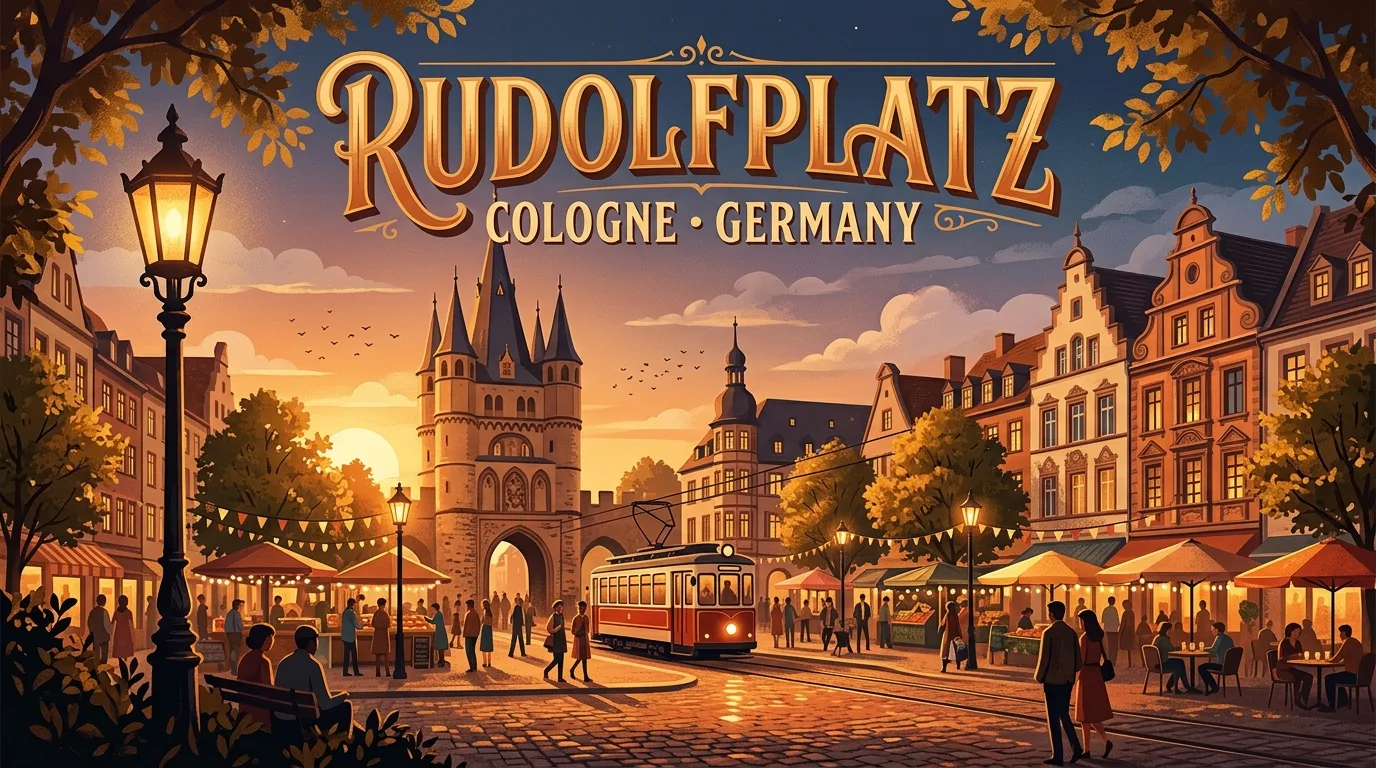
Rudolfplatz is one of the busiest squares in central Cologne, marking the transition from the historic Altstadt to the broad ring boulevards that have shaped the city's appearance since the 19th century. The square is dominated by the medieval Hahnentorburg, a massive twin-towered gate that stands like a stone relic from a bygone era right in the middle of a modern traffic hub. Restaurants, bars, and cinemas cluster around the old gate, making Rudolfplatz one of the city's most important nightlife districts, especially in the evenings and on weekends. During the day, the square mainly functions as a traffic junction between Hohenzollernring and Aachener Straße, while at night it transforms into a lively meeting point for night owls, cinema-goers, and fans of Cologne's restaurant scene.
History of Rudolfplatz
The history of Rudolfplatz is inseparable from that of the Hahnentorburg, a city gate built as a twin-tower structure as early as the beginning of the 13th century and first documented in 1264. In the Middle Ages, the important road to Aachen and Jülich passed through the Hahnentor into the city, and it was through this very gate that newly crowned kings made their ceremonial entrance into Cologne after their coronation in Aachen. The gate also served at times as a prison: on 3 April 1528, two men condemned as heretics were held there before the reformer Adolf Clarenbach and his fellow prisoner Peter Fliesteden were burned at the stake at Melaten cemetery on 28 September 1529. The gate's name is traced either to a 12th-century landowner named Hageno von Anselm or to the word Hano, meaning forest, referring to the wooded areas that once lined the road to Aachen. When the demolition of the medieval city fortifications began on 11 June 1881, the wall surrounding the Hahnentor disappeared and today's square took shape; it was first named Hahnentorplatz on 4 May 1882 before being renamed Rudolfplatz as early as 20 December 1883 in honor of the Habsburg king Rudolf I. In 1888, city planner Josef Stübben completed the restoration of the Hahnentorburg and converted it into a historical museum. During the Nazi era, from 1933 until 21 April 1945, the square was known as Schlageterplatz before reverting to its original name, Rudolfplatz, after the war. As early as 18 May 1877, Cologne's first horse-drawn streetcar line had already begun operating at the Hahnentorburg, an early sign of the site's importance for transport. Rudolf I of Habsburg, after whom the square is named, was the first Habsburg to hold the throne of the Holy Roman Empire, reigning from 1273 until his death in 1291; renaming the former Hahnentorplatz in his honor commemorated a significant medieval ruler who was never himself crowned in Cologne, yet whose name has marked this central square at the historic city boundary ever since. As part of the large-scale redevelopment of the Ring boulevards under the plans of Josef Stübben, the entire area around the Hahnentorburg also received wide, tree-lined avenues that still define the appearance of Cologne's Ring today.
Highlights of Rudolfplatz
The undisputed centerpiece of Rudolfplatz remains the Hahnentorburg itself, whose massive twin towers create a striking contrast with the modern traffic swirling around them and offer a rare, well-preserved glimpse of Cologne's medieval city fortifications. Since 1988, the gate has housed the long-established carnival society EhrenGarde der Stadt Köln von 1902 as well as a casino, which means the historic building remains actively used rather than serving purely as a museum piece. Two striking postwar buildings framing the square are also architecturally notable: the six-story residential building at Hohenzollernring 1-3, completed in 1935 by architect Hans Heinz Lüttgen with its curved travertine facade, and the seven-story commercial building at Hohenzollernring 2-10, completed in September 1953 by Wilhelm Riphahn and Paul Doetsch, which originally housed the Kaufhalle AG department store. Both buildings are considered important examples of Cologne's 1950s reconstruction architecture. Numerous restaurants, cocktail bars, cinemas, and clubs have sprung up around the square, making Rudolfplatz, together with the adjoining stretch of Hohenzollernring, one of Cologne's most popular nightlife districts, particularly on weekends and warm summer nights. During the day, heavy traffic from trams, cars, and pedestrians creates an entirely different, businesslike atmosphere, making Rudolfplatz one of the most important traffic junctions in the entire city center. This blend of medieval monument, postwar architecture, and modern nightlife gives the square its own unmistakable character. The Hahnentorburg takes on particular symbolic weight during Carnival, when festively dressed members of the EhrenGarde gather in front of the historic gate. In the evening, illuminated facades and the neon signs of surrounding bars turn the square into a lively backdrop that highlights the contrast between centuries-old masonry and the pulse of a modern city.
Opening Hours, Tickets & How to Get to Rudolfplatz
Rudolfplatz, as a public traffic square, is freely accessible at all times; only the casino inside the Hahnentorburg keeps its own opening hours and age restrictions for entry. The Hahnentorburg itself can always be viewed from the outside free of charge, though visiting the interior is only possible in connection with the casino or the carnival society that uses the building. Thanks to its own light-rail stop, Rudolfplatz, located directly beneath the square and served by several lines, the location is excellently connected to Cologne's public transport network and reachable within minutes from the main train station or from Neumarkt. The square is also easy to reach on foot, roughly ten to fifteen minutes via Hohe Straße and Neumarkt. For drivers, the location directly on Hohenzollernring is convenient, although traffic on the square itself is heavy, so public transport is generally the more practical choice; several parking garages in the surrounding area nonetheless offer options. The best time to visit the Hahnentorburg itself is in the morning or early afternoon, when the square is less crowded, while Rudolfplatz is best experienced in the evening and at night for its lively restaurant and bar scene.
Attractions Near Rudolfplatz
Just a few minutes' walk from Rudolfplatz lies Neumarkt, the largest square in Cologne's Altstadt, home to the landmark Dropped Cone sculpture and several museums. Along Hohenzollernring, visitors can quickly reach other stretches of Cologne's Ring boulevards, lined with numerous cafés, boutiques, and bars. The Belgisches Viertel with its Brüsseler Platz is also within comfortable walking distance, offering a clear counterpoint to the lively Rudolfplatz with its independent shops and cafés. Hohe Straße leads conveniently to Cologne Cathedral and the historic Altstadt on the Rhine. Fans of classic Cologne architecture should also consider a short detour to the church of St. Aposteln on Neumarkt, just a few minutes away. For a glimpse into Cologne's theater scene, a walk to the nearby Schauspiel Köln playhouse is also worthwhile.
Where to stay in Cologne, Germany
Compare current hotel prices and find the right place to stay.