Römergrab
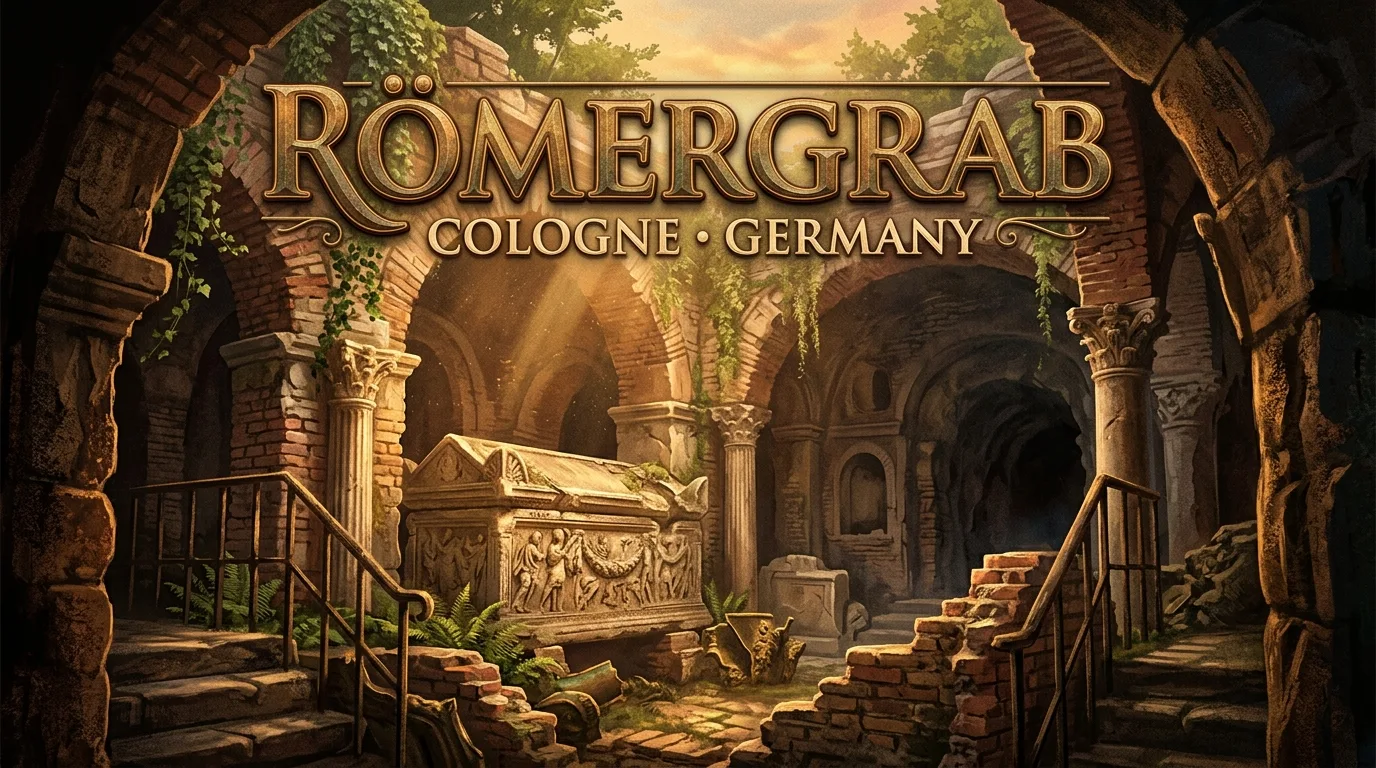
Far outside the tourist center, in Cologne's western district of Weiden on the busy Aachener Straße, lies one of the city's most archaeologically significant yet least-known monuments: the Römergrab. Anyone driving past might easily overlook the small structure at the roadside, covered by a protective glass housing - and yet beneath it lies a burial chamber nearly 1,900 years old, considered one of the best-preserved of its kind north of the Alps. The Römergrab is a reminder that Cologne, as Colonia Claudia Ara Agrippinensium, was already a thriving Roman city in antiquity, whose wealthy citizens buried their dead in elaborately designed tomb structures along the roads leading out of the city. For visitors interested in Cologne's Roman roots, the Römergrab is an impressive, authentic testimony to this nearly two-thousand-year-old era.
History of Römergrab
The Römergrab in Cologne-Weiden was discovered by chance in 1843 during earthworks and has since been regarded as one of the most important archaeological finds in the Cologne area. The underground burial chamber was likely built in the 2nd century AD and served as the final resting place for a wealthy family of the Roman Colonia Claudia Ara Agrippinensium, today's Cologne. Its location on the former Roman road leading toward Jülich and Aachen was no coincidence: Roman tombs were traditionally built along major roads leading out of the city, so that the monuments would be seen by travelers and the memory of the deceased would remain alive.
During the excavation of the Römergrab, archaeologists found an exceptionally rich array of grave goods, still considered unique for the region today: an elaborately crafted marble sarcophagus, three portrait busts believed to depict family members, two stone chairs, and numerous everyday objects and Roman coins. The coins found proved especially valuable for scholarship, as they span from the reign of Emperor Vespasian through the reign of Constantine II - a period of roughly 70 AD to the mid-4th century. These coin finds allowed archaeologists to precisely reconstruct the chamber's period of use across several generations and gain important insights into Roman burial culture along the Rhine.
Due to its exceptionally good state of preservation - the underground chamber remained largely intact over the centuries - the Römergrab in Weiden is today considered one of the best-preserved Roman burial monuments north of the Alps. This classification makes the site a monument of supra-regional archaeological importance, well known in academic circles far beyond Cologne. To protect its delicate structure, a small protective housing was built over the actual burial chamber, allowing visitors to look into the ancient chamber without exposing it directly to the elements.
Highlights of Römergrab
The greatest highlight of the Römergrab is undoubtedly the opportunity to look directly down into an originally preserved Roman burial chamber through the glass covering - an immediate, almost intimate experience offered by very few places in Germany in this form. Unlike museum reconstructions or finds displayed in cases, visitors here experience the burial chamber at its original, historic location, surrounded by traces of a burial practice nearly two thousand years old.
Another highlight is the small gatehouse at the entrance to the site, which provides an information panel explaining the history and significance of the find, making the visit comprehensible even without prior research. For visitors interested in archaeology, the unusual find situation is of particular appeal: the combination of a marble sarcophagus, portrait busts, stone seating furniture, and a coin sequence traceable across generations is exceptionally extensive for a single Roman tomb monument in this region, offering a rare glimpse into the life and death of a wealthy Roman family on the Rhine.
Particularly striking is also the historical contrast the Römergrab offers within today's cityscape: nestled among modern residential buildings and the traffic of Aachener Straße, the small site serves as an immediate reminder that western Cologne was already a densely settled Roman hinterland nearly two thousand years ago. For visitors interested in the full range of Roman traces in Cologne - from the city wall to the Praetorium and the Dionysus Mosaic - the Römergrab forms an important and often overlooked piece of this larger historical picture.
Opening Hours, Tickets & How to Get to Römergrab
The Römergrab is located on Aachener Straße in Cologne's Weiden district, near the border with Frechen-Königsdorf. The site, with its protective glass structure, can be viewed from outside free of charge at any time, meaning visitors can generally look into the burial chamber without prior booking and without an admission fee. As it is a protected archaeological monument under the responsibility of the Römisch-Germanisches Museum Köln, regular fixed opening hours for interior visits are not continuously offered; occasional guided tours or special opening dates are usually organized by the Römisch-Germanisches Museum or local history associations and should be inquired about directly with these institutions before planning a visit.
The easiest way to reach the Römergrab is by public transport, as Aachener Straße is one of Cologne's major arterial roads, served by several tram and bus lines heading toward Weiden and Frechen. From central Cologne, the journey by tram takes roughly 20 to 25 minutes, followed by a short walk along Aachener Straße. Drivers will find some parking options along the residential side streets, but should factor in heavy traffic on Aachener Straße during peak hours.
Attractions Near Römergrab
Although the Römergrab lies off the classic central Cologne route, it is worth combining with other destinations in western Cologne. Nearby is the Weiden district itself, with its established, green residential areas offering a pleasant contrast to the dense inner city and a glimpse into everyday life outside Cologne's tourist centers. Visitors interested in Cologne's Roman history overall should ideally combine a visit to the Römergrab with a trip into central Cologne, where the Römisch-Germanisches Museum presents numerous further finds from the Roman era, including the world-famous Dionysus Mosaic.
In central Cologne itself, further Roman traces can be explored, such as remnants of the ancient city wall and the Praetorium, the former seat of government of the Roman provincial capital, located beneath the historic city hall. Cologne Cathedral and the historic old town with its Romanesque churches are also easily reachable from here by public transport, complementing a visit to the Römergrab with the medieval and sacred dimension of Cologne's urban history. Nature lovers can also take a detour to the nearby green spaces of western Cologne, which combine well with a history-focused excursion.
Where to stay in Cologne, Germany
Compare current hotel prices and find the right place to stay.