Reiterstandbild Friedrich Wilhelm III.
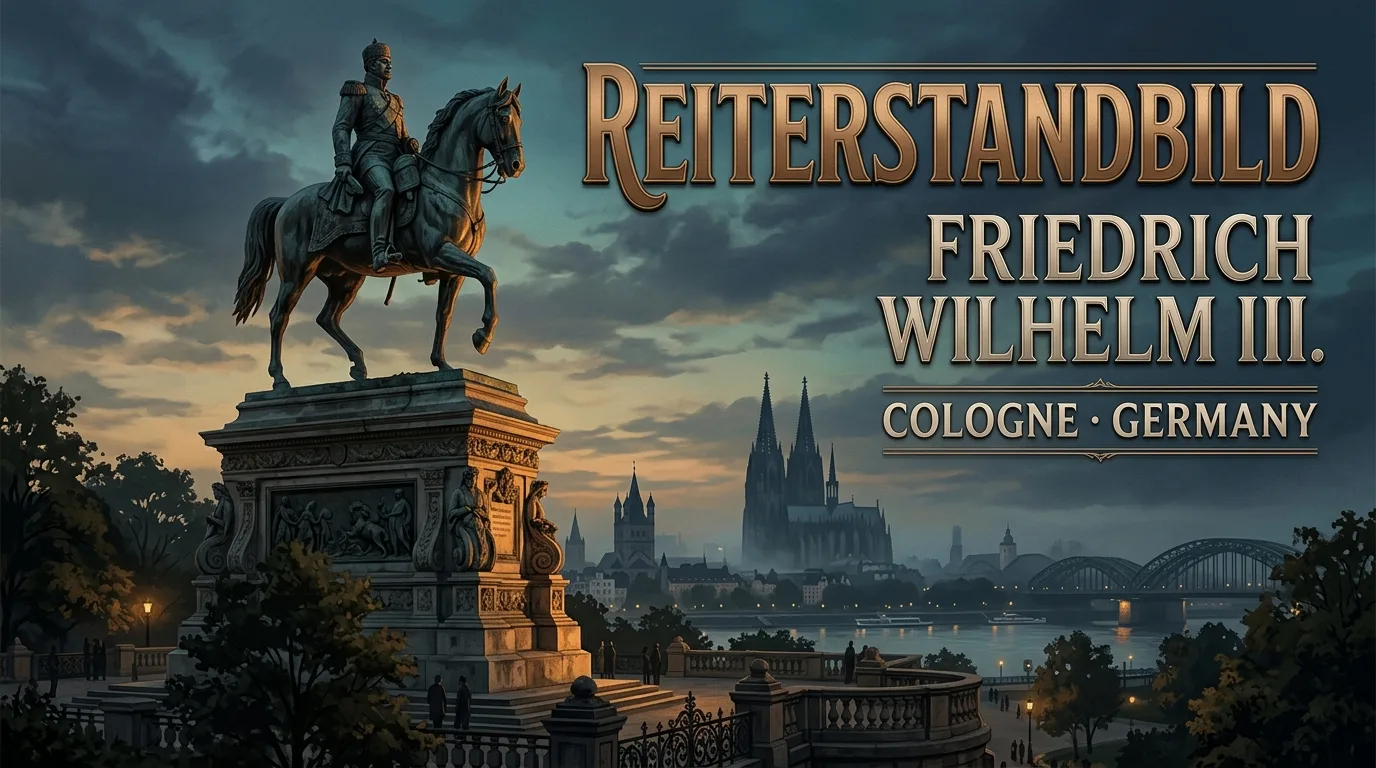
In the middle of the Heumarkt, the second-largest square in Cologne's old town, stands the Reiterstandbild Friedrich Wilhelm III. - one of the most imposing and historically significant monuments that Cologne has ever dedicated to a Prussian ruler. This monumental bronze equestrian statue commemorates the Prussian king under whose rule the Rhineland, and with it Cologne, became part of Prussia in 1815 following the Congress of Vienna, an event that would shape the city's history for more than a century. Visitors strolling across the lively square today, past street cafés, the nearby Rhine, and the towers of Groß St. Martin, find themselves almost incidentally standing before a work that survived war, destruction, and reconstruction, and that now serves as a quiet witness to Prussian-German history woven into everyday Rhineland life. The Reiterstandbild Friedrich Wilhelm III. is therefore far more than a decorative relic of the nineteenth century - it is a monument with a turbulent, almost dramatic history of creation and survival that continues to be told today.
History of Reiterstandbild Friedrich Wilhelm III.
The creation of the Reiterstandbild Friedrich Wilhelm III. stretched across several decades and several generations of artists. The commission was initially entrusted to sculptor Gustav Blaeser, who began his first work on the composition as early as 1855. Blaeser, a respected Berlin sculptor of the historicist era, conceived the monument as a monumental overall work of art, with the king mounted high on horseback above an elaborately decorated pedestal. The ceremonial laying of the foundation stone on the Heumarkt took place on 16 May 1865, but Blaeser would not live to see his work completed: he died on 20 April 1874, before the monument was finished. The work was subsequently taken over and completed by Berlin artists Alexander Calandrelli and Rudolf Schweinitz. It was not until 26 September 1878 - more than two decades after the first designs - that the monument could finally be unveiled in a ceremonial event attended personally by Kaiser Wilhelm I, an occasion that fell during the early years of the newly founded German Empire after 1871 and was marked with considerable ceremonial pomp. The original monument comprised a total of sixteen bronze figures along with four multi-part relief panels on the pedestal, depicting reforms and achievements from the Prussian king's reign, including administrative reforms, the integration of the Rhineland into the Prussian state, and the aftermath of the Wars of Liberation against Napoleon. The monument survived the First World War largely unscathed, but the Second World War would deal it a severe blow: on 29 June 1943, an aerial mine struck close by, toppling horse and rider from their pedestal and leaving the monument in ruins. In the post-war years, the surviving fragments were even threatened with being melted down entirely in 1959, but fortunately the king's head and the horse group were preserved. The rescued horse group found a temporary home on the Deutz bridge ramp starting in 1982, before it was finally able to return to its original location in 1990. Sculptor Raimund Kittl took on the demanding task of reconstructing the monument using the surviving original parts. On 29 September 1990, the restored Reiterstandbild was ceremonially re-erected, and the complete assembly of the historic reliefs on the pedestal was finally finished in 1993.
Highlights of Reiterstandbild Friedrich Wilhelm III.
The undisputed highlight is the equestrian figure itself: the Prussian king in period uniform, sitting upright on his horse in a posture meant to project dignity and royal authority - very much in the style of late nineteenth-century historicism, which deliberately drew on classicist models such as Berlin's great equestrian monuments. The materiality of the work is particularly striking: darkly patinated bronze set on a massive sandstone pedestal that forms a clear contrast with the lighter façades of the surrounding old-town houses. Visitors who take the time to examine the pedestal more closely will discover the elaborately crafted reliefs and accompanying figures that symbolically recall the political and social reforms of Friedrich Wilhelm III.'s reign - from the reorganization of the Prussian administration to the integration of the Rhineland after the Napoleonic Wars. Another compelling aspect lies in the dramatic story of the monument's survival: knowing that the head and horse group survived the destruction of 1943 and were kept separate from the rest of the monument for decades gives visitors a different perspective on the work seen today - it is a monument that itself tells a story of survival. The setting on the Heumarkt is another highlight in its own right: the square is one of the oldest and largest in Cologne's old town, with origins documented as far back as the tenth century under Archbishop Bruno. Everyday Cologne life pulses around the monument - street cafés, the view of the distinctive four-tower silhouette of Groß St. Martin close by, and in winter the atmospheric Heinzelmännchen Christmas market, which lends the square a unique atmosphere shaped by Cologne's own legends. Photographically, the view from the south is especially rewarding, with the monument in the foreground and the historic Heumarkt buildings in the background, as well as dusk, when the warm glow of the square's lighting brings out the sculptural detail of the bronze figure particularly well.
Opening Hours, Tickets & How to Get to Reiterstandbild Friedrich Wilhelm III.
As a freely accessible outdoor monument standing in the middle of a public square, there are no fixed opening hours - the Reiterstandbild Friedrich Wilhelm III. can be visited free of charge around the clock, seven days a week. No admission fee is charged, and no tickets or reservations are required. For the best experience, a visit in the late morning or early afternoon is recommended, when the light brings out the details of the bronzework particularly well, or alternatively at dusk for atmospheric photographs. Getting there is remarkably straightforward: the Heumarkt has its own stadtbahn (light rail) stop of the same name, which has been in operation since December 2013 and is served by several of Cologne's stadtbahn lines, making the monument directly accessible by public transport. From Cologne's main railway station, the walk takes only about ten to fifteen minutes through the historic old town, passing Cologne Cathedral and the Alter Markt along the way. Drivers will find an underground car park with around 460 spaces beneath the square, available since its reopening in 2001. Since the Heumarkt is designed as a pedestrian zone adjoining a traffic-calmed old-town area, travelling by public transport or on foot is generally recommended. A visit is especially popular when combined with a stroll along the nearby Rhine promenade or as part of a winter visit to the Christmas market, when the square is bathed in festive light and the monument provides an appealing historical counterpoint amid the market stalls.
Attractions Near Reiterstandbild Friedrich Wilhelm III.
Its location right in the heart of Cologne's old town makes the Reiterstandbild Friedrich Wilhelm III. an ideal starting point for a walking tour through historic Cologne. Just a few steps away rises the Romanesque church of Groß St. Martin with its distinctive four-tower design, which together with Cologne Cathedral defines the city's unmistakable skyline as seen from the Rhine. Heading south, visitors quickly reach the Alter Markt with its historic town hall and Gothic tower, another center of medieval Cologne life. The Rhine and its riverside promenade are also just a few minutes' walk away, inviting a relaxed stroll with views of the Hohenzollern Bridge and the Kranhäuser in the Rheinauhafen harbor district. Those wishing to follow the monument's history further can make a short detour to the Deutz bridge, on whose ramp the rescued horse group of the monument was temporarily displayed between 1982 and 1990. The world-famous Cologne Cathedral, with its twin Gothic towers, is about a ten-minute walk away and, together with the main railway station, forms another nearby destination for visitors wishing to extend their old-town tour. The traditional Fischmarkt along the Rhine riverbank, once a trading place for fish and goods, is also in the immediate vicinity and, with its restored gabled houses, conveys an authentic impression of historic Cologne along the river.
Where to stay in Cologne, Germany
Compare current hotel prices and find the right place to stay.