Poller Wiesen
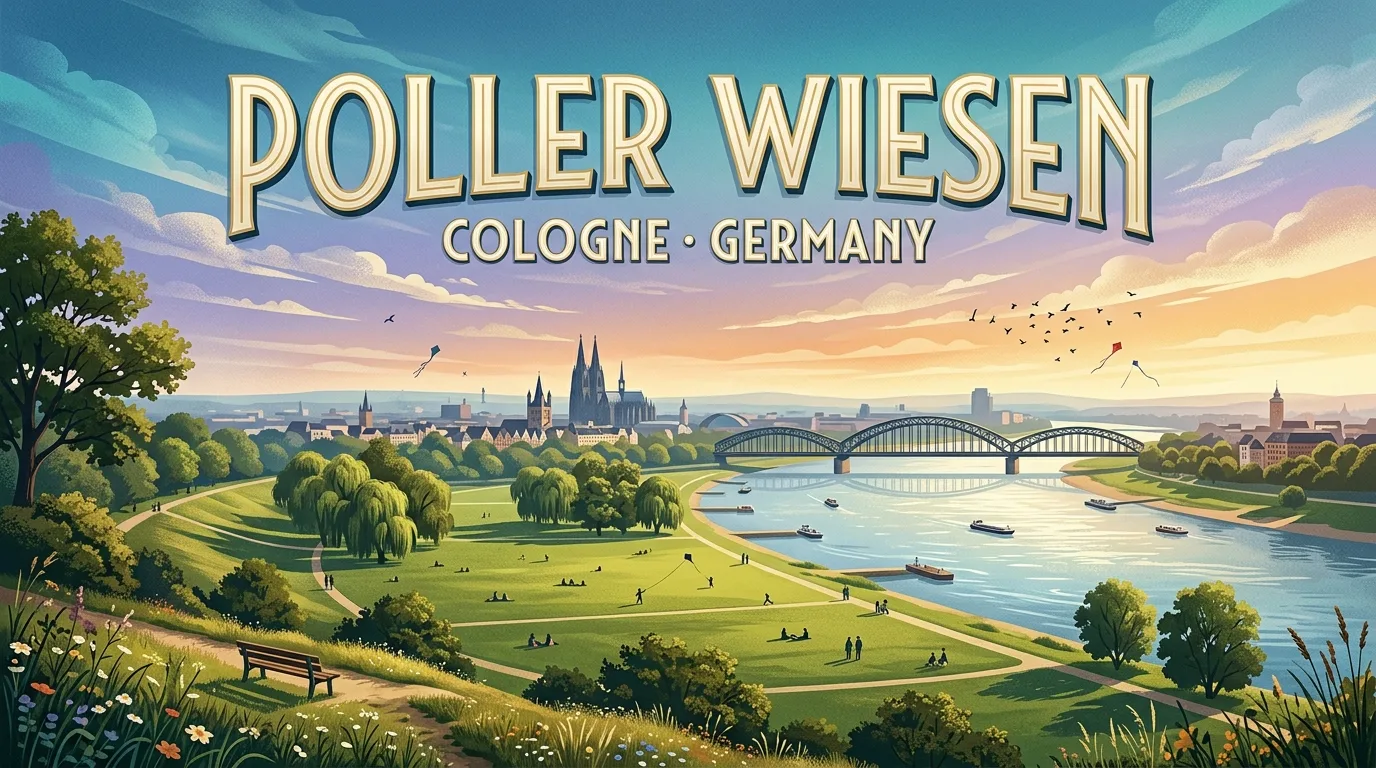
Right on the right bank of the Rhine in the district of Poll, directly across from Cologne's historic old town, the Poller Wiesen stretch out as one of the most generous green spaces along the river. This wide, flat meadow landscape offers one of the finest unobstructed views of Cologne's classic skyline: the twin towers of Cologne Cathedral, the colorful gabled houses of the Fischmarkt, and the silhouette of the Severinsbrücke reflect in the Rhine on calm days, while on the meadow itself, picnic blankets, impromptu football games, and playing children dominate the scene. The Poller Wiesen are not only a beloved recreational and sports ground for Cologne's residents, but also a protected cultural monument that recalls centuries of riverbank engineering history. Visitors looking to experience Cologne away from the tourist trail will find here one of the most authentic perspectives on the city.
History of Poller Wiesen
The history of the Poller Wiesen is closely tied to Cologne's centuries-long struggle with the Rhine. Starting as early as 1560, the city of Cologne built the so-called Poller Köpfe at this stretch of the right bank – massive riverbank fortifications made of iron-reinforced oak logs weighted down with basalt blocks and reinforced with willow plantings and groynes. The purpose of these elaborate hydraulic engineering works was to keep the Rhine from shifting its riverbed further east, a development that would have seriously threatened Cologne's then-vital harbor on the opposite bank. Without these early river-regulation measures, Cologne might well have lost its significance as an important Rhine harbor city. During archaeological excavations in 2003, two historic shipwrecks from 1530 and 1590 – so-called "Niederländer" vessels – were even uncovered, deliberately sunk as part of the fortification system within the riverbed.
The district of Poll itself only officially became part of Cologne in 1888, during the city's major wave of incorporations. Over the course of the 20th century, the historic Poller Köpfe were largely replaced by more modern stone groynes and breakwaters, particularly in connection with the construction of the Deutzer Hafen. Due to their outstanding significance for the history of riverbank protection, the Poller Wiesen were officially placed under cultural heritage protection in 2005. That same year, the wide meadow gained additional nationwide attention when it hosted tens of thousands of pilgrims during World Youth Day 2005; two years later, the grounds once again served as a major event space for the 2007 German Protestant Church Congress (Kirchentag).
Highlights of Poller Wiesen
The greatest highlight of the Poller Wiesen is undoubtedly the unobstructed panoramic view of Cologne's old town, stretching along the entire length of the meadow by the riverbank. Unlike from most of the inner-city riverside promenades, the complete city skyline – with the cathedral's twin spires, the Fischmarkt, and the Romanesque Groß St. Martin church – lies fully open and unobstructed before visitors' eyes, a view that is especially beautiful in the evening hours, when the facades of the old town catch the golden light, making it one of the most photographed vistas in Cologne. The wide, flat lawn invites picnicking, sunbathing, football, and frisbee games, and on warm weekends practically becomes an informal open-air living room for the surrounding neighborhoods.
Right next to the meadows are several sports facilities, including football pitches and tennis courts used by local clubs, as well as a station of the German Life Saving Association (DLRG), which keeps watch over swimmers along the riverbank during summer. A popular culinary stop is the traditional Poller Fischerhaus, whose waterfront terrace offers yet another excellent view of the city while serving freshly caught fish and classic Rhineland specialties. Once a year, traditionally on May 1st, the Poller Wiesen transform into a colorful folk festival for the Poller Maifest, which commemorates the district's centuries-old fishing tradition with music, stalls, and large crowds of visitors. An information panel from the EU-Life Maifisch project also recalls the successful efforts to reintroduce this once-native fish species to the Rhine, making the meadows a worthwhile destination for nature enthusiasts as well.
Opening Hours, Tickets & How to Get to Poller Wiesen
As a public green and recreational space maintained by the city of Cologne, the Poller Wiesen are freely accessible year-round and around the clock; there are no fixed opening hours or admission fees. The best time to visit is during the afternoon and evening hours on warm, clear days, when the light over the old town is especially striking, or in the early morning for a quiet walk without large crowds. During the warmer months, visitors should be aware that the meadows can get quite busy on weekends, particularly near the sports facilities and the Poller Fischerhaus.
The most convenient way to reach the Poller Wiesen is by public transport: light rail line 7 runs to the Westhoven or Poll Salmstraße stops, from which the meadows are just a short walk away, and several bus lines also run through the Poll district close to the riverbank. Since the traditional ferry service between Poll and the left bank was discontinued decades ago, the connection to the old town across the river today runs mainly via the nearby Severinsbrücke, which is also easily crossed by bicycle. Drivers will find limited, mostly free parking along the residential streets surrounding the meadows, though they should expect busy streets on sunny weekends.
Attractions Near Poller Wiesen
On the opposite bank of the Rhine from the Poller Wiesen lies Cologne's historic old town, with Cologne Cathedral, the Fischmarkt, and the Romanesque Groß St. Martin church all particularly photogenic from this vantage point. Crossing the nearby Severinsbrücke – one of Cologne's most distinctive Rhine bridges, recognizable by its single pylon – leads in roughly 20 to 25 minutes on foot directly into Cologne's Südstadt district, with its bars and the Chlodwigplatz. Heading downstream on foot or by bike along the riverbank leads to the town of Rodenkirchen and its bridge, while upstream the district of Deutz, with the KölnTriangle Panorama Plattform and the LANXESS Arena, is within easy reach. Nature lovers can also enjoy a walk along the Poll riverbank heading south toward the nature reserves that count among the last semi-natural Rhine floodplains within Cologne's city limits. Those interested in local cuisine will find one of the most charming addresses for Rhineland food with a river view at the nearby Poller Fischerhaus.
Where to stay in Cologne, Germany
Compare current hotel prices and find the right place to stay.