Overstolzenhaus
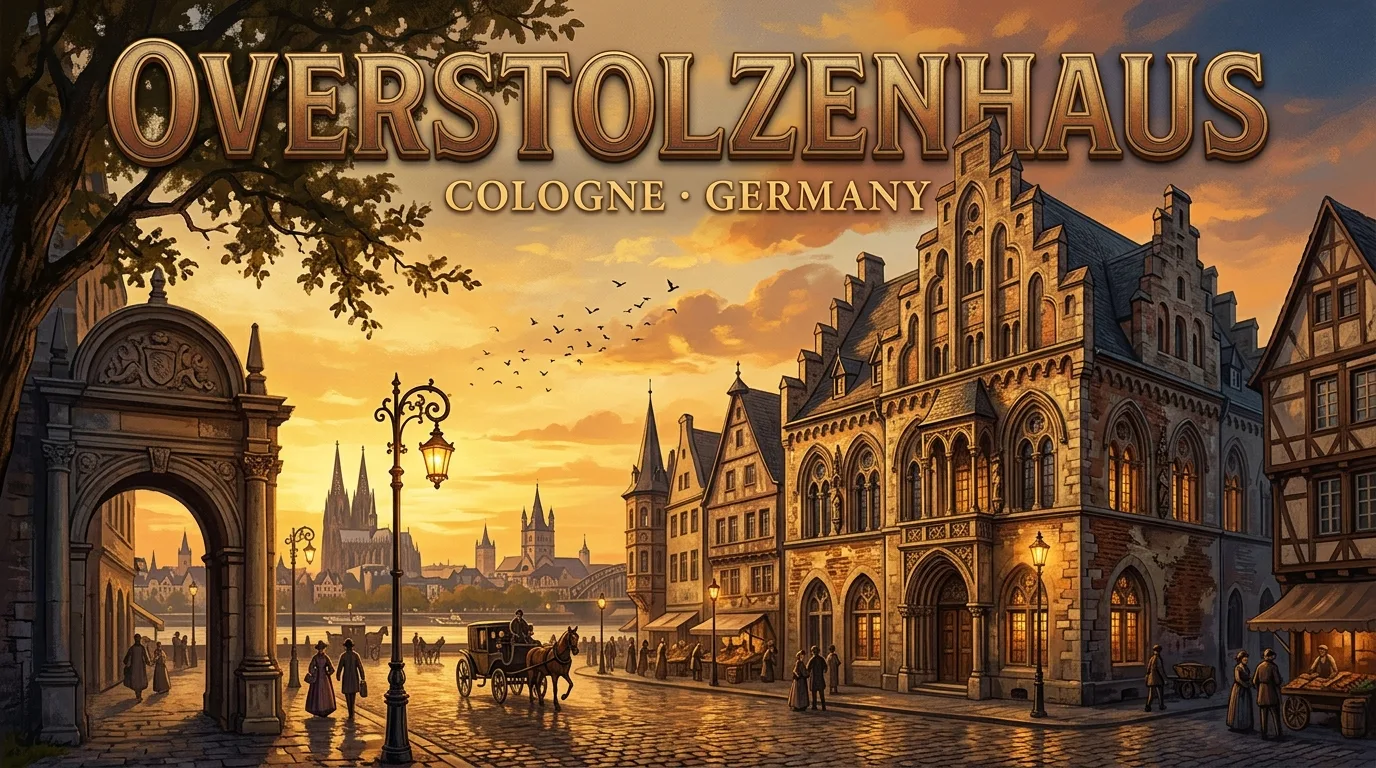
Overstolzenhaus, tucked into the narrow Rheingasse in Cologne's Altstadt-Süd district, is considered one of the oldest and best-preserved patrician houses in Germany and the only fully preserved Romanesque town house of its kind in Cologne. Built around 1230 by Blithildis Overstolz, a member of the powerful Cologne patrician family Overstolz, the building's striking stepped gables and richly articulated windows demonstrate the wealth and self-confidence of the urban elite just before Cologne's architecture turned toward the Gothic - only a few years before the foundation stone of the Gothic Cologne Cathedral was laid in 1248. For centuries the house witnessed the political rise and fall of the Overstolz family, who at one point supplied the city with 21 mayors. Since 1990 the historic building has housed one of Europe's most respected media art colleges, linking medieval architecture with contemporary art and media education.
History of Overstolzenhaus
The story of Overstolzenhaus begins around the year 1230, when Blithildis Overstolz, together with her husband Werner von der Schuren, had the property built on Rheingasse, close to the Rhine riverbank where the Overstolz merchant family accumulated its wealth through trade and finance. The family, whose founding ancestor Gottschalk Overstolz was first documented in 1197, rose during the 13th and 14th centuries to become one of Cologne's most influential patrician families: after the Battle of Ulrepforte in 1268, which proved significant for both guilds and patricians, their political influence grew further, and with Daniel Overstolz the family provided its first mayor in 1271; over the course of the 14th century the Overstolz family would go on to supply 21 mayors of the city. With the so-called Verbundbrief of 1396, which reorganized Cologne's guild constitution, the patriciate - and with it the Overstolz family - lost its dominant political position. The building itself changed hands several times over the centuries and was acquired by the city of Cologne in 1838. Extensive interior renovations took place between 1899 and 1900. On 30 May 1942, Overstolzenhaus suffered considerable damage during one of the heavy air raids on Cologne in the Second World War; on 21 April 1955, the city council decided on a faithful reconstruction that preserved the historic facade with its characteristic stepped gables. Since October 1990, the restored building has been used by the Academy of Media Arts Cologne (Kunsthochschule für Medien Köln) as one of its sites.
Highlights of Overstolzenhaus
Overstolzenhaus impresses above all through its late Romanesque architecture, unique in Cologne for having survived in such completeness. The main facade facing Rheingasse measures roughly 19.5 meters in width and is crowned by two striking stepped gables, whose clean geometric form is typical of early 13th-century Rhenish architecture. Five large, individually designed double-arched windows structure the facade, lending the massive rubble-stone walls a surprising lightness and elegance despite their defensive solidity. Inside, the house originally comprised two representative residential floors topped by four storage floors, reflecting its function as both a residence and a trading office for the merchant family. Particularly impressive is the tall, spacious hall on the ground floor, whose proportions and masonry still convey a sense of the living culture of Cologne's upper patrician class in the Middle Ages. As one of the few completely preserved Romanesque secular buildings in Germany, Overstolzenhaus is regularly cited by art historians as a reference point for the development of Rhenish secular architecture and, together with the Dreikönigenhaus in Trier, is considered one of the most important surviving examples of its kind. Today the Academy of Media Arts Cologne (KHM) uses the building as one of its teaching and exhibition venues, so the historic rooms are regularly filled with contemporary media art, video installations, and student projects - creating an appealing dialogue between medieval fabric and experimental contemporary art. During the academy's annual open-house days, Overstolzenhaus opens its doors to the public, offering a rare glimpse into interiors otherwise closed to visitors.
Opening Hours, Tickets & How to Get to Overstolzenhaus
Since 1990, Overstolzenhaus has served as an institute building of the Academy of Media Arts Cologne, so its interior is not permanently open to tourists but is used for the college's ongoing teaching activities. The striking exterior facade with its stepped gables and arcaded windows, however, can be admired free of charge and without restriction from the public Rheingasse at any time, making a visit to the outside straightforward at any hour. Visitors interested in seeing the historic interior have the best opportunity during the academy's annual open-house event, when the college opens its rooms along with student projects, as well as during occasional public exhibitions and lectures announced by the academy. Such events are generally free of charge. Getting to Overstolzenhaus on Rheingasse is easy thanks to its central location in Cologne's Altstadt-Süd: KVB tram lines 1, 7, and 9, together with services to the Heumarkt stop, bring visitors within a short walk of the building, as do the bus stops around Gürzenich. Cologne's main railway station is about a 15-minute walk away or just a few tram stops, and the Rhine riverside tunnel and nearby bridges also make the site reachable by car, although the narrow lanes of the old town offer only limited parking. Visitors arriving on foot from the cathedral or Alter Markt square can reach Rheingasse in under ten minutes.
Attractions Near Overstolzenhaus
Rheingasse sits in the historic heart of Cologne's Altstadt-Süd, placing Overstolzenhaus within easy reach of numerous other sights. Just a few steps away stands the Gürzenich, Cologne's late Gothic festival hall dating from the 15th century, while Alter Markt and Heumarkt squares, lined with historic gabled houses and fountains, invite a leisurely stroll. The Rhine with its lively riverside promenade is only a few minutes' walk away and offers splendid views of the Hohenzollern Bridge and the opposite riverbank in Deutz. The Romanesque church ensemble of St. Maria im Kapitol, with its distinctive trefoil choir, also ranks among the nearby highlights and vividly illustrates the Romanesque architectural tradition from which Overstolzenhaus itself emerged. Heading north, visitors reach the world-famous Cologne Cathedral and the MiQua Jewish museum within about ten minutes, while to the south, Severinstraße with its lively neighborhood scene, cafes, and shops invites a relaxed walk.
Where to stay in Cologne, Germany
Compare current hotel prices and find the right place to stay.