Königsforst
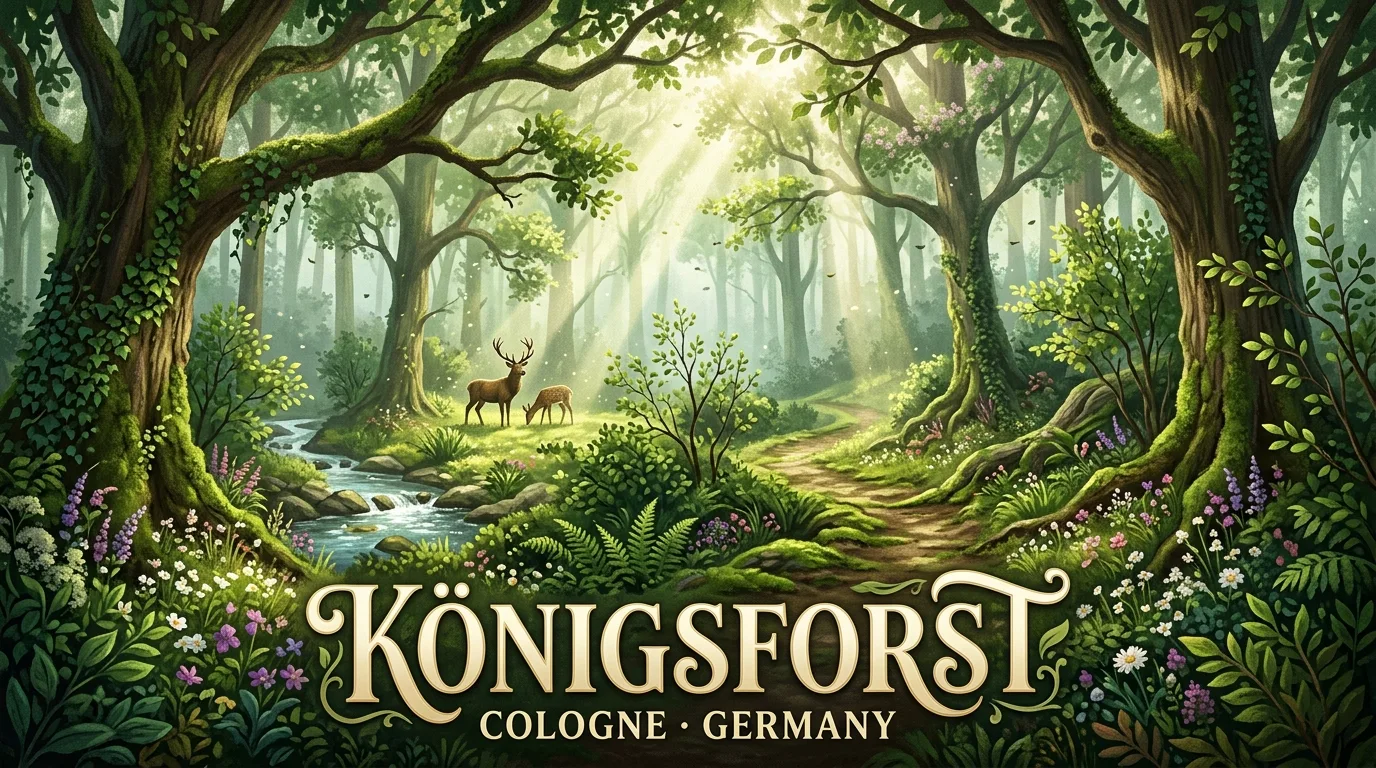
Königsforst, located in eastern Cologne between the districts of Rath/Heumar and the neighboring towns of Bergisch Gladbach and Rösrath, covers approximately 2,519 hectares, making it one of the largest contiguous forest areas in the entire Rhineland and the largest unbroken woodland on the right-bank Rhine middle terrace. For generations, Königsforst has been the most important recreational area for Cologne residents on the city's eastern side, offering extended hikes, long cycling tours, and quiet nature observation all within the same stretch of forest. Unlike the many designed urban parks of Cologne, Königsforst is a genuine, historically evolved forest bearing thousands of years of traces of human use, while also being protected as a European bird sanctuary and a Fauna-Flora-Habitat conservation area. With the terminus of tram line 9 located directly at the edge of the forest, Königsforst is also one of the most easily accessible large woodland areas in Germany by public transport, making it an ideal destination for a nature-focused day trip without a car.
History of Königsforst
The history of Königsforst stretches far back into prehistory: burial mounds from the Hallstatt culture, dating to the 6th and 7th centuries BCE, show that the area was already being used by people and chosen as a burial site roughly 2,700 years ago. The forest received its name in the 10th century, when Emperor Otto I bequeathed the area to his brother Bruno, the Archbishop of Cologne, bringing it into the possession of the Cologne church. The first documented mention of Königsforst dates to the year 1003, when Archbishop Heribert leased a quarter of the forest to Deutz monastery, an early indication of the forest's economic importance to the region. In the 12th century, control over large parts of the area passed to the Counts of Berg, who used the forest primarily as a hunting ground. In 1790, around 4,000 red deer were culled to prevent damage to natural forest regeneration caused by an excessive wildlife population, a sign of the intensive princely hunting practices of the time. Following the Congress of Vienna, the territory passed to Prussia in 1815, which initiated systematic reforestation and increasingly structured the forest for timber production. In 1908, the so-called Kaisereiche oak was planted to commemorate Emperor Wilhelm I; the original tree was destroyed during the French occupation, and the tree standing today is a later replacement. During the Second World War, parts of Königsforst served as a military training ground, and a munitions factory operated within the forest; remnants of bunkers from this period can still be found today. From 1890 to 1961, the so-called Sülztalbahn, the Cologne-Mülheim–Lindlar railway line, also ran through the forest, before the line was decommissioned and later converted into a popular cycling and hiking trail.
Highlights of Königsforst
Nature enthusiasts will find two thematic educational trails in Königsforst: the roughly four-kilometer Waldlehrpfad, featuring 31 information stations covering tree species, forest ecology, and forestry practices, and the shorter Bodenlehrpfad, with six stations explaining the area's different soil profiles in an accessible way. A particular highlight for families is the approximately 50-hectare Wildgehege Brück wildlife enclosure, established by the City of Cologne on March 10, 1967, where red deer and wild boar can be observed up close. Kettners Weiher, two ponds created by damming the Wahlbach stream, along with a Kneipp water-treading station on the Giesbach, offer refreshing variety during longer hikes. With the Tütberg, which at 212 meters marks the highest point of the entire forest, and Monte Troodelöh at 118.04 meters as the highest elevation within Cologne's city limits, Königsforst also offers topographically interesting destinations for more ambitious hikers. The paved Rennweg crosses the forest from north to south and is extremely popular among cyclists of all levels, while a section of the Way of St. James passes through the forest, lending the area an additional spiritual and historical dimension. Conservationists also value Königsforst as a habitat for rare bird species such as the middle spotted woodpecker, kingfisher, grey woodpecker, black woodpecker, hobby, red kite, and honey buzzard, all protected under the European bird sanctuary designation DE-5008-401. The area designated as the Großer Steinberg old-growth forest reserve further demonstrates how a central European mixed forest develops over a long period without any human forestry intervention.
Opening Hours, Tickets & How to Get to Königsforst
As a publicly accessible forest area, Königsforst is open free of charge around the clock throughout the year; no admission fee is charged for the forest itself, though small fees may occasionally apply for guided programs at the Wildgehege Brück enclosure. The most convenient way to arrive is via tram line 9, whose terminus, "Königsforst," is located directly at the edge of the forest and offers a direct connection to Cologne's city center and to the University of Cologne. Drivers can use several park-and-ride lots, including ones at Rösrather Straße 771 and at Rather Mauspfad, which are open around the clock and offer free parking provided a valid public transport ticket is held. Cyclists benefit from the numerous well-signposted bike paths connecting Königsforst to the eastern districts of Cologne and to the neighboring towns of Bergisch Gladbach and Rösrath. Within the forest, the path network consists mostly of natural, unpaved forestry tracks, so sturdy footwear is recommended, while the paved Rennweg is also easily navigable with a stroller or road bike. Dogs are generally allowed to roam freely but should be kept on a leash during the spring breeding and fawning season and in the immediate vicinity of the wildlife enclosure, in order not to disturb the animals.
Attractions Near Königsforst
Just a few minutes' walk from the terminus of tram line 9 lies Gut Leidenhausen, a historic manor estate complex with an attached environmental education center that regularly offers events and guided tours relating to Königsforst and its wildlife. Heading toward Rösrath, visitors can also reach the historic Sülztalbahn route, which today serves as an attractive cycling and hiking trail all the way to Overath, offering an appealing excursion into the Bergisches Land region. In Bergisch Gladbach, which borders directly on Königsforst, a visit to the historic town center is worthwhile, with its traditional paper-mill heritage closely tied to the water power of the surrounding streams. Travelers heading back toward central Cologne can reach Cologne Cathedral and the historic old town in about 25 to 30 minutes via tram line 9, making it easy to combine a nature-filled morning in Königsforst with a cultural afternoon in the city.
Where to stay in Cologne, Germany
Compare current hotel prices and find the right place to stay.