Kölner Seilbahn
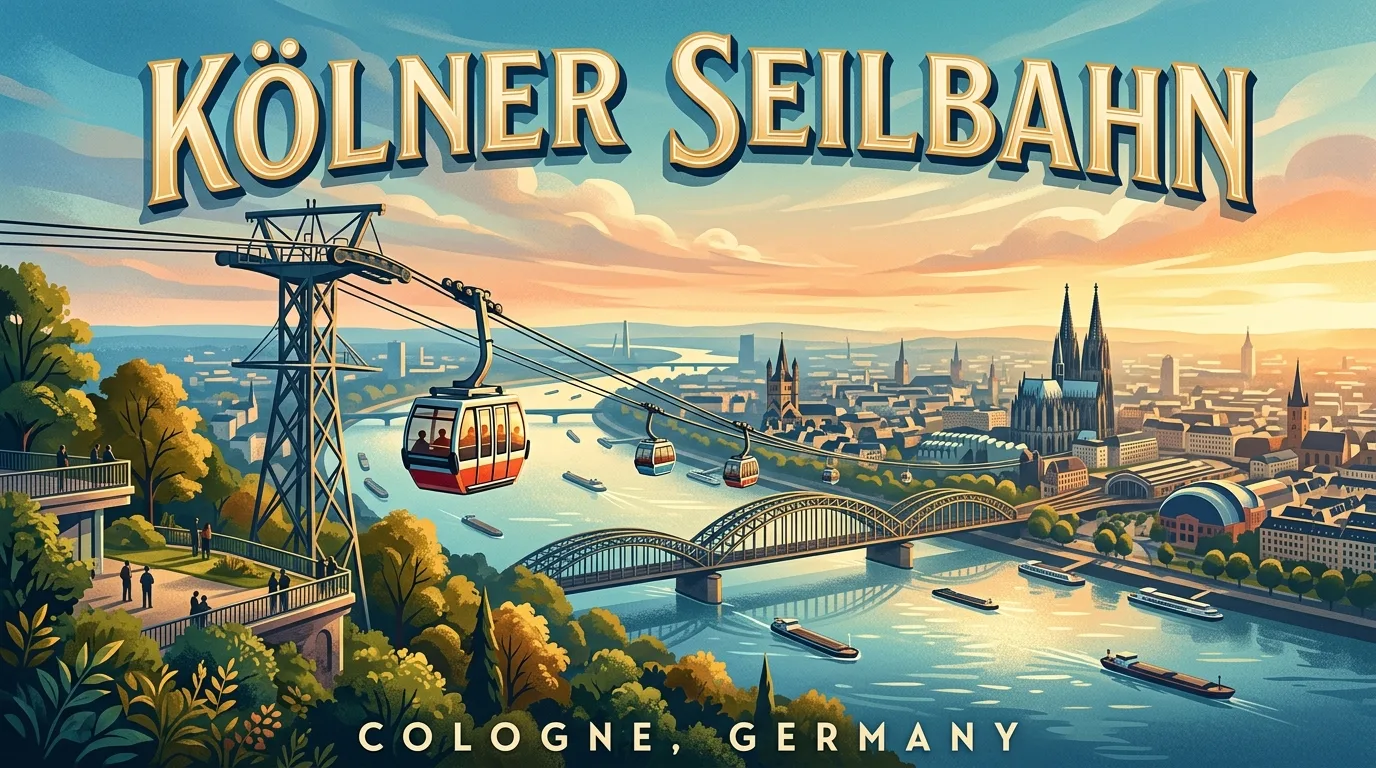
The Kölner Seilbahn is one of Germany's most unusual forms of public transport and, at the same time, one of the most popular attractions along the Rhine. Spanning roughly 935 metres and rising as high as 50 metres above the river, the gondola lift connects Cologne Zoo and the Flora botanical garden in the Riehl district with Rheinpark on the opposite bank in Deutz. This makes it one of the oldest river-crossing cable cars in Europe, and to this day it offers one of the most spectacular views of Cologne Cathedral, the Hohenzollern Bridge, and the city skyline. For anyone wanting to experience Cologne from above, the roughly six-minute ride is a far more affordable alternative to a helicopter flight or an observation tower. The Kölner Seilbahn is therefore much more than a simple means of transport – it is a piece of local history, a favourite photo subject, and a destination that appeals equally to families, photographers, and engineering enthusiasts.
History of Kölner Seilbahn
The history of the Kölner Seilbahn begins in 1957, when it was built for the Bundesgartenschau, Germany's federal horticultural show. Constructed at a cost of around 1.1 million Deutsche Mark, it was considered a technical sensation at the time: it was the first cable car in Europe to cross a river. Prominent guests tested the new attraction right from its opening, including Federal President Theodor Heuss and Chancellor Konrad Adenauer, who both rode the gondolas personally. During the garden show alone, around 1.35 million visitors used the cable car, an impressive record for its era.
The ride proved so popular that the city of Cologne decided to keep operating the Kölner Seilbahn permanently after the show ended. However, the construction of the Zoobrücke (Zoo Bridge) soon conflicted with the original route across the river. As a result, the system had to be dismantled from 3 September 1963 and was rebuilt on a slightly altered alignment with new support towers in Rheinpark, reopening on 22 August 1966. Since that reconstruction, the route has remained essentially unchanged. Since 1998, the Kölner Seilbahn has been operated by the Kölner Verkehrs-Betriebe (KVB), Cologne's public transport company, which has professionally marketed and technically modernised the attraction ever since. Its safety record is remarkable: between 1957 and 2004, more than 13.7 million passengers were carried without a single accident, a testament to the quality of the original engineering. Today, the Kölner Seilbahn carries more than half a million passengers every year, making it not just a historical curiosity but a thriving, economically successful part of Cologne's transport and tourism landscape.
Highlights of Kölner Seilbahn
The greatest highlight of the Kölner Seilbahn is, without question, the view it offers. As the gondola glides across the Rhine at a gentle speed of around 10 kilometres per hour, it reveals a panorama usually reserved for far more expensive helicopter tours: on one side, the unmistakable twin towers of Cologne Cathedral and the silhouette of the old town; on the other, the expansive green spaces of Rheinpark with its fountains, footpaths, and the Tanzbrunnen open-air stage. With a maximum gradient of up to 40 percent and support towers rising between 34 and over 50 metres, the ride crosses not only the river itself but also passes directly over the Claudius Therme spa, whose thermal pools look especially striking from above.
Engineering enthusiasts appreciate the robust construction behind the Kölner Seilbahn: the 22-millimetre haulage rope is rated for a load of 30 tonnes, while the 45-millimetre carrying cable can bear more than 230 tonnes. Dozens of cabins circulate continuously between the two stations, allowing the system to carry more than 1,600 passengers per hour at peak times, with none of the queuing typical of conventional amusement rides. The journey is also a treat for photographers: especially during the golden hour, when the low evening sun bathes the Rhine waterfront in warm light, the gondola offers unique shots of the cathedral and the Hohenzollern Bridge. On special occasions, such as autumn evening rides, the Kölner Seilbahn even operates after dark, when the illuminated old town and bridges present an entirely different side of the city. Families also appreciate that the gondolas of the Kölner Seilbahn connect directly to Cologne Zoo and Rheinpark, making it easy to combine a ride with a zoo visit or a relaxed walk along the river.
Opening Hours, Tickets & How to Get to Kölner Seilbahn
The Kölner Seilbahn operates seasonally and, unlike many other Cologne attractions, is not open year-round. For the 2026 season, the cable car runs daily from 10 a.m. to 6 p.m., with last boarding at 5:45 p.m., and regular operations continue into early November. During the winter months the system normally shuts down completely; in 2026, however, it reopens for a handful of special rides on four selected Advent weekends before going into its full winter break. Anyone planning a visit should check the exact seasonal operating dates on the official website before travelling, since they can shift slightly from year to year depending on the weather and event calendar.
Ticket prices for the Kölner Seilbahn in 2026 are structured as follows: a one-way ticket costs 5.50 euros for adults and 3.30 euros for children aged four to twelve. A round trip costs 9.50 euros for adults and 4.80 euros for children. Frequent riders can buy a ten-ride card for 85 euros (adults) or 43 euros (children). Groups of four or more, as well as school classes and large groups of 17 or more, receive discounted fares, and holders of a KölnCard, Köln-Pass, CityTour ticket, or a valid public transport ticket also pay reduced prices of between 6 and 8.50 euros for a round trip.
The valley station of the Kölner Seilbahn is located at Riehler Straße 180, 50735 Köln, directly next to Cologne Zoo. By public transport, it can be reached via tram lines 18 and 140 and bus lines 150, 250, and 260; the second station lies on the right bank of the Rhine in Rheinpark. Parking is available beneath the Zoobrücke and in the car park on Riehler Straße, and a dedicated stop is provided for coach buses.
Attractions Near Kölner Seilbahn
Several of the city's most popular destinations lie right around the Kölner Seilbahn. On the left bank, the valley station borders directly on Cologne Zoo, one of Germany's oldest and most species-rich zoos, as well as on the Flora, Cologne's historic botanical garden with its ornate greenhouses and sprawling grounds. Both make an excellent combination with a ride on the Kölner Seilbahn, for instance by visiting the zoo in the morning and then gliding across the Rhine to Rheinpark by gondola.
On the right bank, where the second station of the Kölner Seilbahn is located, visitors find the expansive Rheinpark with its manicured lawns, the Tanzbrunnen stage, and numerous footpaths and cycling routes along the riverbank. Just a short walk away lies the Claudius Therme, a modern thermal spa that the cable car passes directly overhead on its route. From there, it is not far to the Mülheim district, known for its lively harbour quarter and growing creative scene. Cologne's old town, with its cathedral, the Hohenzollern Bridge, and the riverside promenade, is also just a few minutes away by bus or train from either station of the Kölner Seilbahn, making it easy to fold a ride into a full day of sightseeing in Cologne.
Where to stay in Cologne, Germany
Compare current hotel prices and find the right place to stay.