Jan-von-Werth-Brunnen
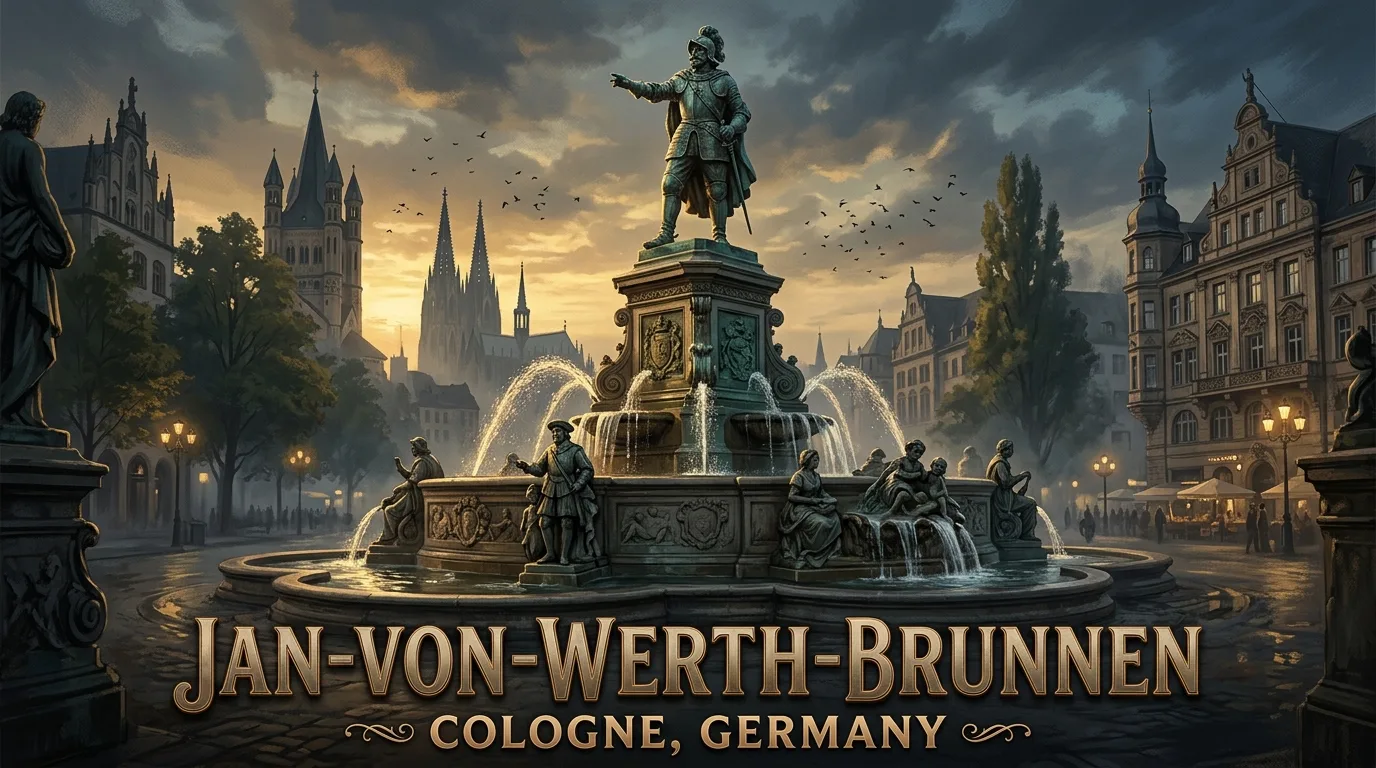
On the Alter Markt, one of the oldest and liveliest squares in Cologne's old town, the Jan-von-Werth-Brunnen has stood since 1884 - a monument that combines two stories in one: the real-life story of a Cologne cavalry general from the Thirty Years' War, and the still-popular folk tale of unrequited love between Jan and Griet, eventually reconciled. Hardly any other monument in the city blends historical fact and oral legend as closely as this fountain, which is also one of the few structures on the Alter Markt to have survived the Second World War almost unscathed, while the surrounding buildings were almost completely destroyed. To this day, the Jan-von-Werth-Brunnen remains an integral part of Cologne Carnival, with traditional street processions ending at this very fountain year after year - proof of just how deeply the story of Jan and Griet is rooted in the city's collective memory.
History of Jan-von-Werth-Brunnen
The story of the Jan-von-Werth-Brunnen begins with a real historical figure: Johann von Werth, better known as Jan von Werth, was born in 1591 in Büttgen on the Lower Rhine near Cologne into simple peasant circumstances, and rose during the course of the Thirty Years' War to become one of the most famous cavalry generals of his time. He initially served as a simple mercenary under the Spanish general Ambrosio Spinola, later fought for the Catholic League under Tilly, and as a Bavarian cavalry commander led the feared cavalry charges that earned him the nickname "Scourge of the French" (Franzosenschreck). His military high point came at the Battle of Nördlingen in September 1634, where his decisive cavalry charge contributed significantly to the victory of the imperial-Spanish troops. In 1638 he was taken prisoner by the French, from whose custody he was only released after more than four years in exchange for the Swedish general Gustaf Horn; he later served the Cologne Elector-Archbishop and ultimately the Imperial court, before dying at Benatek Castle in Bohemia on 12 September 1652. Already during his lifetime, and even more so afterward, his extraordinary social rise - from simple farmhand to highly decorated general - gave birth to the still-popular Cologne folk tale of "Jan und Griet." According to the legend, the poor farmhand Jan fell in love with the maid Griet, who rejected his feelings in the hope of a better match. Embittered, Jan went off to war as a soldier and, through bravery and good fortune, experienced an unparalleled rise to the rank of general. When he finally returned to Cologne in triumph, he happened to spot Griet at the market, where she was by then earning her living as a simple fruit seller. He dismounted his horse and greeted her with the now-famous Cologne dialect words "Griet, wer et hätt jedonn!" ("Griet, who would have thought it!"), to which she replied "Jan, wer et hätt jewoss!" ("Jan, who could have known!"). To permanently immortalize this story in the cityscape, the Cologne sculptor and architect Wilhelm Albermann began building a monumental fountain weighing around five tonnes on the Alter Markt in April 1884; it was completed as early as June of the same year and ceremonially inaugurated by Lord Mayor Hermann Becker on 14 July 1884.
Highlights of Jan-von-Werth-Brunnen
The Jan-von-Werth-Brunnen impresses with its rich figurative programme, which tells the story of the cavalry general and the legend of Jan and Griet on several levels. On the north and south sides of the fountain are allegorical figures symbolizing the city's defensive strength and purity, represented by the classic type of the Cologne farmer on one side and a young maid on the other - a direct visual reference to the legend's two main characters. Particularly striking are the side relief panels, which capture the central scenes of the legend in stone: on one side, Jan is depicted as the rejected, embittered farmhand spurned by Griet, while on the other side the two are shown joyfully reunited, as Jan returns to Cologne as a successful general and meets Griet again at the market. This narrative juxtaposition of rejection and reconciliation makes the fountain one of the most emotionally striking monuments in the city. Also notable is the structural quality and resilience of the roughly five-tonne fountain, which survived the bombing raids of the Second World War in 1942 and 1943 remarkably well, while the historic buildings around the Alter Markt were almost completely destroyed - a striking contrast that still lends the fountain a special symbolic power as a survivor of Cologne's urban history. Another highlight is the fountain's continuing cultural role to this day: during Cologne Carnival, the Jan-von-Werth-Brunnen is the traditional destination of numerous street processions, which year after year come to their festive conclusion right here, making the fountain not merely a historical monument but a living meeting point of Cologne's customs and traditions.
Opening Hours, Tickets & How to Get to Jan-von-Werth-Brunnen
The Jan-von-Werth-Brunnen stands freely accessible in the middle of the public Alter Markt and can therefore be visited at any time, on every day of the week, completely free of charge - there are no fixed opening hours, admission fees, or reservations required. A visit is especially rewarding in the early morning, when the square is still quiet and the details of the reliefs can be studied at leisure, or during the Carnival season in February, when the fountain takes centre stage in traditional Cologne customs and the square fills with festively dressed visitors. Getting there is straightforward, as the Alter Markt lies right in the heart of Cologne's old town: from the main railway station, the square can be reached on foot in about ten to fifteen minutes, passing Cologne Cathedral and winding through the narrow old-town lanes. Alternatively, the Alter Markt can be comfortably reached via the Heumarkt or Appellhofplatz stadtbahn stops, each just a few minutes' walk from the square. Since the Alter Markt itself is designed as a car-free pedestrian zone, travelling by public transport or on foot is generally recommended; drivers will find several paid parking garages nearby, for instance at the Heumarkt or close to the Rhine riverbank. A visit pairs wonderfully with a stroll through the surrounding old-town lanes, home to numerous traditional brewery taverns and cafés.
Attractions Near Jan-von-Werth-Brunnen
The Alter Markt with the Jan-von-Werth-Brunnen lies at the centre of one of the densest clusters of attractions in Cologne's old town. Just a few steps away stands the historic Cologne town hall with its Gothic tower, one of the oldest secular buildings in the city and, for centuries, the seat of municipal administration. Also nearby is the Romanesque church of Groß St. Martin with its distinctive four-tower design, which together with Cologne Cathedral shapes the city's skyline as seen from the Rhine; right next to it, at the Gürzenich, stands the Tünnes und Schäl Denkmal, another beloved bronze sculpture of Cologne folk culture. Just a few minutes' walk away is the Heumarkt with the imposing Reiterstandbild Friedrich Wilhelm III. as well as the Heinzelmännchenbrunnen in the nearby lane Am Hof, which tells the famous Cologne legend of the household spirits. Heading toward the Rhine, visitors quickly reach the riverside promenade with views of the Hohenzollern Bridge and the traditional Fischmarkt, while the world-famous Cologne Cathedral, with its Gothic towers, is about ten to fifteen minutes away on foot. This close proximity makes the Alter Markt an ideal starting point for an extensive walking tour through Cologne's old town, with its many historic monuments, fountains, and sites of legend.
Where to stay in Cologne, Germany
Compare current hotel prices and find the right place to stay.