Herkulesberg
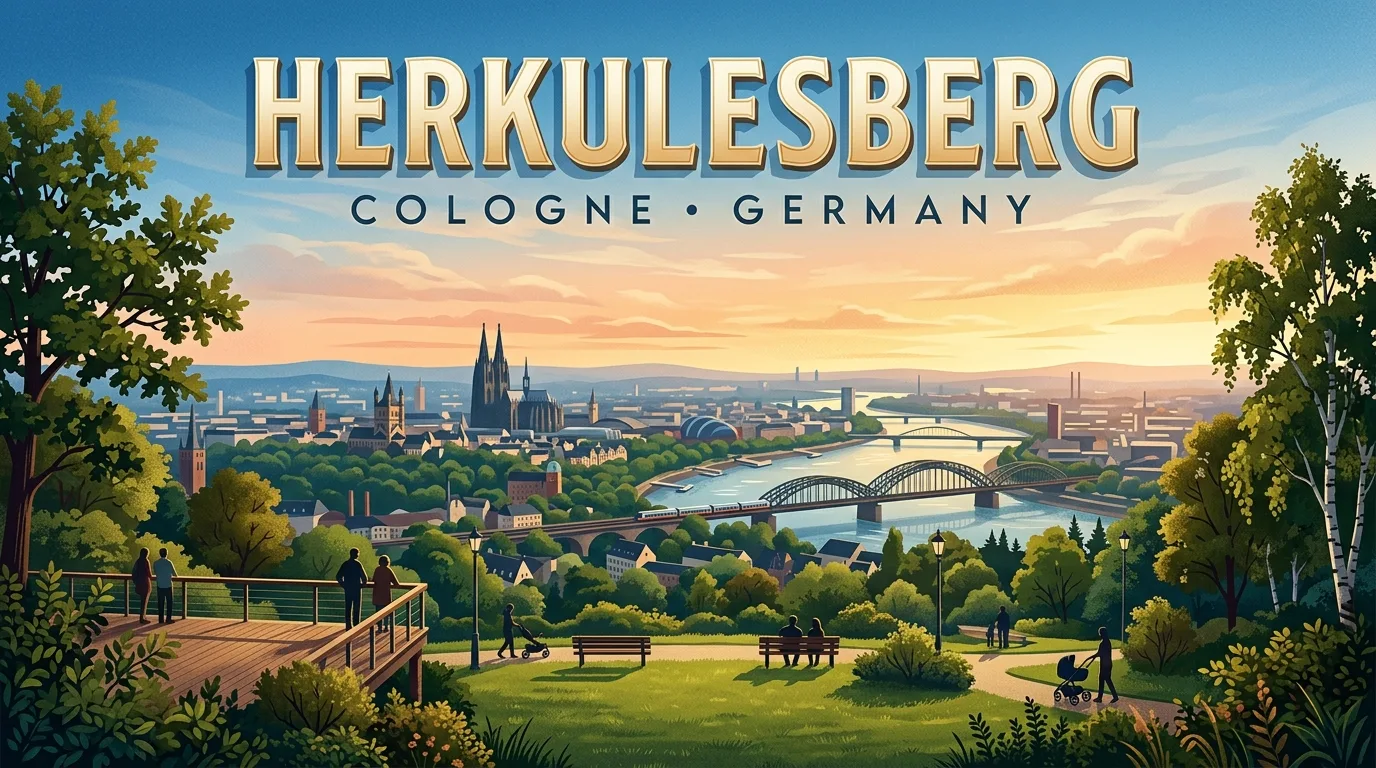
In the middle of the densely populated Cologne district of Neustadt-Nord, just a stone's throw from the Mediapark, rises the Herkulesberg – a green hill that at first glance looks like a natural part of the Cologne landscape, but is in fact a monument to the city's more recent history. Standing roughly 72.2 meters above sea level and about 25 meters above the surrounding terrain, this densely wooded hill is the largest of eleven so-called Trümmerberge, or rubble hills, piled up after the Second World War from the debris of the destroyed Cologne city center. Among locals, it is affectionately known as "Mont Klamott," a nickname that became widely popular across the city thanks to a well-known 1973 song by the Cologne dialect band Bläck Fööss. Today, several hiking paths wind through the forest up to small clearings and lookout points, offering surprisingly expansive views over the rooftops of Neustadt-Nord, the Mediapark, and the surrounding neighborhoods.
History of Herkulesberg
The history of the Herkulesberg begins in the darkest years of Cologne's modern history. Between 1942 and 1945, Allied air raids destroyed roughly 90 percent of Cologne's old town and large parts of the surrounding districts; by the end of the war, enormous mountains of rubble, bricks, and concrete debris had piled up across the city. Rather than hauling the construction debris away at great expense, the city of Cologne decided in the postwar years to pile part of the rubble at central collection sites instead. Starting in 1950, debris from the bombed-out city center was systematically brought to a site between what is now Herkulesstraße and Innere Kanalstraße and stacked into an artificial hill. With a base area of roughly 130,000 square meters, the Herkulesberg became the largest of Cologne's eleven rubble hills, with others located in places such as the Vorgebirgspark and the Stadtwald.
Once the piling was complete, the hill was covered with soil and planted, allowing a dense mixed forest to develop over the following decades that today almost completely conceals the hill's artificial origin. In the 1960s, a small weather station with a distinctive wind vane was also erected on the summit, which remains a characteristic feature of the hilltop to this day. The hill truly entered popular culture in 1973, when the Cologne dialect band Bläck Fööss immortalized it under the nickname "Mont Klamott" in their song about Cologne landmarks – a name that has since become firmly established in everyday Cologne speech and is, for many locals, used even more often than the official name Herkulesberg.
Highlights of Herkulesberg
The centerpiece of any visit to the Herkulesberg is the walk through the densely wooded hill itself. Several unpaved and partly paved paths wind in switchbacks from the base of the hill up to its summit, passing old trees, small clearings, and shaded benches that invite visitors to linger. Those who make the modest climb are rewarded with a perspective on Cologne rarely seen elsewhere: at several points, gaps between the treetops open up views over the rooftops of Neustadt-Nord all the way to the striking high-rises of the Mediapark, including the KölnTurm, which rises just a few hundred meters away. On clear days, the towers of Cologne Cathedral can even be glimpsed in the distance from the higher clearings.
The distinctive 1960s wind vane at the top of the hill has become an informal landmark for the surrounding neighborhoods and a popular destination for a quick lunchtime walk. The dense tree cover also makes the Herkulesberg a favorite spot for dog owners, joggers, and families looking for a green escape away from the traffic noise of the adjoining main roads. In spring and autumn, the mixed forest transforms into a colorful sea of leaves, making the hill one of the most photogenic yet little-known excursion spots in northern Cologne. Unlike the more touristy viewpoints of the inner city, the Herkulesberg offers a quiet, almost village-like atmosphere in the middle of a big city – a place that locals tend to keep to themselves, and one that many visitors have not yet discovered.
Opening Hours, Tickets & How to Get to Herkulesberg
As a public green space maintained by the city of Cologne, the Herkulesberg is freely accessible year-round and around the clock; there are no fixed opening hours, and entry is always free of charge. The only general recommendation is to avoid the unlit forest paths late at night, since the hill is only sparsely lit away from the main routes. There are no tickets, reservations, or admission fees of any kind, which makes the Herkulesberg an ideal spontaneous stop for a short break.
Getting to the Herkulesberg is straightforward thanks to its central location in Neustadt-Nord. By public transport, the easiest way is to take light rail lines 3, 4, 5, 13, 16, or 18 to the Mediapark/Pittlerstraße or Friesenplatz stops; from there, it is roughly a ten-minute walk along Innere Kanalstraße to the foot of the hill. Bus lines running along Subbelrather Straße also stop nearby. Cyclists can reach the Herkulesberg comfortably via the well-developed bike paths along Cologne's inner ring roads, with bicycle racks available at several entrances. Drivers will find limited parking along the surrounding residential streets, as well as in the parking garage at Mediapark, from which the hill is also just a short walk away.
Attractions Near Herkulesberg
Right next to the Herkulesberg lies the modern Mediapark, a former gasworks site redeveloped in the 1990s into a media and business district, which today invites visitors to relax by its artificial lake, green spaces, and the striking KölnTurm high-rise. Just a few minutes' walk away is the trendy Agnesviertel, with its cafés, independently owned boutiques, and the neo-Gothic St. Agnes church, the second-largest church in Cologne after the cathedral. Heading south, it takes roughly 15 to 20 minutes on foot to reach the lively Friesenplatz and Cologne's ring roads, known for their colorful bar and pub scene. The Belgian Quarter, with its design shops and the Brüsseler Platz, is also within comfortable walking distance. Those who continue a little further into the city center can reach Cologne Cathedral and the Hohenzollern Bridge in about 25 minutes on foot or a short light-rail ride, making it easy to combine a visit to the Herkulesberg with a stroll through the northern city center.
Where to stay in Cologne, Germany
Compare current hotel prices and find the right place to stay.