Heinzelmännchenbrunnen
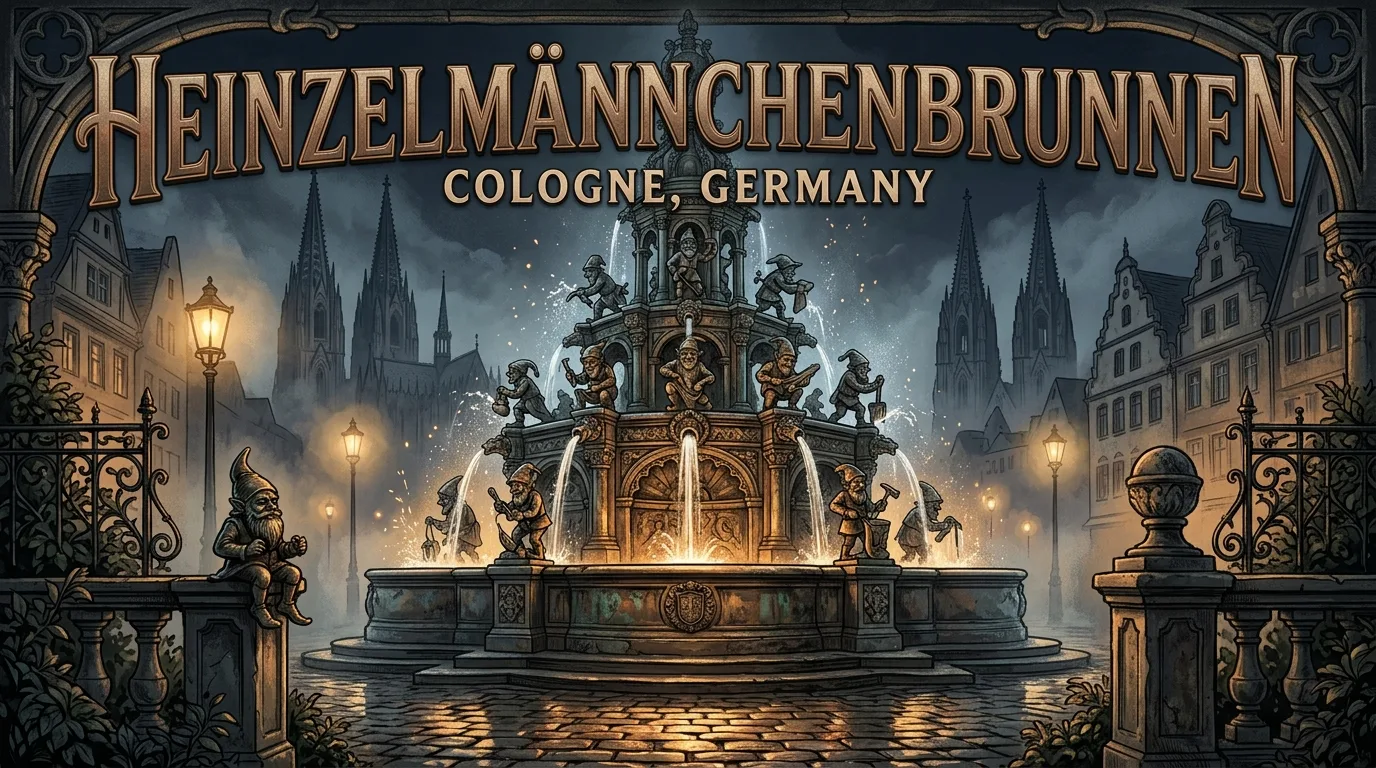
In the narrow lane Am Hof, directly opposite the traditional Brauhaus Früh and just a few steps from Cologne Cathedral, the Heinzelmännchenbrunnen quietly bubbles away - one of the most charming and most photographed monuments in Cologne's old town. Unlike many of the city's other monuments, this fountain does not commemorate a historical ruler or political event, but one of the best-known legends of the Rhineland: the tale of the Heinzelmännchen, small industrious household spirits who secretly helped the citizens of Cologne with their work at night, until a curious woman uncovered their secret and they vanished forever. The fountain is therefore far more than a pretty photo opportunity for tourists: it is a piece of Cologne identity carved in stone, one that has fascinated generations of children and adults alike and that continues to find its way into Christmas markets, dialect theatre, and the city's own cultural self-image.
History of Heinzelmännchenbrunnen
The legend of the Heinzelmännchen reaches far back into Cologne's storytelling tradition. As early as 1826, the writer Ernst Weyden recorded a written version of the legend, noting that the little helpers had reportedly been active in the city "no more than fifty years" earlier. The story only became truly famous, however, through the poet and painter August Kopisch, who in 1836 published his ballad "Die Heinzelmännchen," deliberately relocating a motif originally found more generally across the Rhineland to Cologne and giving it the form that is still known today. In Kopisch's verses, it is said that the little men came at night, "before one could think," and with great diligence carried out all manner of domestic and craft work for the citizens of Cologne while they slept - from baking bread to carpentry to tailoring. According to the legend, this wondrous arrangement came to an abrupt end when the curious wife of a tailor - "curious was the tailor's wife" - became desperate to see what the Heinzelmännchen actually looked like. She scattered dried peas on the stairs so that the little creatures would slip and reveal themselves during their nightly work. Indeed, the Heinzelmännchen did stumble over the scattered peas, but felt so deeply offended and exposed that they left the city forever afterward, never again returning to help the people of Cologne with their work. To permanently immortalize this beloved tale in the cityscape, the Heinzelmännchenbrunnen was erected between 1899 and 1900. Responsible for its design were the architect Heinrich Renard, who lived from 1868 to 1928, together with his father, the renowned sculptor Edmund Renard the Elder, who lived from 1830 to 1905. Father and son thus jointly created a monument that translated the city's storytelling tradition into stone and bronze, and it has since become one of the most visited small monuments in Cologne's old town.
Highlights of Heinzelmännchenbrunnen
The Heinzelmännchenbrunnen first impresses with its artful overall architectural composition: a trefoil-shaped, clover-like granite fountain basin forms the centre of the ensemble, framed by a double staircase on which the figure of the tailor's wife is depicted holding a lantern in her hand - the very moment in the story when she secretly spies on the nocturnal helpers and ultimately exposes them. This depiction of the tailor's wife is considered the emotional centrepiece of the entire fountain and is a particular favourite among visitors for photographs. Around the fountain basin rises a massive sandstone balustrade wall decorated with a total of eight elaborate reliefs. Six of these reliefs depict different traditional craft professions that, according to the legend, were carried out by the Heinzelmännchen: a carpenter, a joiner, a baker, a butcher, a tavern keeper, and a tailor - a small, lovingly crafted compendium of medieval Cologne craft life. The remaining two relief panels bear excerpts of verse from Kopisch's famous ballad, meaning the fountain directly quotes its literary source in stone and gives visitors the chance to read the story almost on the spot. A particularly charming detail is the depiction of an owl holding a magnifying glass, watching over the scene: it symbolizes wisdom and vigilance and alludes to the literary work of August Kopisch, who first gave the legend the fame it enjoys today. The fountain's setting - directly opposite the traditional Brauhaus Früh, first documented in 1396, and just a stone's throw from Cologne Cathedral - also creates a particularly atmospheric ambience: the narrow old-town lanes around Am Hof, framed by historic façades, intensify the fairy-tale character of the place and turn a visit into a small excursion into Cologne's world of legend.
Opening Hours, Tickets & How to Get to Heinzelmännchenbrunnen
As a freely accessible fountain standing in a public street, the Heinzelmännchenbrunnen can be visited free of charge at any time, on every day of the week, around the clock. Neither an admission fee nor prior registration is required - visitors can simply drop by, linger, and take photographs for as long as they like. A visit is especially rewarding in the early morning or late evening, when the narrow old-town lanes are less crowded and the details of the fountain can be studied in peace, as well as during the Christmas season, when the surrounding area is festively decorated and the Heinzelmännchen theme comes further to life thanks to nearby Christmas market stalls. Getting there is remarkably easy, since the fountain sits right at the very heart of Cologne's old town: from Cologne's main railway station, the lane Am Hof can be reached in just about five to eight minutes on foot, passing the south portal of Cologne Cathedral along the way. The fountain can also be reached in a few minutes' walk from the Heumarkt or Appellhofplatz stadtbahn stops. Since the area around the cathedral and the adjoining old-town lanes is largely car-free or traffic-calmed, travelling by public transport or on foot is generally recommended; visitors arriving by car will find several paid parking garages nearby, for instance at the cathedral or at the Heumarkt. A visit pairs wonderfully with a stop at the Brauhaus Früh directly across the street, one of the oldest and best-known brewery taverns in the city, where Kölsch beer is served in a traditionally cosy Rhineland atmosphere.
Attractions Near Heinzelmännchenbrunnen
Thanks to its central location in Cologne's old town, the Heinzelmännchenbrunnen sits in the immediate vicinity of numerous other attractions. Above all, the world-famous Cologne Cathedral with its twin Gothic towers is only a few minutes' walk away and, together with the adjoining cathedral square, forms the undisputed tourist heart of the city. Directly across from the fountain stands the historic Brauhaus Früh, one of Cologne's most traditional brewery taverns, where a visit to the legend can ideally be combined with a Kölsch tasting. Just a few minutes' walk away is also the Alter Markt with the historic Cologne town hall, whose Gothic tower ranks among the oldest secular buildings in the city. The Heumarkt with its imposing Reiterstandbild Friedrich Wilhelm III. is likewise within easy walking distance and invites a further detour into Cologne's monument history. Heading toward the Rhine, visitors reach the riverside promenade within a few minutes, with views of the Hohenzollern Bridge, while the Romano-Germanic Museum, with its significant archaeological finds from Cologne's Roman past, is also located right next to the cathedral. Those wishing to explore Cologne's world of legend further will find several smaller fountains and monuments in the surrounding area that engage with the city's rich dialect and storytelling tradition, making the Heinzelmännchenbrunnen an ideal starting point for a folklore-themed walk through the old town.
Where to stay in Cologne, Germany
Compare current hotel prices and find the right place to stay.