Hahnentorburg
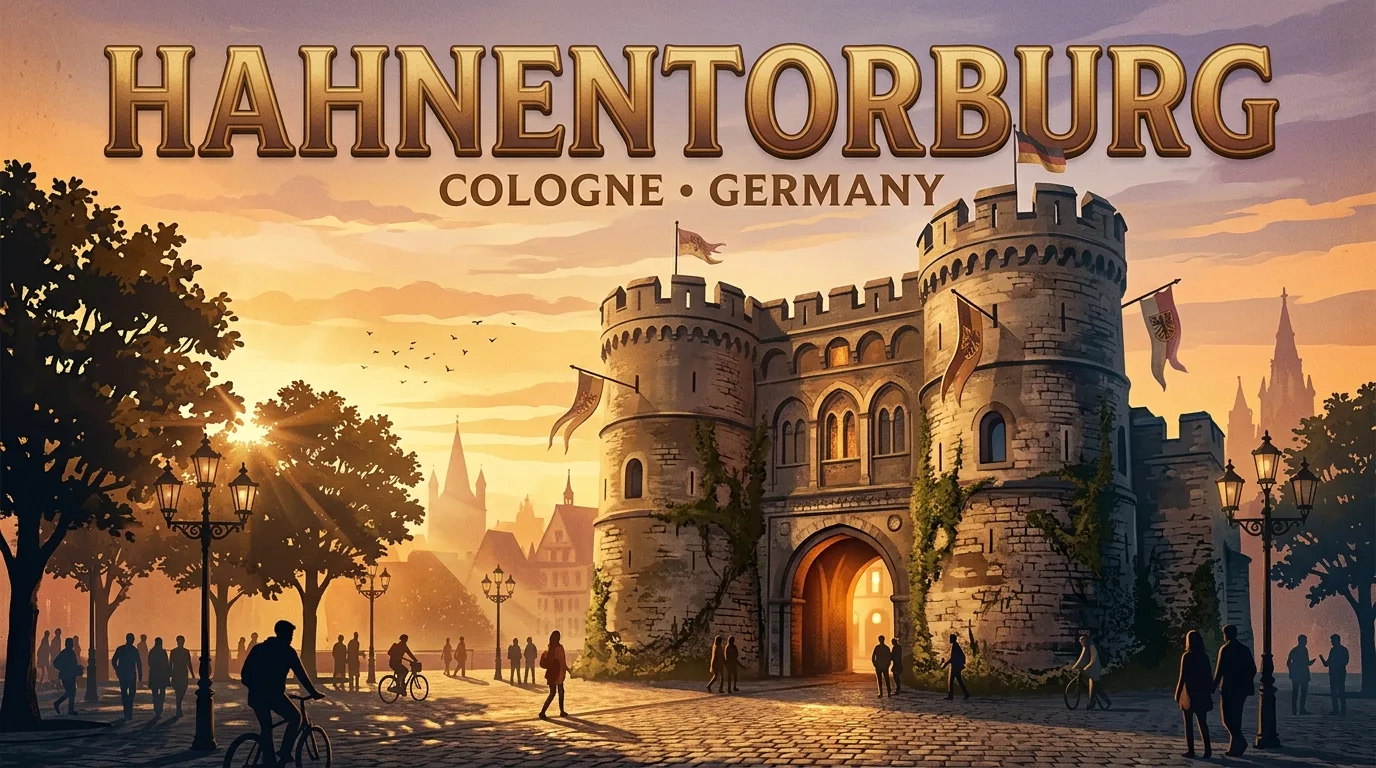
In the middle of the bustling traffic of Rudolfplatz, surrounded by cinemas, cafés and the start of Cologne's famous Ringstraßen boulevards, stands Hahnentorburg like a stone time traveler from the Middle Ages. While the modern city rushes past on all sides, this fortified double-tower gate recalls an era when Cologne was enclosed by a mighty city wall punctuated by twelve monumental gates. Of those twelve gates, only a handful survive today, and Hahnentorburg ranks among the most impressive of them. It once formed the western entrance to the city and served, among other things, as the symbolic gateway for newly crowned kings, who would process ceremonially through it into Cologne after their coronation in Aachen. Today, Hahnentorburg forms a striking architectural counterpoint to the modern buildings lining the Ring, telling visitors a story of royal ceremony, urban defense and shifting use that continues into the present.
History of Hahnentorburg
The origins of Hahnentorburg date back to the early 13th century, when it was built as a fortified double-tower gate as part of Cologne's great medieval expansion, which gave the city's wall its later, vast circumference. The gate was first documented in writing in 1264, though its foundations are likely several decades older. Hahnentor secured the city's western approach along the important long-distance road to Aachen and Jülich, giving it outstanding strategic as well as ceremonial significance. In the Middle Ages, newly crowned Roman-German kings would pass through this gate in festive procession along Aachener Straße into Cologne after their coronation ceremony in Aachen Cathedral - a ritual act underscoring the close bond between the coronation city of Aachen and the powerful trading metropolis of Cologne. Over the centuries, as the city grew and warfare changed, the gate increasingly lost its military function, yet it survived as part of the city's fortifications even as many of the other eleven great gates were demolished during the 19th-century expansions of the city. Toward the end of the 19th century, as Cologne largely razed its medieval walls to make way for the new Ring boulevards, a decision was made to preserve Hahnentorburg as a historic monument. The eminent Cologne city architect Josef Stübben, who was also responsible for designing the new Ring developments, had the gate thoroughly restored around 1890. An inscription beneath the eagle coat of arms on the outer face of the structure, still visible today, documents this restoration with the note "Erneuert 1888" (renewed 1888). After the destruction of the Second World War, which reduced large parts of Cologne's inner city to rubble, the restored Hahnentorburg initially served as an exhibition building for the professional association of visual artists, showcasing works by contemporary Cologne artists. Since 1988, its use has shifted once again: the historic gate has housed a Cologne carnival society, which uses the premises for its club activities, while part of the building functions as a rentable casino space for private events and celebrations.
Highlights of Hahnentorburg
The most striking feature of Hahnentorburg is its characteristic form as a double-tower gate: two massive, battlemented round towers flank the central passageway, giving the structure its defensive, unmistakable silhouette. This building type was typical of Cologne's great 13th-century city gates and can be seen in similar form at the still-surviving Eigelsteintorburg to the north of the city, allowing visitors an instructive comparison of medieval gate architecture. Particularly striking is the contrast Hahnentorburg forms with its surroundings: directly opposite rises the modern Hahnentor high-rise, so that medieval military architecture and postwar modernism meet head-on - a photogenic moment that makes the city's transformation across the centuries visible at a single glance. The inscription "Erneuert 1888" beneath the eagle coat of arms on the outer face recalls the careful restoration carried out by Josef Stübben, whose urban planning legacy still shapes Cologne today. Rudolfplatz itself, on which Hahnentorburg stands, is one of the city's liveliest squares and also the starting point of the famous Kölner Ringe, one of the grand semicircular boulevards created after the medieval wall was torn down in the 19th century. Visitors to Hahnentorburg can therefore also experience the vibrant bar and cinema scene around Rudolfplatz right next door, which comes especially alive in the evenings and during Cologne's carnival season - a fitting backdrop given the gate's current use as the clubhouse of a carnival society. Architecture enthusiasts will also appreciate the high-quality natural stone masonry, which, despite 20th-century war damage, has preserved much of its medieval fabric.
Opening Hours, Tickets & How to Get to Hahnentorburg
Since Hahnentorburg is today used privately by a Cologne carnival society and does not house a public museum, there are no regular opening hours or general admission fee for an interior visit. The structure can, however, be viewed from outside free of charge at any time, as it stands in the middle of the publicly accessible Rudolfplatz and is visible from every side. Visiting the interior is generally only possible during private events, occasional club dates of the resident carnival society, or special occasions during Cologne's carnival season; interested visitors should contact the society directly or check with KölnTourismus for current information. Hahnentorburg sits centrally on Rudolfplatz, 50674 Köln, right at the transition between the city center and the Belgian Quarter. Getting there by public transport is straightforward, since Rudolfplatz has its own Stadtbahn stop served by several KVB lines and is also well connected via the Ring bus routes. On foot, it takes about 15 to 20 minutes from either Cologne's main train station or the Cathedral, with the route passing along the busy Hohenzollernring shopping street, making it easy to combine with a stroll through the city center.
Attractions Near Hahnentorburg
Rudolfplatz and its surroundings offer a whole range of further attractions that pair well with a visit to Hahnentorburg. Directly adjacent begins the Kölner Ringe, an appealing boulevard lined with numerous shops, cafés and restaurants that stretches for several kilometers around the city center. A few minutes' walk away lies Friesenplatz with its lively nightlife district, while toward the city center you can reach Neumarkt, with its shopping opportunities, and the Museum of Applied Arts Cologne (MAKK), both about ten to fifteen minutes on foot. Nature lovers will appreciate the nearby Volksgarten, one of Cologne's most beautiful historic city parks with a romantic pond, reachable in around 20 minutes on foot or conveniently by Stadtbahn. The Belgian Quarter, with its individual boutiques, cafés and distinctive residential atmosphere in historic buildings, also borders directly on Rudolfplatz and invites a relaxed stroll. For those wishing to compare Cologne's medieval gate architecture, a trip to Eigelsteintorburg in the north of the city or Severinstorburg in the south is also worthwhile, both reachable in a reasonable time by Stadtbahn and likewise part of the city's once-twelve great gates.
Where to stay in Cologne, Germany
Compare current hotel prices and find the right place to stay.