Gürzenich Köln
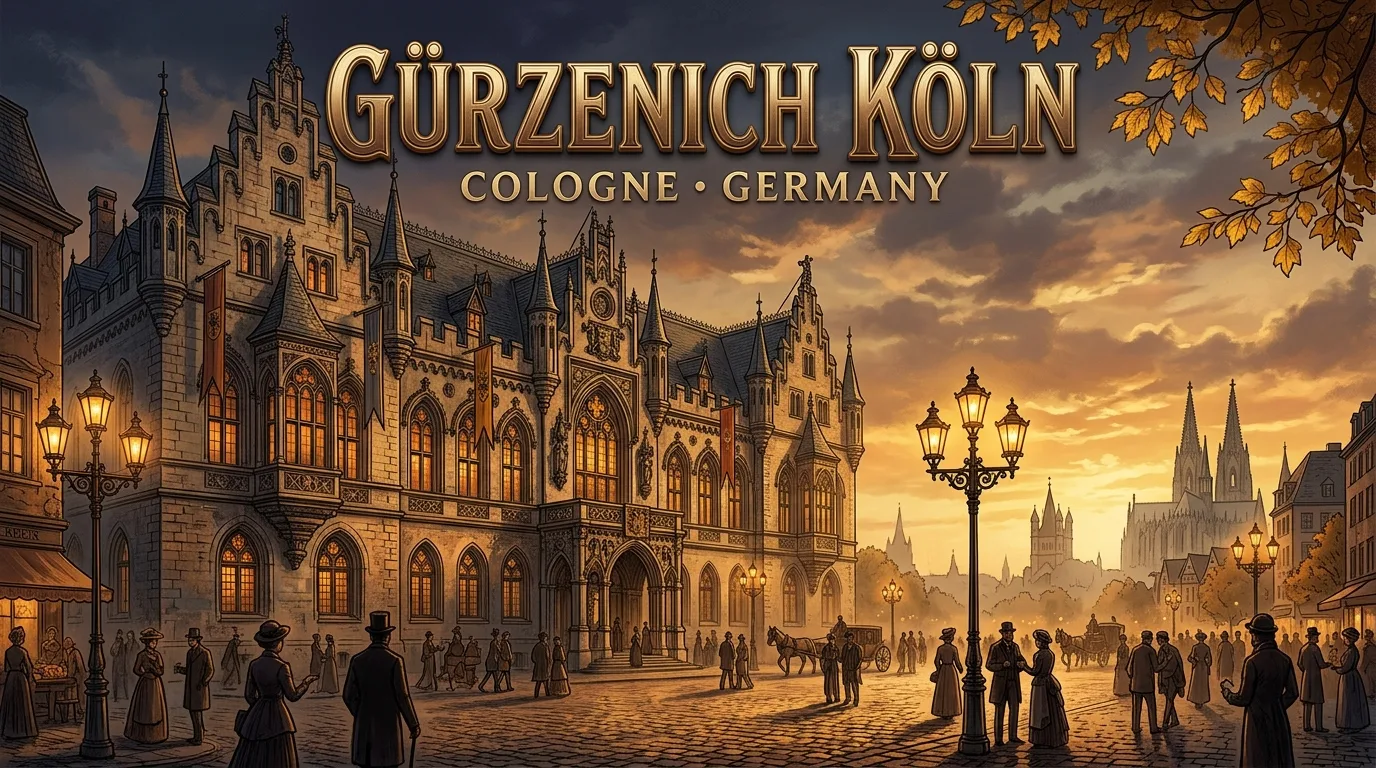
Just a stone's throw from the Historisches Rathaus, in the heart of Cologne's old town, stands Gürzenich Köln, one of the oldest festival halls in Europe still in active use. For more than 580 years, the building has served as a venue for receptions, concerts, balls and festivities, surviving imperial visits, imperial diets, wartime destruction and a remarkable postwar reconstruction. For the people of Cologne, Gürzenich Köln is above all one thing: the heart of carnival, where grand balls have been celebrated since the 19th century and where the city's Dreigestirn, its traditional carnival trio, is proclaimed every year to this day. At the same time, the hall holds international musical significance, having given its name to both the Gürzenich Orchestra and the Gürzenich Choir. Walking along the late-Gothic facade on Martinstraße, visitors encounter a building that, perhaps more than any other in the city, embodies the continuity of Cologne's civic pride across the centuries.
History of Gürzenich Köln
The construction history of Gürzenich Köln begins in 1441, when city councilors Johann von der Arken and Johann von Heimbach initiated the building of a representative municipal dance and festival hall. Under master builder Johann von Bueren, a twin-nave late-Gothic hall with a distinctive twin roof and characteristic dormers was completed by 1447, at a considerable cost of 80,000 guilders. Trachyte stone was quarried from the Drachenfels in the Siebengebirge hills and shipped down the Rhine to Cologne, a logistical undertaking that underscores the project's importance to the city. Shortly after completion, the hall became a stage for major politics: Emperor Frederick III was received here with great pomp in 1474, Emperor Maximilian I followed in 1486, and in 1505 an imperial diet was even held at the Gürzenich. Between 1645 and 1788, the building temporarily lost its festive function and was instead used as a warehouse for cloth and goods, before returning to its role as the city's central event venue in the 19th century. As early as 1822, a year before the official founding of the Festkomitee Kölner Karneval, the first great masked balls were held at the Gürzenich - marking the start of an unbroken tradition that continues today. Between 1855 and 1857, city architect Julius Carl Raschdorff added a neo-Gothic staircase wing with the so-called Isabellensaal, followed in 1885 by an additional three-nave historicist festival hall. Between 1881 and 1885, a 53-meter-long mural frieze depicting the historic 1880 festival procession was created by painters Wilhelm Beckmann, Fritz Roeber, Ernst Roeber and others. Musically, the hall achieved worldwide fame: it hosted the world premieres of Johannes Brahms's Double Concerto (18 October 1887), Richard Strauss's "Till Eulenspiegel's Merry Pranks" (5 November 1895) and "Don Quixote" (8 March 1898), as well as Gustav Mahler's Symphony No. 5 (18 October 1904). From 1857 to 1986, the Cölner Concert-Gesellschaft held its concert series here, giving rise to the Gürzenich Orchestra and Gürzenich Choir that still exist today. Between 1875 and 1922, the building also housed the Cologne stock exchange. During the Second World War, Gürzenich Köln was almost completely destroyed by Allied air raids, including "Operation Millennium." Reconstruction took place between 1952 and 1955 under architect Rudolf Schwarz, who, together with Karl Band, designed the interiors in the style typical of the 1950s; the ceremonial reopening took place on 2 October 1955. Since 1959, Cologne's Dreigestirn has been proclaimed at the Gürzenich every year, and in June 1999 the hall even served as the venue for a G8 summit of heads of state and government.
Highlights of Gürzenich Köln
The architectural centerpiece remains the late-Gothic main hall with its distinctive twin roof, built from massive trachyte blocks quarried from the slopes of the Siebengebirge. The Großer Saal today measures around 1,113 square meters and, depending on the seating arrangement, accommodates between 780 and 1,338 people, while the adjoining Kleiner Saal, at 575 square meters, holds between 400 and 490 guests. Of particular historical value is the Isabellensaal, added in 1885 and covering 211 square meters, as well as the Marsiliussaal, which spans 303 square meters and seats up to 266 people. The 53-meter frieze depicting the 1880s festival procession ranks among Cologne's most significant historicist murals and vividly documents 19th-century civic festivity. Music lovers continue to prize the Gürzenich as a concert hall with exceptional acoustics, where the Gürzenich Orchestra of Cologne performs regularly, carrying forward the great tradition of premieres by Brahms, Strauss and Mahler. A particular highlight of Cologne's annual calendar is the proclamation of the Dreigestirn, celebrated at the Gürzenich since 1959 and marking the opening of the intense carnival season. With an average of around 250 events and roughly 170,000 visitors a year - ranging from concerts and corporate events to balls - Gürzenich Köln is one of the most actively used historic event venues in Germany, a status underscored by its role as the venue for the G8 summit in June 1999. The spacious wine cellar, covering about 390 square meters, rounds out the building's offerings and recalls centuries of Cologne's wine-trading tradition.
Opening Hours, Tickets & How to Get to Gürzenich Köln
Because Gürzenich Köln is primarily an actively used event and concert venue rather than a conventional museum, access to the interior cannot be summarized with fixed opening hours or a single admission price. The late-Gothic facade on Martinstraße and the surrounding area near the adjacent church ruin of Alt St. Alban can be viewed free of charge at any time. The interior of the hall is generally open to the public during concerts by the Gürzenich Orchestra, the annual proclamation of the Dreigestirn, exhibitions, or occasional guided city tours; dates and ticket prices vary by event and are published by the operator Koelncongress and by KölnTourismus. Anyone wishing to see the hall should therefore check the current event calendar in advance, since regular viewing outside of scheduled events is the exception rather than the rule. Gürzenich Köln is centrally located in the old town at Martinstraße 29-37, 50667 Köln, only about 300 meters from the Historisches Rathaus and roughly 700 meters from Cologne Cathedral. The nearest Stadtbahn stops are Appellhofplatz and Heumarkt, from which the Gürzenich can be reached within a few minutes' walk through the car-free old town.
Attractions Near Gürzenich Köln
The central location of Gürzenich Köln in the old town makes it an ideal starting point for a walk through historic Cologne. Directly adjacent stands the church ruin of Alt St. Alban, a quiet memorial site amid the bustling life of the old town. Just about 300 meters away is the Historisches Rathaus with its distinctive council tower and carillon, while the Romanesque church of Groß St. Martin, with its striking four-tower crossing, is also within a few minutes' walk. The Overstolzenhaus on Rheingasse, one of the oldest and best-preserved Romanesque patrician houses in Germany, is only about 400 meters away and well worth a detour. Heading toward the river, a ten-minute walk brings you to Alter Markt and Fischmarkt with their traditional breweries, as well as the Rhine promenade with views of the Hohenzollern Bridge. Walking a little further south, around 15 to 20 minutes takes you to the Chocolate Museum and the modern Kranhäuser in Rheinauhafen - an appealing contrast between medieval and contemporary architecture. Cologne Cathedral, the ecclesiastical counterpart to the secular power center around the Rathaus and Gürzenich, is also about a ten-minute walk away.
Where to stay in Cologne, Germany
Compare current hotel prices and find the right place to stay.