Funkenmariechen-Denkmal
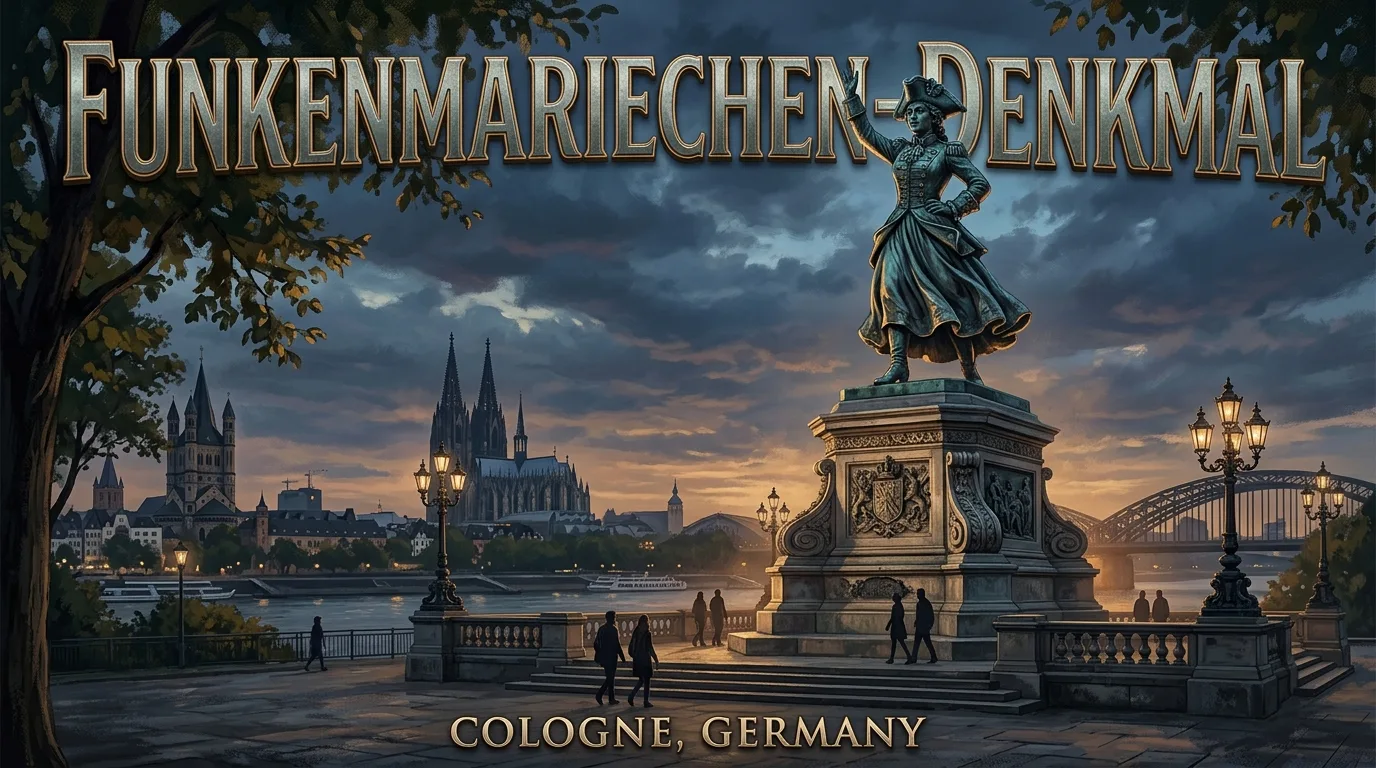
Tucked away in the narrow, cobblestoned lanes of Cologne's Martinsviertel, just a stone's throw from Fischmarkt and the Rhine, stands the small but meaningful Funkenmariechen-Denkmal on the square known as Rote-Funken-Plätzchen. It honors one of the most colorful and oldest traditions of Cologne Carnival: the Rote Funken, officially named Kölsche Funke rut-wieß vun 1823, and their dancing symbolic figure, the Funkenmariechen. Visitors who stroll through the old town and happen upon this unassuming square encounter a piece of living folk culture cast in stone and bronze, one that tells far more than an ordinary monument: a story of military satire, joie de vivre, and nearly two centuries of organized merriment along the Rhine. For anyone wanting to understand Cologne Carnival beyond its grand parades, this spot is an ideal starting point.
History of Funkenmariechen-Denkmal
The roots of the Rote Funken reach back to the former city soldiers of Cologne, who served in distinctive red uniform jackets and white trousers before being disbanded in 1794 during the French occupation of the Rhineland. When Cologne staged its first organized Rosenmontagszug in the modern sense in 1823, the Rote Funken were founded as a military parody of precisely these historical soldiers and already took part in that very first parade on February 10, 1823. They are therefore considered the oldest traditional corps of Cologne Carnival, older than most of the city's other well-known carnival societies. At the heart of their self-presentation from the very beginning has been the affectionate mockery of Prussian military discipline through exaggerated parades, comical commands, and the characteristic Stippeföttchen dance, in which two Funken lean back to back and bounce together in rhythm. A central figure of this tradition has always been the Funkenmariechen, traditionally portrayed by a male member in historicizing costume who dances alongside a Funk and became a crowd favorite of many Rosenmontag parades. To make this tradition permanently visible in the cityscape, a monument was donated in 1977 on the small square in the Martinsviertel that has since been officially known as Rote-Funken-Plätzchen, and it remains to this day one of the city's very few permanent carnival monuments.
Highlights of Funkenmariechen-Denkmal
The monument itself consists of two complementary elements that together capture the history and spirit of the Rote Funken. On one side, a relief shows the dancing Funkenmariechen together with two cheerfully drinking Funken, a scene that perfectly captures the lighthearted, humorous character of Cologne Carnival. On the other side, an adjacent plaque bears the full text of the traditional Funkeneid, the ceremonial oath that new members recite upon joining the society and that is still cited at official Rote Funken ceremonies today. This combination of visual depiction and written word makes the monument a rare example of how intangible local custom can be given permanent form in public space. The hidden location of the square amid the narrow lanes of the Martinsviertel, far from the main tourist flows, is especially appealing, keeping a visit to the monument an authentic, almost private experience. During the Carnival season, in the weeks leading up to Rosenmontag, the small square regularly transforms into an unofficial meeting point for carnival enthusiasts gathering on their way to the surrounding pubs and brewery houses. The detour is worthwhile even outside Carnival season, since the Martinsviertel itself, with its medieval lanes, the striking church of Groß St. Martin, and numerous traditional brewery pubs, ranks among the most atmospheric corners of Cologne's old town. Those who take the time to read the inscription of the Funkeneid gain direct insight into the values of camaraderie, humor, and community that continue to define Cologne's carnival culture today, and come to understand why the Rote Funken have held a firm place in the city's heart for more than two centuries.
Opening Hours, Tickets & How to Get to Funkenmariechen-Denkmal
The Funkenmariechen-Denkmal stands freely accessible in the public space of Rote-Funken-Plätzchen and can therefore be visited without restriction on any day of the year, at any time. There is no admission fee and no fixed visiting hours to observe, making a short detour here easy to combine with a longer stroll through the old town. A visit is especially atmospheric in the evening, when the surrounding brewery pubs and bars of the Martinsviertel light up and the quarter reveals its full charm, or during the Carnival season between November and February, when the connection to living local custom feels particularly vivid. The easiest way to get there is on foot, since the square lies just a few minutes from Fischmarkt, the Rhine riverside, and Alter Markt. Travelers using public transport are best served by the Heumarkt light rail stop, from which the Martinsviertel is reached in about ten minutes on foot. The Severinstraße stop is also within comfortable walking distance. Drivers should note that the narrow lanes of the old town are largely closed to traffic or only partially accessible, so it is advisable to use one of the several parking garages at the edge of the old town, for instance near the riverside, from which the square can be reached in just a few minutes on foot. Those arriving from the central train station can comfortably cover the roughly twenty-minute walk through the historic old town.
Attractions Near Funkenmariechen-Denkmal
The area around the Funkenmariechen-Denkmal holds one of the densest concentrations of sights in all of Cologne's old town. Just a few steps away rises the Romanesque church of Groß St. Martin with its distinctive crossing tower, one of the defining landmarks of the Cologne skyline. Also close by is Fischmarkt, right on the Rhine, offering a wide view of the river and the opposite bank. Alter Markt, with its historic gabled houses and numerous brewery pubs, is likewise reachable in a few minutes on foot and offers the chance to sample a fresh Kölsch straight from the barrel. The world-famous Cologne Cathedral, a UNESCO World Heritage Site and one of Germany's most visited buildings, is also within comfortable walking distance. Those with an interest in Cologne theater history will find the Hänneschen-Theater at Eisenmarkt and the Willy-Millowitsch-Denkmal nearby as well, two further stops that combine ideally into a single walk through the old town.
Where to stay in Cologne, Germany
Compare current hotel prices and find the right place to stay.