Friedhof Melaten
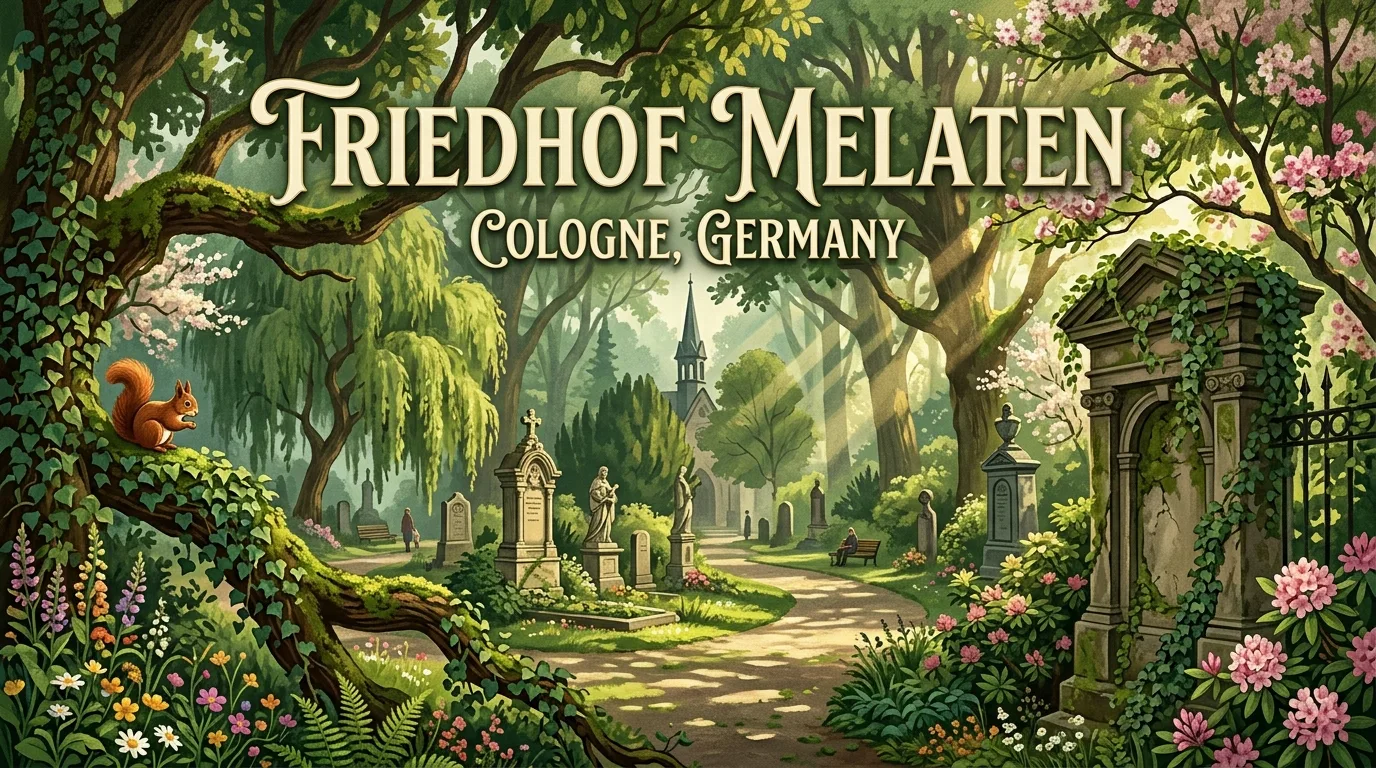
Friedhof Melaten is one of the most remarkable sights in Cologne's Lindenthal district and far more than an ordinary burial ground: covering roughly 43.5 hectares and holding more than 55,000 graves, it is the city's largest cemetery and, at the same time, a unique open-air museum of funerary art, architecture, and urban history. Strolling along its shaded avenues between Piusstraße, Aachener Straße, Melatengürtel, and Weinsbergstraße, visitors encounter elaborate mausoleums, neoclassical grave temples, wrought-iron enclosures, and centuries-old trees that give the place an almost park-like, contemplative atmosphere. Composers, industrialists, politicians, actors, and beloved local Cologne personalities rest here, their names still shaping the city's cultural memory today. For anyone interested in history, art, and the particular character of Rhenish culture, Friedhof Melaten is a must-see destination — peaceful and dignified, yet surprisingly alive, especially during the traditional All Saints' guided walks or the popular historical tours offered throughout the year.
History of Friedhof Melaten
The history of Friedhof Melaten reaches back to the Middle Ages, when a leprosarium stood on this site outside the city walls — an isolation facility for the sick, from which the area's name is believed to derive, as "Melaten" is linguistically rooted in the medieval term for leprosy sufferers. The site gained its present significance, however, only through a decree issued under Napoleon, which banned burials within city walls for hygienic reasons and forced cities to establish new cemeteries outside their fortifications. In Cologne, the chosen site was the land at Melaten, and on June 29, 1810, cathedral priest Michael Joseph DuMont ceremonially consecrated the new cemetery. Its design was entrusted to the Cologne scholar and collector Ferdinand Franz Wallraf, who drew clear inspiration from the famous Père-Lachaise cemetery in Paris — the model that shaped the European idea of the cemetery as a designed landscape featuring individual, artistically crafted monuments. Throughout the 19th and early 20th centuries, Melaten was expanded several times as Cologne grew rapidly and demand for burial space increased; at the same time, the cemetery became the preferred final resting place of the city's wealthy and influential bourgeoisie, a fact still visible today in the sheer density of elaborate grave monuments. The surviving chapel of St. Maria Magdalena und Lazarus, whose origins date back to 1245, recalls the medieval history of the site as a hospital and leprosy location and ranks among the oldest preserved buildings in the entire city of Cologne. In June 2024, a new columbarium was also opened, demonstrating how the historic cemetery continues to adapt to changing burial customs and the growing demand for urn-based graves without losing its historic character.
Highlights of Friedhof Melaten
The main draw of Friedhof Melaten lies in the unusual density of art-historically significant grave monuments scattered across its expansive grounds, making a walk here feel much like visiting an open-air gallery. Particularly famous is the "Sensenmann" (Grim Reaper) sculpture by August Schmiemann, an impressive Art Nouveau monument depicting death as a winged, hooded figure, and one of the most photographed motifs on the entire cemetery grounds. Equally striking are the numerous neoclassical grave temples, cast-iron family plots from the Gründerzeit era, and elaborate mausoleums built by wealthy Cologne merchant families, reflecting the city's economic boom throughout the 19th century. Among the more than 300 notable personalities who found their final resting place here are composer Ferdinand Hiller, former Reich Chancellor Wilhelm Marx, Nicolaus Otto, inventor of the four-stroke combustion engine, as well as local Cologne cultural icons such as popular actor Willy Millowitsch and dialect songwriter Willi Ostermann, whose grave is still regularly visited by fans bearing flowers and small keepsakes. Several war grave fields and memorials also commemorate the victims of both World Wars, adding further historical depth to any walk through the grounds. The broad main avenues, lined with old trees, simply invite a quiet stroll regardless of one's interest in art history — many residents of Cologne use Melaten quite naturally as a green recreational space in the middle of the city. Regularly scheduled themed guided tours, covering famous graves, the symbolism of funerary art, or the city's history, make these highlights even more accessible to visitors and deepen the understanding of the artistic and historical context behind them.
Opening Hours, Tickets & How to Get to Friedhof Melaten
Like Cologne's other municipal cemeteries, Friedhof Melaten is open to the public free of charge year-round; no admission fee is charged, since it remains an active burial ground managed by the City of Cologne as well as a public green space. As is typical for German cemeteries, opening hours follow the seasonal availability of daylight: gates generally remain open until the late evening during the summer half of the year, and close correspondingly earlier, in the early evening, during the winter months; exact current times can be found through the municipal cemetery administration or the official City of Cologne information pages, since times shift with the seasons. The main entrance is located near Piusstraße close to Aachener Straße in the Lindenthal district, with additional access points from Melatengürtel and Weinsbergstraße. By public transport, Melaten is easily reached via several Cologne tram and bus lines running along Aachener Straße and the outer ring road, with the nearest stops just a short walk from the main entrance. Drivers will find limited parking on the surrounding residential streets, though spaces tend to fill up on weekends and during fine weather. Visitors are advised to wear sturdy footwear and, depending on the season, bring an umbrella, as many paths are unpaved or covered in old cobblestones. Since this remains an active cemetery, visitors are asked to behave respectfully and quietly; private photography is generally tolerated, but funerals in progress should never be disturbed.
Attractions Near Friedhof Melaten
Directly to the west of Friedhof Melaten lies the expansive Kölner Stadtwald, one of the city's largest and most popular green spaces, offering hiking and jogging trails, an enclosure with fallow deer and roe deer, and the idyllic Stadtwaldweiher pond — an ideal spot for a relaxed walk after visiting the cemetery. Within walking or short cycling distance is the campus of the University of Cologne, with its historic main buildings around Universitätsstraße, which shape much of the student-driven atmosphere of the Lindenthal district. Heading southwest brings visitors to RheinEnergieSTADION and the adjoining Sportpark Müngersdorf, home ground of 1. FC Köln, which also offers stadium tours outside match days. Following Cologne's Inner Green Belt, which sweeps in a wide arc around the western inner city, visitors can conveniently explore further green sections of the city from Melaten, toward Lindenthal or Sülz. The lively university quarter around Berrenrather Straße and Luxemburger Straße also offers plenty of cafés, student bars, and small shops for a break after touring the historic cemetery.
Where to stay in Cologne, Germany
Compare current hotel prices and find the right place to stay.