Forstbotanischer Garten
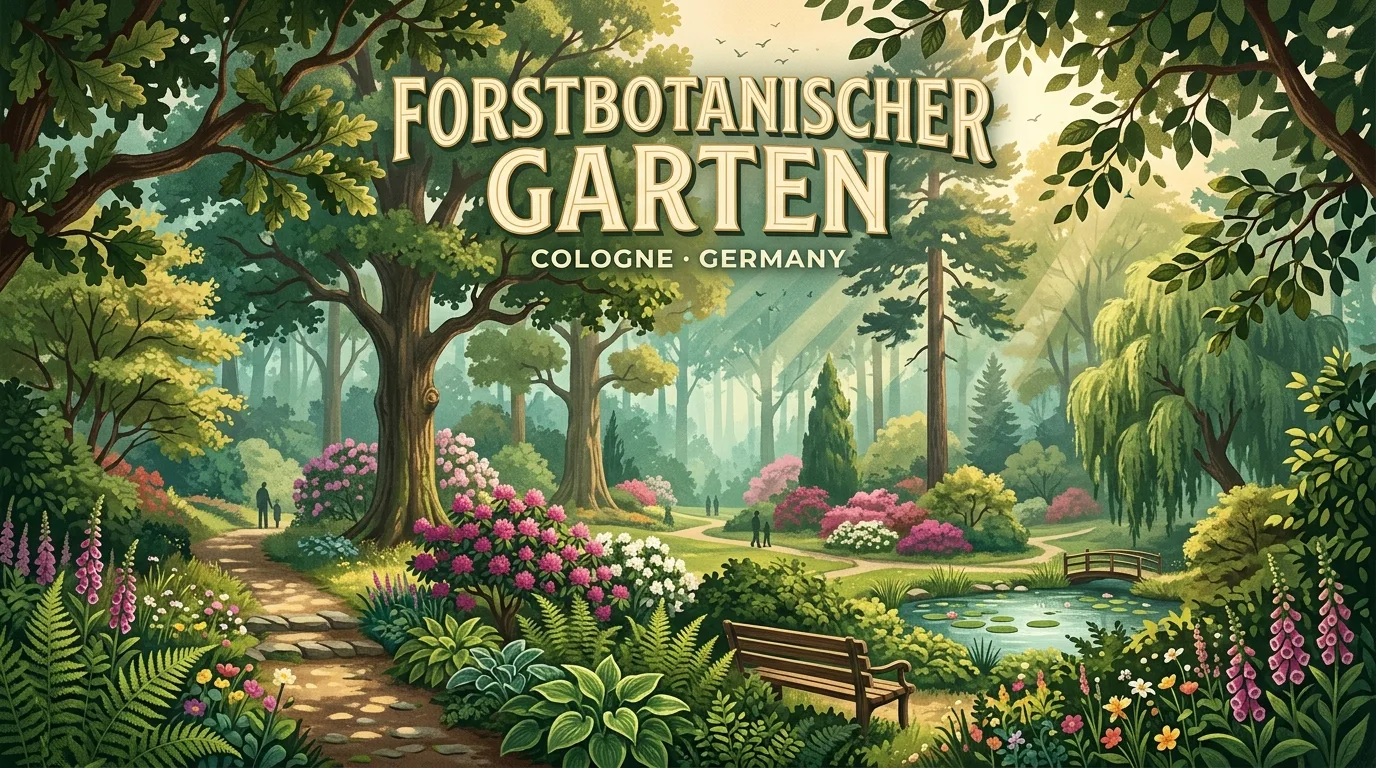
The Forstbotanischer Garten in Cologne's Rodenkirchen district is one of the botanically most significant and, at the same time, largest green spaces in the entire city. With a total area of around 90 hectares, roughly 25 of which form the fenced, classic botanical garden core, the site combines scientific plant collections with expansive recreational grounds for the public. More than 3,000 different woody plant species from around the world grow here across areas that range from carefully landscaped parkland to near-natural woodland, so visitors experience strikingly different impressions of color, scent, and vegetation depending on the season. The garden lies in southwest Cologne near the Cologne-South motorway interchange and is accessed on its eastern side via a central parking lot and the street Zum Forstbotanischen Garten. For botany enthusiasts, families with children, and photographers alike, the site offers one of the most peaceful yet biologically richest green oases anywhere in Cologne.
History of Forstbotanischer Garten
The history of the Forstbotanischer Garten began in autumn 1962, when the first groundwork for the site got underway. Forestry scientists Hans Berge and Herbert Aden were responsible for its planning and execution, aiming to create a site that would serve both forestry research and public recreation. This ambitious project was made possible by the then-independent municipality of Rodenkirchen, which at the time had substantial financial resources from business taxes paid by local industrial companies, allowing it to fund a project of this scale that many other Cologne districts could not have realized on their own. The garden was officially opened to the public as early as 1964, with its core collection of woody plants continuously expanded over the following decades. In the 1980s, the so-called Friedenswald, an additional recreational area of about 26 hectares, was added, broadening the overall character of the grounds and shifting part of it further toward near-natural forest recreation. The grounds also contain remnants of early-20th-century fortifications, a reminder that this part of Cologne once served military purposes before becoming one of the city's greenest corners. Since its opening, the Forstbotanischer Garten has become a fixture of environmental education in Cologne and a popular destination for school classes, families, and nature enthusiasts from across the wider region.
Highlights of Forstbotanischer Garten
The botanical centerpiece of the garden is its extraordinary collection of more than 3,000 woody plant species, presented across thematically organized sections. Particularly impressive are the towering giant sequoias, visible from a distance above the surrounding native tree canopy, along with the finely branched Japanese maples, which rank among the garden's most photographed plants thanks to their brilliant red and orange autumn foliage. In spring, numerous Japanese ornamental cherry trees turn large areas of the grounds into a sea of pink and white blossoms that draws visitors from across Cologne. Extensive rhododendron and azalea plantings provide another colorful spectacle from April through June, while bamboo groves lend the garden an almost exotic, distinctly Asian atmosphere. The collection is further rounded out by numerous North American conifer species, forming dense stands that contrast sharply with the more open, park-like sections of the garden. The adjoining Friedenswald invites visitors on extended walks along near-natural forest paths, offering quiet respite for anyone wanting a break from the dense botanical program of the core garden. Information boards along the paths explain the origin, growth habits, and notable characteristics of the most important woody plants, giving a visit clear educational value for families and school groups alike. Birdwatchers also appreciate the grounds, since the varied woody-plant structure provides habitat for numerous native bird species, and lively birdsong fills the entire garden especially during the early morning hours. Good signage and mostly flat, barrier-free paths also make the garden one of the most accessible botanical gardens in the Rhineland. Picnic areas along the main paths, together with several benches overlooking the garden's most striking plant groupings, invite visitors to slow down and enjoy the atmosphere over several hours rather than rushing through.
Opening Hours, Tickets & How to Get to Forstbotanischer Garten
The Forstbotanischer Garten is open year-round, though exact opening hours vary by season: from April to August, the garden is open daily from 9:00 a.m. to 8:00 p.m., in March as well as September and October from 9:00 a.m. to 6:00 p.m., and during the darker months from November to February from 9:00 a.m. to 4:00 p.m. Admission is free for all visitors, and the grounds are largely barrier-free, allowing wheelchair users and families with strollers to explore the site comfortably. For arrival by public transport, Stadtbahn lines 16 and 17 run to the Rodenkirchen stop, from where the garden is just a few minutes' walk away; bus lines 131 and 135 also serve the immediate vicinity. Drivers will find a central parking lot at the eastern entrance on the street Zum Forstbotanischen Garten, 50999 Köln-Rodenkirchen. Thanks to its proximity to the Cologne-South motorway interchange, the garden is also easily reached by car from across the greater Cologne area, making it a popular day-trip destination for visitors from the wider region. Visitors are advised to set aside at least two to three hours in order to explore both the fenced core area and the adjoining Friedenswald at a relaxed pace.
Attractions Near Forstbotanischer Garten
Just a few minutes away lies the Rhine waterfront of Rodenkirchen, with its popular riverside beach area, numerous boathouses, and the historic floating restaurant Alte Liebe right by the Rodenkirchen bridge. Along the river, visitors also find historic fishermen's houses such as the Fährhaus, as well as elegant 1930s Bauhaus villas that, while privately owned, can be admired from the public riverside paths. A short walk away is also Finkens Garten, a nature experience park designed for children and families, which combines ideally with a visit to the Forstbotanischer Garten for a nature-filled day out. The Rhine cycling path, part of the regional Erlebnisweg Rheinschiene route, runs directly past both sites, allowing cyclists to experience Rodenkirchen's green side in a single tour. Visitors with extra time can then reach Cologne's city center by Stadtbahn in just a few minutes and round off their nature-focused day with a visit to the old town or Rheinauhafen.
Where to stay in Cologne, Germany
Compare current hotel prices and find the right place to stay.