Flora und Botanischer Garten
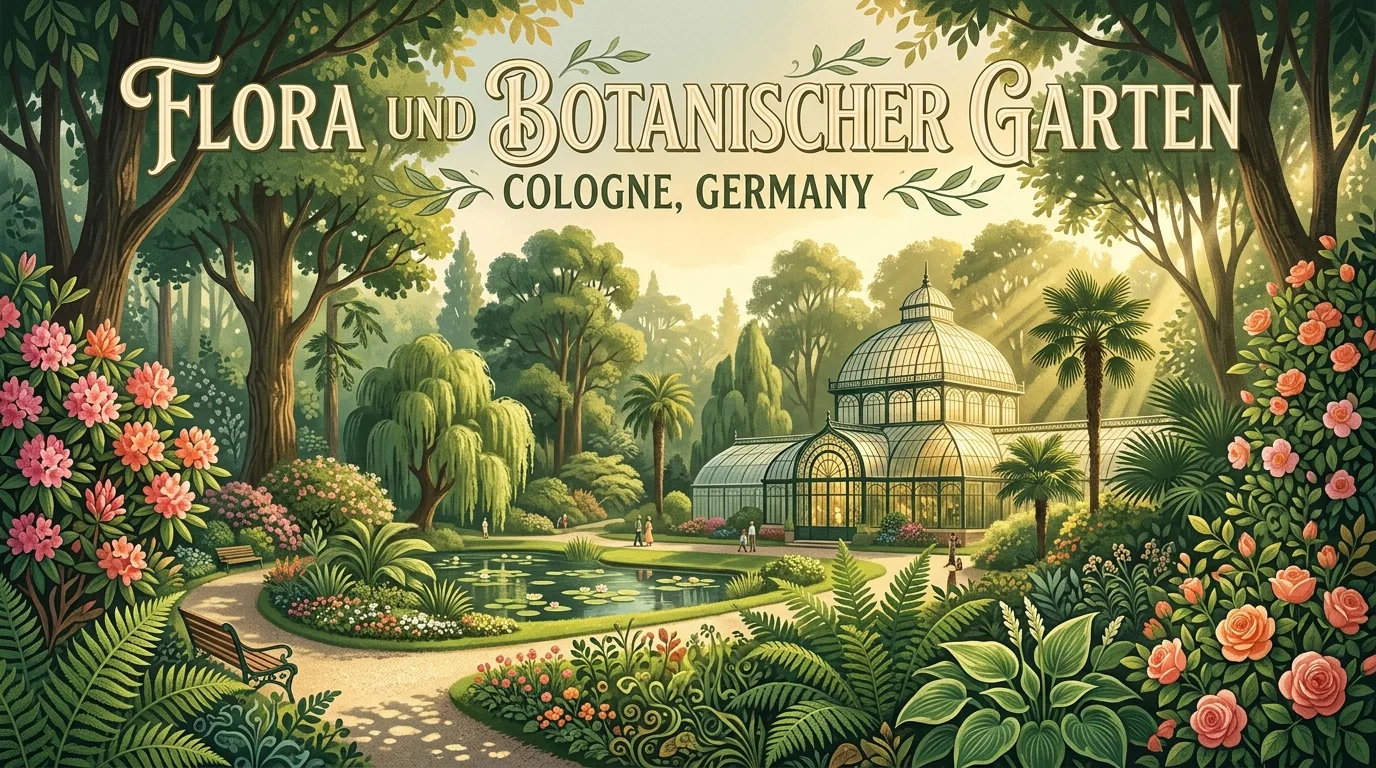
Flora und Botanischer Garten lies in the Cologne district of Riehl, directly adjoining Cologne Zoo on the left bank of the Rhine, and ranks among the city's oldest and most beautiful historic garden complexes. Spanning more than eleven hectares, the grounds combine a grand, baroque-inspired formal section around the listed Festhaus with a sweeping English-style landscape garden and the botanical garden proper, home to more than 10,000 plant species and cultivars. Since opening in 1864, Flora und Botanischer Garten has drawn both Cologne residents and visitors from around the world seeking calm among magnificent flowering plants, mature tree stands and themed planting areas. The combination of historic park architecture and botanical diversity makes the site one of North Rhine-Westphalia's most significant garden monuments and a popular destination for families, photographers and plant lovers alike.
History of Flora und Botanischer Garten
The story of Flora und Botanischer Garten begins in the early 1860s, when the old botanical garden next to Cologne Cathedral had to make way for the construction of the main railway station and the city needed to find a replacement site. The design of the new garden was entrusted to none other than Peter Joseph Lenné, the Prussian royal garden director, who had already created numerous significant parks across Prussia. The grounds were initially financed and built by the private joint-stock company "Flora AG," with the practical implementation of the plans overseen by Julius Niepraschk. The park was ceremonially opened on 14 August 1864 and quickly became a fashionable social gathering place for Cologne's bourgeoisie.
The centrepiece of the early garden was the magnificent Festhaus, a winter-garden-style building of iron and glass designed by architect Max Nohl, which hosted concerts, balls and social events. As the private operation run by Flora AG became increasingly loss-making, the City of Cologne took over the entire site in 1919 and permanently integrated it into its public green-space system. Over the course of the twentieth century the botanical section of the garden was systematically expanded, including new greenhouses, an alpinum for mountain plants and numerous themed plant collections. The entire site has been a protected heritage monument since 1980, and the Festhaus underwent a thorough renovation between 2010 and 2014 at a cost of around €36 million, preserving its historic fabric while securing its use as an event venue for the twenty-first century.
Highlights of Flora und Botanischer Garten
The visual centrepiece of the grounds is the so-called Parterre, a roughly 100-metre-long, baroque-style flower bed stretching between the main entrance and the Festhaus, forming an elaborate pattern of colours and shapes that changes with the seasonal planting. The Parterre is framed by historic sculptures, including a cast-iron Neptune statue by Vital-Gabriel Dubray from 1856 and a marble sculpture of Venus and Amor by Anton Werres from 1863, both among the oldest surviving artworks in the park. Of particular botanical significance is the internationally recognised camellia collection, comprising more than 650 cultivated varieties and around 50 wild species, which earned Flora und Botanischer Garten the status of an International Camellia Garden of Excellence.
In the expansive English-style landscape garden, winding paths, mature tree stands and small watercourses with cascades and weirs invite long walks. Themed garden areas, including a dahlia garden, a historic farmer's garden and a medicinal plant garden, showcase the diversity of cultivated plant life, while the alpinum presents a collection of mountain plants drawn from different altitudes around the world. A particular architectural gem is the Frauenrosenhof, an Art Nouveau pavilion designed by architect Joseph Maria Olbrich and surrounded by fragrant rose beds. The greenhouses house tropical and subtropical plant species from across the globe; in 2026 a new, modern greenhouse complex opened, replacing the previous 1950s structures and providing up-to-date climatic conditions for sensitive plant species.
Opening Hours, Tickets & How to Get to Flora und Botanischer Garten
Flora und Botanischer Garten is open to visitors daily throughout the year, and admission to the park is free of charge. The exact daily opening hours vary seasonally between the summer and winter months, with the grounds generally accessible from the early morning hours until dusk; for the current schedule it is best to check the information boards at the entrances or the City of Cologne's website. The Festhaus itself is regularly used for private and public events and may have restricted access or require a separate admission fee during such occasions, while the garden itself remains freely accessible regardless.
Flora und Botanischer Garten is located in the Riehl district directly next to Cologne Zoo and is very easy to reach by public transport. Cologne's light-rail lines 16 and 18 stop right at the park gates at the "Zoo/Flora" stop, making the journey from the main railway station just a few minutes long. Visitors coming from the right bank of the Rhine can alternatively use the seasonally operating Cologne Cable Car, which runs directly from Rheinpark across the river to Riehl. By bicycle, the garden can be reached via the well-developed cycle paths along the Rhine and through the adjoining Stadtwald forest; parking for cars is available on the surrounding streets of Riehl, though the garden itself has no large dedicated car park.
Attractions Near Flora und Botanischer Garten
Directly adjoining the garden is the world-famous Cologne Zoo, one of Germany's most species-rich and oldest zoos, whose Hippodom, elephant park and huge variety of exotic animals make it a natural complement to a stroll through Flora und Botanischer Garten. Just a few minutes' walk away begins the Cologne Stadtwald, an extensive forest area with walking paths, sports facilities and small lakes, ideal for a longer stay amid nature. The Cologne Cable Car provides a quick connection across the Rhine to Rheinpark, with its Tanzbrunnen stage and the historic fountain installation from the 1957 Bundesgartenschau. Cologne's old town, with its cathedral, the Hohenzollern Bridge and the riverside promenade, is also just a few minutes away from Riehl by light rail, making it easy to combine a visit to Flora und Botanischer Garten with other classic Cologne sights.
Where to stay in Cologne, Germany
Compare current hotel prices and find the right place to stay.