Escher See / Monkey's Island Köln
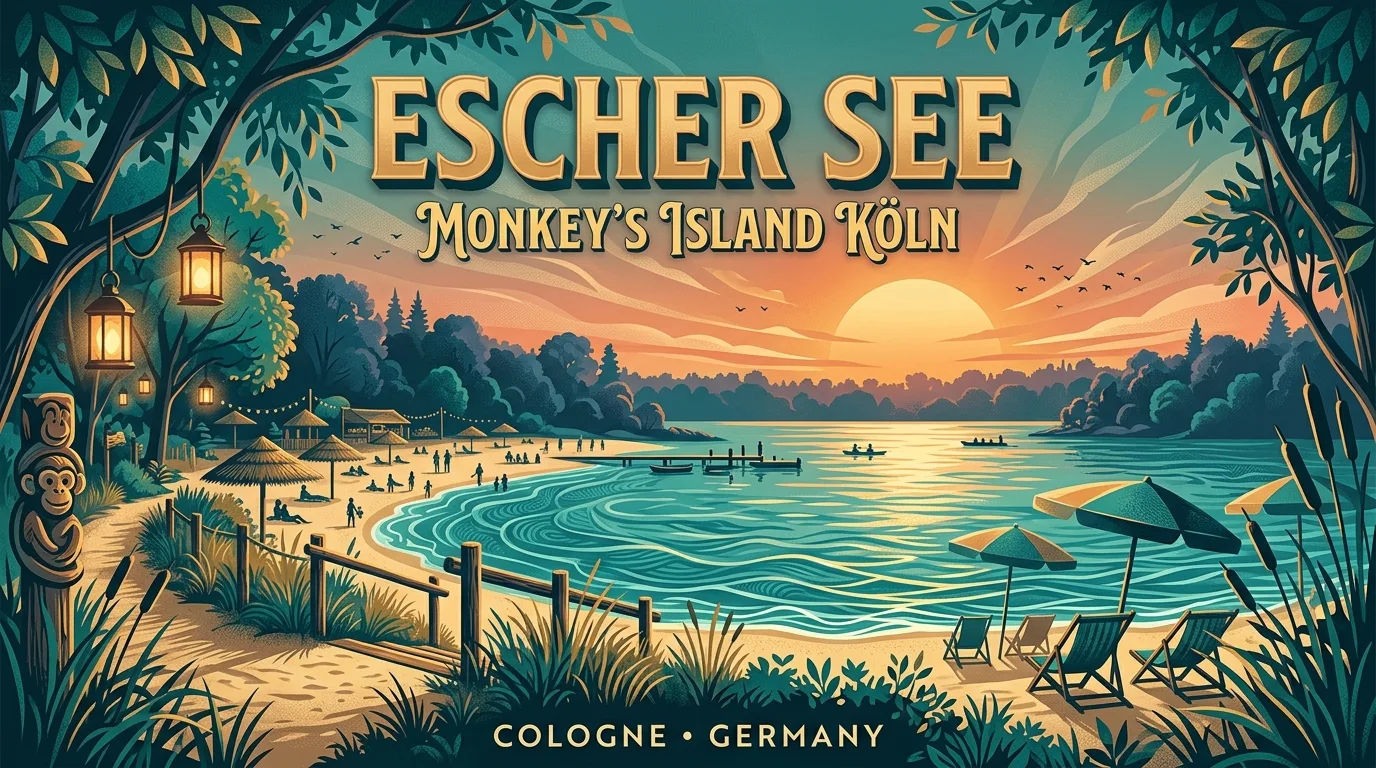
Escher See / Monkey's Island Köln is a well-known summer leisure destination in northern Cologne. The lake is located in the district of Esch/Auweiler, within the Chorweiler borough, in a landscape shaped by former sand and gravel extraction. Its open water and surrounding green areas have made the location an appealing point of interest for people seeking an outdoor escape without travelling far from the city. The site is also an example of how former industrial extraction areas can become part of a region's recreational landscape.
The name Monkey's Island refers to the beach club that became known for its sandy beach, loungers, food and drink facilities, and summer holiday atmosphere. In previous operating periods, visitors could spend time on the sand, reserve comfortable seating, buy refreshments and attend selected music events. However, the lake and the commercial beach club must be distinguished. The venue has been involved in disputes concerning building structures and the permissions required for its operation. In May 2026, the local newspaper Kölner Stadt-Anzeiger reported that the beach club had not yet received approval to reopen. The operator's website continues to publish opening hours and promotional information, while the Cologne leisure portal koeln.de lists the facility as closed. Visitors should therefore confirm the actual operating status before travelling.
The location is interesting for more than a possible day at the beach. Its historical background, the old village centres of Esch and Auweiler, and the transformation of former extraction sites into recreational landscapes give the wider area additional appeal. Anyone researching Escher See / Monkey's Island Köln should pay particular attention to current access arrangements, possible admission charges, transport connections and the applicable swimming rules. Swimming outside an officially authorised bathing facility is not permitted. A visit should therefore not rely solely on older photographs or historic descriptions of leisure activities.
History of Escher See / Monkey's Island Köln
The origins of Escher See are closely connected with the geographical and economic development of northern Cologne. The region contains deposits of sand and gravel that were extracted commercially over an extended period. This activity created artificial depressions that filled with water after extraction ended. Escher See is therefore not an originally natural lake but part of a landscape altered by human activity. Former extraction sites can acquire new functions after their commercial use ends, including wildlife habitats, open landscapes and recreational spaces.
The history of Esch is considerably older than the lake itself. Esch was mentioned in a document from 989 under the name villa ascha. The historical record is associated with Archbishop Everger of Cologne and the Benedictine monastery of Groß Sankt Martin. The neighbouring settlement of Auweiler appears in a record from 1312 under the name Ourwiler. For centuries, both settlements were shaped by agricultural life. Farms, fields, religious buildings and rural roads formed the basis of local life. Some of these historic structures remain visible in the older village centres today.
The growth of Cologne gradually changed the surroundings of Esch and Auweiler. Alongside agriculture, raw material extraction and the development of new residential areas became increasingly important. The former extraction sites left behind several bodies of water that later became part of the region's recreational landscape. Esch and Auweiler were incorporated into the city of Cologne in 1975. As part of subsequent development, the Stöckheimer Höfe recreational area was established in 1986, incorporating the wider setting of former gravel lakes. The history of Escher See is therefore part of a broader transformation in which land used for economic purposes gradually acquired new functions.
The bathing facilities at Escher See went through several phases. Historical accounts state that the swimming operation run by KölnBäder GmbH ended in 2003. From 2007, a private operator ran the facility under the name Sundown Beach. The concept centred on a defined beach area where visitors could relax beside the water and enjoy a summer swimming destination. Sand, lounging areas and leisure services helped establish the location as a recognised option for people from Cologne and the surrounding region.
The leisure facility was later promoted under the name Monkey's Island. Its concept combined a designed sandy beach with food and drink services, reservable loungers, comfortable beach beds and music events. According to the operator, Monkey's Island reopened under this name in 2022. The venue aimed to create a place where guests could enjoy a beach-style day, meet friends or use the catering facilities beside the water. This developed the site beyond the concept of a conventional outdoor swimming facility into a commercial leisure destination with different areas for relaxing and socialising.
The more recent history has been affected by disputes concerning construction work and official permissions. According to reports by the Kölner Stadt-Anzeiger, the City of Cologne objected in 2023 to certain structures that allegedly did not comply with the earlier building permit. Further disputes over the use of the facility followed. In May 2026, the newspaper reported that permission to operate had not yet been granted. The operator's website continues to publish information about services and usual opening hours, while koeln.de identifies the venue as closed. Current access should therefore not be inferred from older promotional descriptions.
Highlights of Escher See / Monkey's Island Köln
The defining landscape feature of Escher See is its open water surface, which contrasts with the more densely developed urban areas of Cologne. The shoreline and surrounding vegetation give the lake a different character from a conventional city swimming pool. For visitors interested in the geographical history of the Rhineland, the lake is also an example of the way former extraction sites continue to shape the local landscape. However, not every part of the shoreline is automatically open to the public.
Monkey's Island became particularly well known for its designed sandy beach. The Cologne leisure portal koeln.de describes a facility covering approximately 30,000 square metres and featuring more than 5,000 tonnes of beach sand. These figures refer to the beach-club premises rather than the entire lake. The sand and lounging areas were intended to create a holiday atmosphere similar to a beach destination without requiring visitors to leave Cologne. Whether these areas are currently accessible depends on the actual operating status of the facility.
Facilities advertised in earlier operating periods included individual loungers, double loungers, parasols and larger beach beds. These options were intended to accommodate different preferences, from a simple place to sunbathe to a more comfortable area for groups. Some loungers and beach beds could be reserved in advance. These services were part of the commercial beach-club concept and were not automatically included in access to the public landscape. Anyone travelling specifically for a particular seating option should confirm whether reservations are currently available and which conditions apply.
Food and drink were another important part of the Monkey's Island concept. Earlier descriptions mentioned a beach bar, a snack counter, light meals and ice cream. Various beverages were also advertised. This made the venue interesting not only to swimmers but also to visitors who wanted to relax in a beach-style setting without necessarily going into the water. Such catering facilities distinguish a commercial beach club from a simple undeveloped lakeshore. Whether food and drinks are currently available must, however, be confirmed with the operator.
The combination of relaxation and entertainment contributed to the site's identity. DJs and musical events were advertised for selected dates, making Monkey's Island relevant to visitors looking for a social summer evening as well as a quiet afternoon. Music events were not automatically part of every visit. Anyone planning a trip around a particular performance should check the current events programme instead of relying on general promotional descriptions.
Stand-up paddleboarding was another activity described in the earlier range of services. Participants use a broad board and a single-bladed paddle to move across the water. The operator advertised equipment rental for an additional fee. Whether boards are currently available and which safety conditions apply must be checked separately. Previous descriptions do not guarantee that water sports are available today.
The location in northern Cologne is another advantage for visitors who prefer shorter excursions. Esch and Auweiler retain elements of their village character, making them different from the more densely developed central districts. A trip to the area can therefore be combined with a walk through the historic village centres. This is particularly useful for visitors who are more interested in the landscape and regional history than in the commercial beach club itself.
The distinction between the lake and the authorised bathing facility is essential. Escher See is not a public swimming pool where bathing is permitted everywhere. According to the Kölner Stadt-Anzeiger, swimming outside the Monkey's Island beach area is prohibited. The City of Cologne also warns that swimming in non-approved former gravel lakes can be dangerous because of uncertain depths, steep banks and submerged obstacles. If the beach facility is closed, visitors cannot simply move to another part of the shoreline and assume that swimming is allowed.
The location's appeal comes from the combination of water, regional history and a former beach-club culture. A visit for food, a beach-style experience or water sports requires current confirmation that the relevant service is operating. Understanding this distinction helps visitors plan realistically and avoid confusing historic promotional information with services that are actually available.
Opening Hours, Tickets & How to Get to Escher See / Monkey's Island Köln
Opening hours for Monkey's Island should be checked carefully because the available information is inconsistent. The operator's website publishes opening hours of 12:00 to 21:00 from Monday to Friday and 11:00 to 22:00 on Saturdays, Sundays and public holidays. According to the operator, the beach club depends on suitable summer weather, and the season usually runs from May or June until September. These are the published standard hours, not a guarantee that the facility will actually open on a particular day.
The difference between the sources is important when planning a visit. The Cologne leisure portal koeln.de lists Monkey's Island as closed. On 27 May 2026, the Kölner Stadt-Anzeiger reported that the City of Cologne had temporarily prohibited opening because building-related issues remained unresolved. The operator's website, on the other hand, continues to display opening hours and information about its services. Visitors should obtain direct confirmation that the facility is permitted to operate and will welcome guests on the intended date before starting the journey.
Admission prices also require careful interpretation. The koeln.de listing gives prices of 10 euros for adults on weekdays and 12.50 euros for adults on weekends and public holidays. It lists 6 euros for children aged six and over, school pupils, students and pensioners. Children under six and people with disabilities are listed as eligible for free admission. Because these figures appear on a page that also describes the facility as closed, they should be treated as published or historical tariff information rather than confirmed prices for an actual visit in 2026 or 2027.
Additional charges may apply to loungers, parasols, reservable beach beds and water-sports equipment. Actual prices depend on the services currently offered and the operator's conditions. Special events may also have separate admission or booking rules. Without confirmation that the facility is operating, visitors should not assume that a beach bed can be reserved or that water-sports equipment will be available.
The published address is Am Baggerfeld 4, 50765 Köln, Germany. For public transport, the Cologne leisure portal lists KVB bus route 125 to the stop named “Escher See”. Visitors should check the official Cologne public transport journey planner for current departures and connections. The best route depends on the starting point within Cologne. Anyone travelling specifically for the beach club should confirm its opening status before setting out.
Travelling by car is another possible option. Parking has been advertised in the area around the beach club, but current access arrangements and any parking charges should be verified before arrival. Demand can rise during hot summer weekends. Visitors whose main interest is the historic centres of Esch or Auweiler should check parking arrangements for those locations separately.
Visitors must also observe local access restrictions and safety rules. Not every section of the lake is publicly accessible, and swimming is not permitted everywhere. Restricted areas should not be entered, and swimming outside a designated, authorised bathing facility should be avoided. The availability of toilets, changing facilities, showers and food services likewise depends on whether Monkey's Island is actually operating.
For current planning, the operator's website at https://monkeysisland.koeln/, the Cologne leisure portal at https://www.koeln.de/freizeit/ll/strandbars-und-beachclubs-koeln/monkeys-island-am-escher-see/ and the City of Cologne website at https://www.stadt-koeln.de/ are useful starting points. Because the information about opening differs, the actual operating status should be confirmed directly before travelling. This helps visitors avoid unnecessary journeys and respect the current access and swimming rules.
Attractions Near Escher See / Monkey's Island Köln
The area around Escher See is well suited to visitors who want to combine time beside the water with a walk through the historic settlements of northern Cologne. The old village centre of Esch is a particularly relevant starting point. Its documented history reaches back to 989, and parts of its traditional layout remain visible. The village centre provides an impression of rural life before the settlement became part of Cologne. St Martin's parish church and historic farm buildings are among the area's historical reference points. A walk through the older streets is a fitting addition for visitors interested in local history.
Auweiler is another worthwhile destination for people who enjoy smaller settlements and historic farm buildings. The village was first documented in 1312 and remained strongly connected with agriculture for centuries. Older farmsteads and the area around the village square help preserve its rural character. Auweiler is not a major tourist centre filled with large attractions. Its appeal lies in its quieter atmosphere and its contrast with the more densely developed parts of Cologne. Some buildings remain private or in agricultural use, so visitors should respect property boundaries and local access rules.
Historical reference points in the wider area include Damianshof in Esch and Doktorshof in Auweiler. Such farmsteads illustrate the importance of agriculture in the development of northern Cologne. They belong to a settlement history that predates the modern leisure facilities around the lake by many centuries. Visitors can use the older village areas to complement a trip to the water, but should not assume that private buildings are open for interior visits.
The Stöckheimer Höfe recreational area offers another geographical reference. The landscape includes former extraction sites, bodies of water, settlements and open spaces. Escher See is part of this setting, demonstrating how gravel extraction and later leisure use changed northern Cologne. Depending on local access arrangements, walks through the surrounding area can provide a closer look at this landscape development. Visitors should follow signs and avoid private or restricted land.
Those looking for another water-based outing can research Fühlinger See and its Blackfoot Beach facility. Both are in northern Cologne, but they are separate destinations with their own opening hours, access arrangements and services. They should not be confused with Escher See. Other lakes in the wider Cologne area may also offer seasonal alternatives, but current operating information and authorised bathing conditions should be checked independently before travelling.
For a culture-focused day trip, central Cologne offers major attractions such as Cologne Cathedral, the Old Town and the Rhine waterfront. These places are not immediately beside Escher See and should be planned as a separate part of the itinerary. Visitors with enough time may combine an outing in northern Cologne with a later visit to the city centre, taking account of actual travel times and transport connections.
A practical itinerary for a quieter outing combines the lake's surroundings with the historic village centres of Esch and Auweiler. Fühlinger See is a separate option for visitors interested in water-based leisure, while Cologne Cathedral and the Old Town are better suited to a dedicated cultural visit. This approach allows Escher See to form part of a varied Cologne itinerary without assuming that Monkey's Island will be open on every day of the visit.
Where to stay in Cologne, Germany
Compare current hotel prices and find the right place to stay.