Eigelsteintorburg
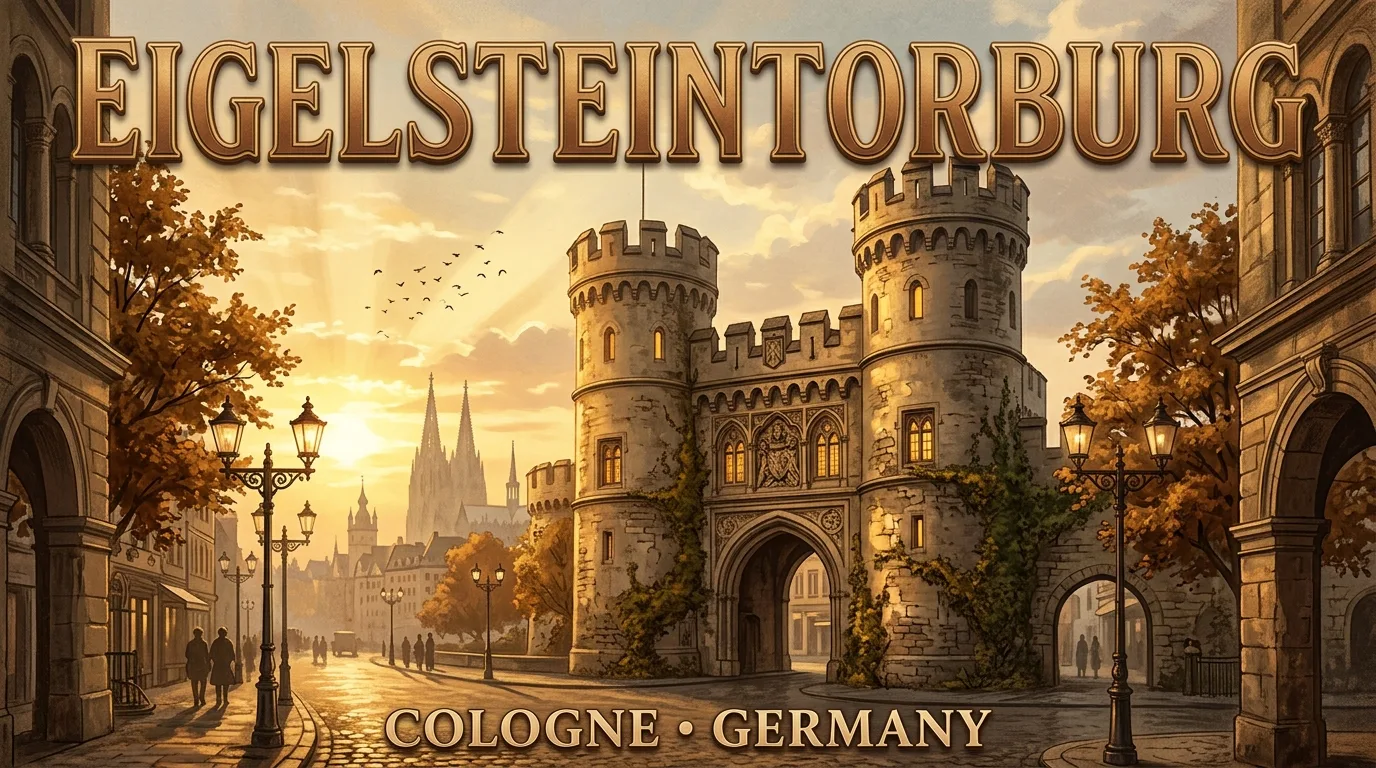
Eigelsteintorburg ranks among the most impressive surviving structures of Cologne's medieval city fortifications and continues to define the streetscape around Ebertplatz in the Altstadt-Nord district. As one of only three surviving gate towers of the former Cologne city wall - alongside Hahnentorburg to the west and Severinstorburg to the south - this fortified landmark offers a vivid sense of just how massively defended the Rhine metropolis once was. Anyone strolling along the bustling Eigelstein street today can hardly miss the twin, crenellated round towers of the gate, which once guarded the city's northern approach and greeted travelers, merchants, and even queens as the first stone symbol of municipal power. Today, Eigelsteintorburg is far more than a silent monument: it serves as a versatile event venue for weddings, concerts, and exhibitions, bridging eight centuries of history with vibrant present-day life.
History of Eigelsteintorburg
The origins of Eigelsteintorburg trace back to Cologne's second city expansion in 1106, when an earlier Eigelsteintor gate was built roughly one hundred meters further south to protect the growing settlement north of the original Roman core. With the third and largest expansion of the city, which between 1180 and 1259 created the vast semicircular wall ring around medieval Cologne, the present Eigelsteintorburg was erected between 1228 and 1248 at its current location near today's Ebertplatz. Designed as a so-called double semicircular tower gate, the structure consisted of two massive, crenellated semicircular towers connected by a gatehouse with a central passage controlling traffic on the important route toward Neuss and the Lower Rhine. Over the centuries, the gate witnessed significant historical moments: in 1641 the French queen mother Maria de' Medici entered the city through it, and in 1804 Napoleon Bonaparte and his wife Joséphine passed through Eigelsteintorburg during a triumphal visit. As Cologne grew into a modern metropolis, the medieval fortifications lost their military purpose, and in 1882 large sections of the city wall were demolished to make way for the new town and its ring boulevards. Eigelsteintorburg survived as one of the few remaining relics and was thoroughly restored between 1889 and 1892 under the direction of renowned city planner Josef Stübben, whose renovation added distinctive wall openings reminiscent of medieval arrow loops.
Highlights of Eigelsteintorburg
Architecturally, Eigelsteintorburg impresses above all with its fortified twin-tower silhouette: two massive semicircular towers of brick and natural stone flank the former passageway and are crowned by a continuous ring of battlements, lending the structure a castle-like appearance that endures to this day. Particularly noteworthy is the city-facing facade of the western tower, whose niche has housed the stone figure of the "Kölsche Boor" (Cologne farmer) since 1891 - a statue created by sculptor Christian Mohr that was originally designed for the Hahnentorburg and symbolizes the defiant, martial spirit of Cologne's citizens. The figure ranks among the city's best-known landmarks and is affectionately regarded by locals as the guardian of the north. Inside, the gate tower reveals atmospheric vaulted halls spread across several floors, where raw medieval masonry, modern lighting installations, and historic timber framing create an appealing contrast between past and present. These halls today serve as an event venue for civil wedding ceremonies, wedding receptions, corporate events, concerts, art exhibitions, and seminars, allowing visitors to experience the building from the inside during such occasions rather than only admiring it from the street. The small, intimate chapel on the ground floor, where civil marriages are performed, is considered one of the most romantic wedding venues in Cologne. Walking around the entire structure is also worthwhile, as the two facades differ noticeably: while the city-facing side is richly decorated, the side that once faced potential attackers displays plainer, more defensive masonry with recognizable traces of the original fortification architecture. The gate's prominent position in the middle of the busy Eigelstein street, surrounded by tram tracks and the pulsing everyday life of the neighborhood, makes a visit feel like experiencing history within a genuinely urban context.
Opening Hours, Tickets & How to Get to Eigelsteintorburg
Because Eigelsteintorburg today primarily functions as a private event venue for weddings, corporate celebrations, and cultural events, the building is not permanently open to casual visitors. The administrative office is regularly reachable on Mondays from 10 a.m. to 2 p.m. and Tuesdays from 2 p.m. to 7 p.m.; for those who wish to see the interior, a free guided tour is offered every Tuesday between 6 and 7 p.m., or individual appointments can be arranged in advance with the management. Admission to view the exterior of the historic building and the adjoining Ebertplatz square is free at all times and requires no booking, since the gate tower stands in the middle of public street space. For weddings, concerts, or private events held inside, however, advance booking through the rental department is required. Getting to Eigelsteintorburg is remarkably straightforward thanks to its central location: KVB tram lines 12, 15, 16, and 18, along with numerous bus routes, stop directly at Ebertplatz, just steps from the gate. Cologne's main railway station, with ICE, regional, and S-Bahn connections, is about a 15-to-20-minute walk away or just two tram stops. Drivers will find sufficient parking in the garages of Altstadt-Nord, for instance around Theodor-Heuss-Ring, though the low-emission zone and limited spaces in the densely built inner city should be factored in. Cyclists can also reach the gate comfortably via the well-developed bike paths along Cologne's ring boulevards.
Attractions Near Eigelsteintorburg
Its location in the lively neighborhood around Ebertplatz makes Eigelsteintorburg an ideal starting point for further exploration of Cologne. Just a few minutes' walk south rises the world-famous Cologne Cathedral with its distinctive twin spires, immediately next to Cologne's main railway station, a central transport hub. Eigelstein street itself, often affectionately called "Cologne's most colorful street," invites visitors on a multicultural stroll past Turkish, Arab, and international shops, bakeries, and snack bars. Ebertplatz square directly in front of the gate tower has been transformed in recent years into a lively cultural plaza with water features, street art, and rotating events. Walking further west, visitors reach the buzzing nightlife district along Hohenzollernring within about ten minutes, home to numerous bars and clubs, while to the north the Mediapark offers a green retreat with its distinctive high-rise towers and adjoining park. The Gothic church of St. Ursula, with its significant relic collection, also lies within walking distance, rounding out the historic ensemble of Cologne's Altstadt-Nord district.
Where to stay in Cologne, Germany
Compare current hotel prices and find the right place to stay.