Ebertplatz
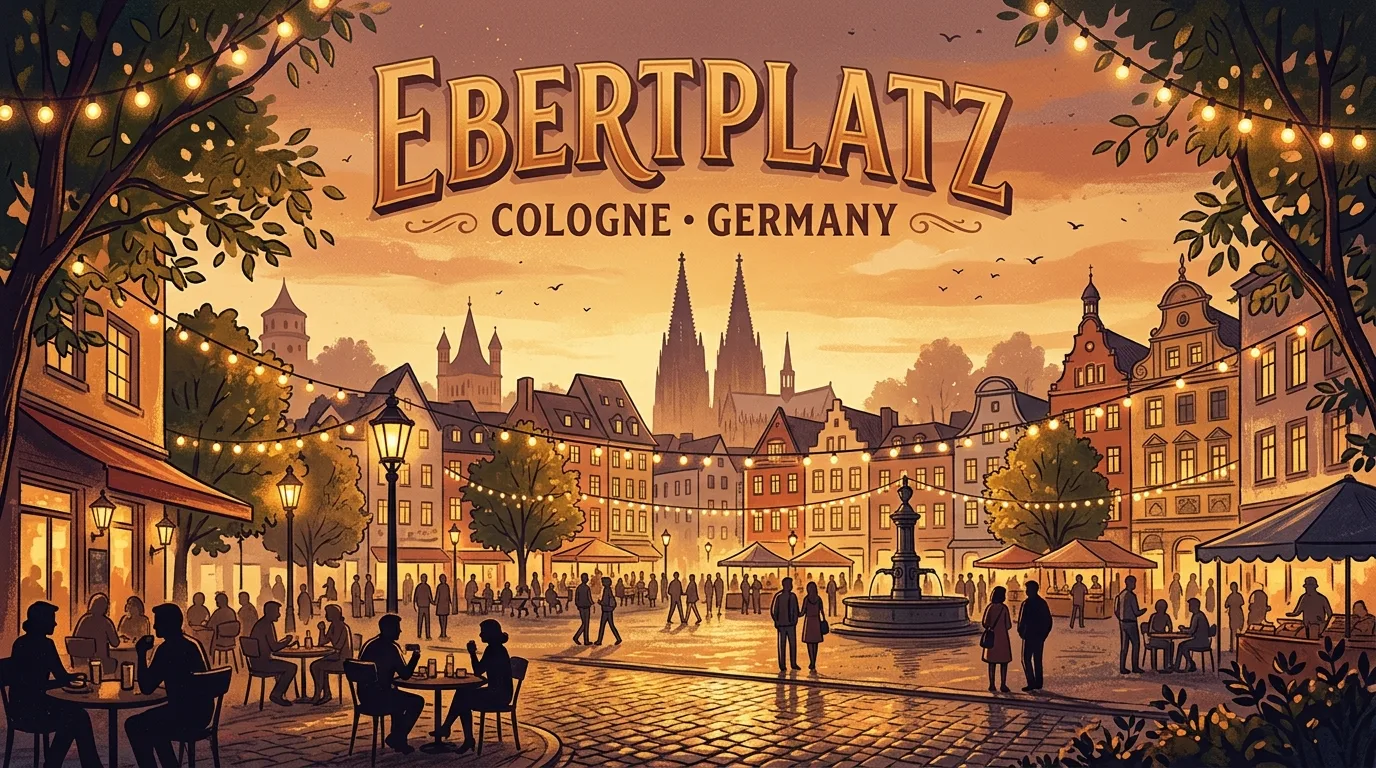
Ebertplatz in Cologne's Neustadt-Nord district is one of the largest and most transformation-rich squares along the historic Cologne ring boulevard. As the northernmost of ten ring segments, it connects Hansaring with Theodor-Heuss-Ring, forming an important traffic hub between the city center and the northern districts. Named after Friedrich Ebert, the first president of the Weimar Republic, the square's turbulent naming history also mirrors a chapter of German contemporary history. Over the past decades, Ebertplatz has undergone a profound transformation: from a representative Belle Époque boulevard square, through a radically modernized traffic facility with a sunken plaza built in the 1970s, to a site of revived urban art and culture in recent years. For visitors interested in urban planning history, contemporary art in public space, or the ongoing adaptability of big-city squares, Ebertplatz offers an unusually multifaceted glimpse into Cologne's more recent history.
History of Ebertplatz
The land now occupied by Ebertplatz originally lay outside Cologne's medieval city fortifications and was used for agriculture for centuries, since building there was long prohibited for military reasons. Only after Prussia sold the land to the city of Cologne in 1881 could urban planners Josef Stübben and Karl Henrici begin designing a generous ring boulevard explicitly modeled on examples such as the Grands Boulevards of Paris and the Ringstrasse of Vienna. The new square was first named Deutscher Platz in 1887. Between 1888 and 1900, elaborately designed Belle Époque villas and apartment buildings with rich Art Nouveau ornamentation were built around the square, giving the entire ensemble a representative, big-city character. In 1922, the square was renamed Platz der Republik in honor of the young democratic form of government, before the Nazis renamed it Adolf-Hitler-Platz after seizing power. After the end of the Second World War, the square finally received its current name in 1950, honoring Friedrich Ebert, the first president of the Weimar Republic. Between 1972 and 1977, a fundamental modernization took place as part of the construction of Cologne's light rail system: the square was lowered, an underground light rail station was integrated, and the kinetic fountain sculpture by Wolfgang Göddertz was installed, which remains a defining feature of the square today. In the years following 2017 and 2018, initiatives such as Unser Ebertplatz and the Brunnen e.V. collective sparked a noticeable revival, breathing new life into the square after years of neglect and periodic crime problems through cultural programming and structural improvements.
Highlights of Ebertplatz
The most striking feature of Ebertplatz remains the sunken, circular plaza area with Wolfgang Göddertz's kinetic fountain sculpture, whose moving metal elements and originally coordinated water display still attract visual attention today, even when the fountain is occasionally out of operation. Surrounding this central area are underground retail spaces and passageways, planned in the 1970s as a modern shopping and traffic concept, which today stand as an interesting, sometimes almost retro-futuristic testament to the urban planning of that era. Since the revival beginning in 2017, numerous art and culture projects have settled on and around the square, including regular exhibitions, light installations, and events organized by the Brunnen e.V. collective, which specifically champions a positive reuse of the underground spaces. Particularly in the evening hours, light art projects transform the square into an unusual site of contemporary urban culture, standing in clear contrast to the classic sights of Cologne's city center. Architecture enthusiasts will also appreciate the surviving Belle Époque facades at the edge of the square, which form an impressive contrast to the radical modernization of the plaza itself and make the layering of different urban planning eras visible within a small space. Ebertplatz simultaneously functions as an important transit hub with a heavily used light rail station, making it, for many Cologne residents and visitors, an everyday, if architecturally unusual, transfer point. This combination of functionality, history, and an emerging art scene makes the square one of the most fascinating, if least conventionally pretty, places in the entire Neustadt district.
Opening Hours, Tickets & How to Get to Ebertplatz
Ebertplatz, as a public transit and city square, is freely accessible at all times, with no admission fees or fixed visiting hours. Since the square is also an important traffic hub, a daytime visit is recommended, when the surrounding shops and art installations are best visible, while the atmosphere in the evening takes on its own distinct urban appeal through light installations and quieter traffic. Visitors specifically wishing to experience the art and culture projects organized by the Brunnen e.V. collective should check current exhibition and event schedules in advance, since these run on a rotating program rather than continuously. Getting to Ebertplatz is remarkably easy, since a light rail station of the same name lies directly beneath the square, served by several lines and forming one of the key public transport hubs in the northern part of Cologne's city center. From Cologne Central Station, the square can be reached in just a few minutes by light rail or in about fifteen minutes on foot along the ring road. The square is also conveniently accessible by bicycle via the well-developed cycling paths along the ring boulevard. Drivers will find several parking options in the area but should be aware of the sometimes heavy traffic at the junction between Hansaring and Theodor-Heuss-Ring, since the square continues to serve an important function in the city's road network.
Attractions Near Ebertplatz
The area around Ebertplatz allows visitors to combine several interesting destinations in the northern part of Cologne's city center. Just a few minutes' walk away lies the Eigelstein quarter with the historic Eigelsteintorburg, another surviving gate of the medieval city fortifications, along with numerous owner-run cafés and international restaurants. Heading south, Cologne Central Station and the world-famous Cologne Cathedral can be reached in about ten to fifteen minutes on foot, making it easy to combine a visit to Ebertplatz with a trip to the city center. The lively Agnesviertel, with its striking St. Agnes Basilica, the second-largest church in Cologne after the cathedral, is also within comfortable walking distance and offers a quieter alternative to the bustling square itself. Those interested in Cologne's emerging art and culture scene will also find several small galleries and studios in the immediate vicinity of Ebertplatz, which have benefited from the quarter's revival since 2017 and regularly host changing exhibitions.
Where to stay in Cologne, Germany
Compare current hotel prices and find the right place to stay.