Die Pescher Vorburg
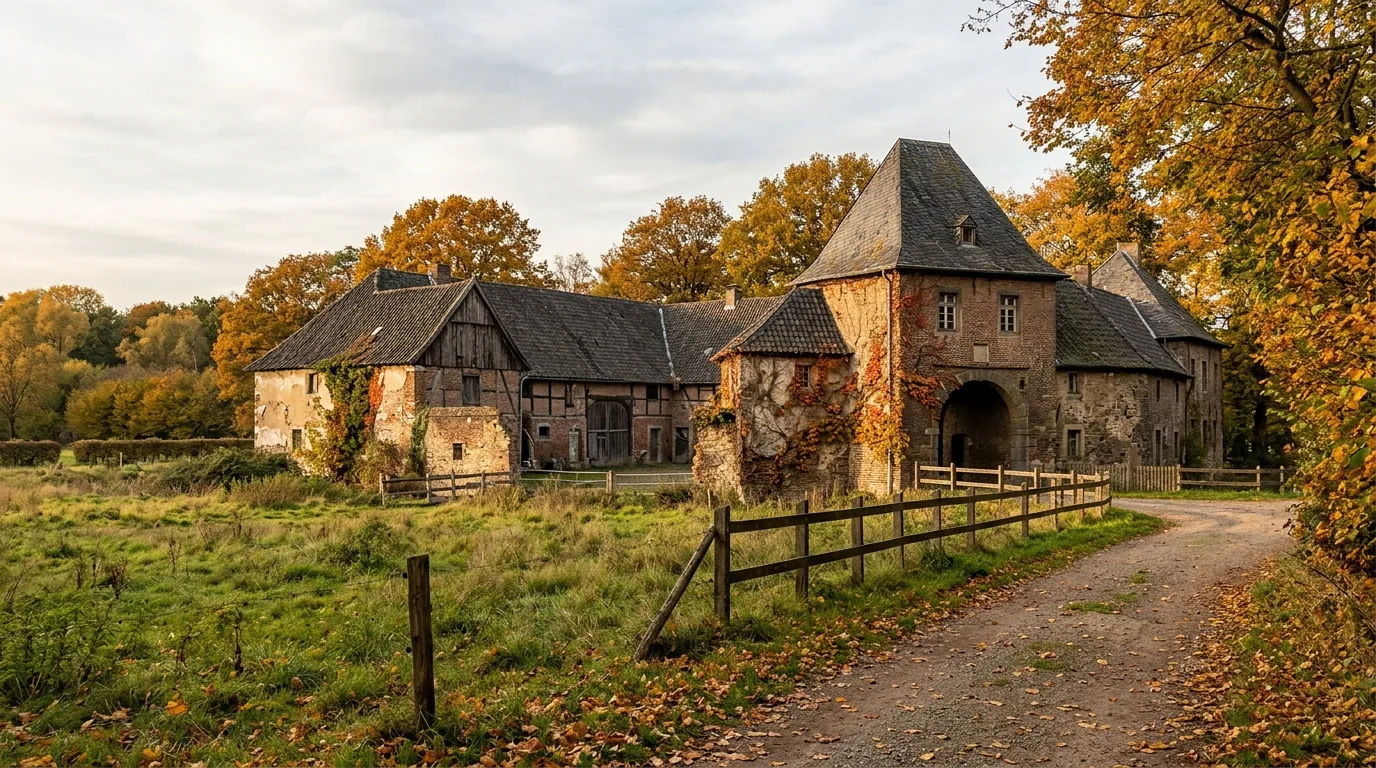
In Cologne's Pesch district, a quiet left-bank neighborhood within the Chorweiler city borough, the site known as Die Pescher Vorburg recalls a time when this now suburban, green area was still defined by scattered farmsteads and fortified estate complexes. In the language of castle studies, a "Vorburg" refers to the outer, usually economically oriented part of a larger estate, which together with a main residence, or "Hauptburg," once formed a self-contained manor, frequently surrounded by moats. Die Pescher Vorburg stands as an example of many similar complexes in the Cologne area, where often only the practically used farm buildings survived the centuries while the actual manor house itself disappeared over time. For visitors interested in the rural prehistory of Cologne's outer districts and in unassuming yet authentic witnesses of Rhenish agrarian history, Die Pescher Vorburg makes for a rewarding, little-visited detour in the north of the city.
History of Die Pescher Vorburg
The Pesch district itself can be traced back in documents to the 14th century, when the area was characterized by individual, scattered farmsteads that gradually developed over the centuries into a small rural settlement community. Several of these historic farm complexes are still known by name today and are partly listed as protected monuments: the so-called Kriegshof is already mentioned in records from 1657, when three further farmsteads and four house plots were documented alongside it, while the Paulshof and the Heribertshof also rank among the old, now heritage-protected farm complexes of the district. It is within this environment of historically grown, partly fortified manor farms that Die Pescher Vorburg should be understood: it is regarded as the surviving, formerly outlying working section of a larger estate that was originally surrounded by moats, a type of complex that was widespread in the Rhineland well into the early modern period. As with numerous comparable estates between Cologne and the Lower Rhine, the actual manor house, the Hauptburg, disappeared over the centuries through fire, decay, or later agricultural conversion, or was altered beyond recognition, while the more solidly built, continuously used farm and outer-bailey buildings remained in service as stables, barns, or storage spaces and thereby preserved their historic fabric. With the gradual urbanization of Pesch, which received its decisive push in the 1960s as the once agrarian village increasingly became a Cologne residential suburb, farming in the immediate surroundings lost its former importance, while the old remnants of the Vorburg survived as a quiet witness to the pre-industrial, village past of the area.
Highlights of Die Pescher Vorburg
The particular appeal of Die Pescher Vorburg lies less in a spectacular, museum-style presentation than in its unpolished, authentic character as a genuinely grown piece of rural building history in the middle of modern Cologne. The massive brick walls of the surviving farm buildings, their typical steep roof shapes, and the arrangement of structures around a central courtyard allow visitors, even without elaborate reconstruction, to imagine what the original complex must once have looked like: a compact, outwardly closed manor farm that combined residential, economic, and defensive functions in a single ensemble. In several places across the grounds, slight depressions and changes in the terrain can still be made out, interpreted as remnants of the former moats that once enclosed the whole complex and protected it from unwanted visitors. The contrast between this historic fabric and the surrounding residential development from the 1960s and 1970s makes Die Pescher Vorburg a vivid example of how Cologne's districts evolved from agricultural villages into modern suburbs without completely losing their historical roots. A walk here is especially rewarding in the early morning or evening hours, when the light brings out the old masonry structures and the calm, green surroundings particularly well. Visitors with an interest in the district's religious architecture often combine a visit to Die Pescher Vorburg with a short detour to the nearby Baroque Donatuskapelle, dated to 1774 and counted among the oldest surviving buildings in the entire district. Together, these small, at first glance unassuming structures form a dense and very personal picture of Pesch's long village history, one that stands in clear contrast to the well-known, heavily visited attractions of central Cologne. Precisely because Die Pescher Vorburg is not marketed as a tourist attraction in the conventional sense, it offers visitors an unfiltered sense of how many small, still largely overlooked witnesses of Rhenish agrarian history have survived within the city limits of Cologne for those willing to walk attentively away from the main routes.
Opening Hours, Tickets & How to Get to Die Pescher Vorburg
Die Pescher Vorburg is not a classic, museum-style destination with fixed opening hours, admission fees, or ticketing; instead, it can be viewed from the outside freely and without charge throughout the year, for instance as part of a walk or a bicycle tour through the quiet Pesch district. Since this is a historic monument situated within an established residential and landscaped environment, visitors are encouraged to view the site respectfully from publicly accessible paths and to be mindful of private property boundaries. Pesch lies within Cologne's Chorweiler city borough with the postal code 50767, making it part of the left-bank green belt in the northwest of the city. By car, the district is conveniently reached via the surrounding main roads and the A1 and A57 motorways, from which well-developed urban streets lead into Pesch; the residential streets around the historic farm complexes generally offer sufficient parking. By public transport, Pesch is connected to the city center and to the neighboring districts of Longerich, Volkhoven/Weiler, and Bocklemünd via Cologne's light rail network and KVB bus lines; from the nearest light rail or bus stop, it is usually just a short walk to the historic farm complexes at the heart of the district. For a relaxed visit, it is best to combine a short journey with a subsequent walk, during which, besides Die Pescher Vorburg, several other historic buildings of the district can also be discovered.
Attractions Near Die Pescher Vorburg
Close to Die Pescher Vorburg lie the Kriegshof, the Paulshof, and the Heribertshof, further historic and partly heritage-protected farm complexes that together form a small, coherent ensemble of Pesch's village building history and can easily be combined into a short thematic walking tour. Just a short walk away stands the Baroque Donatuskapelle from 1774, one of the oldest surviving buildings in the district and a popular destination for lovers of small, understated sacred architecture. Travelers willing to go a little further will find, in the neighboring district of Bocklemünd, the impressive Fort IV, a striking testament to Cologne's Prussian fortress history that forms an engaging historical counterpoint to Pesch's agrarian past. To the west stretches Cologne's Outer Green Belt, the Äußerer Grüngürtel, with numerous cycling and walking paths that are ideal for a longer excursion into the city's natural and recreational landscape. The Fühlinger See, with its recreational and watersports facilities, is also just a short drive from Pesch and offers a pleasant way to round off a day trip into the north of Cologne.
Where to stay in Cologne, Germany
Compare current hotel prices and find the right place to stay.