Chlodwigplatz
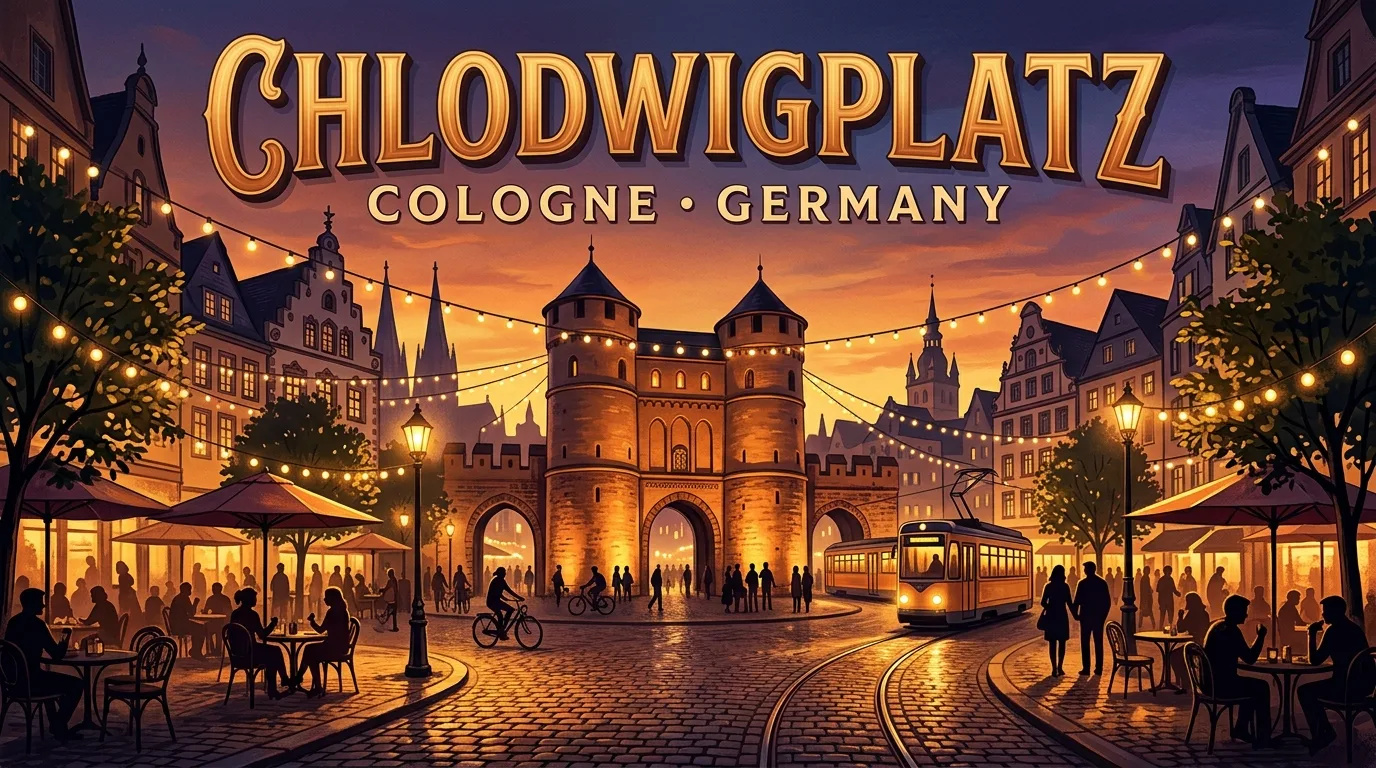
Chlodwigplatz is one of the most distinctive junctions along Cologne's southern ring road and, at the same time, serves as the lively gateway to the Südstadt district. Designed as a large roundabout, it links the inner ring boulevard with the historic Severinstraße and has been a central hub of Cologne city life for well over a century. Visitors walking from the old town through the medieval Severinstor gate find themselves almost immediately on Chlodwigplatz - a seamless transition between the once-walled core of the city and the lively Severinsviertel neighborhood. The square is far more than a traffic feature: it is the traditional starting point of Cologne's Rosenmontagszug carnival parade and, in 1992, was the stage for one of the largest political rallies in the city's post-war history. This combination of infrastructure, history, and living local culture makes Chlodwigplatz a place where the character of Cologne's Südstadt can be experienced in a particularly authentic way.
History of Chlodwigplatz
The square received its name on December 20, 1883, as part of the large-scale development of Cologne's ring boulevards that began in the 1880s after the medieval city fortifications were demolished. City planners chose to name the new square after Chlodwig I (Clovis I), the first Merovingian king documented in connection with Cologne, who decisively shaped the Frankish kingdom in the 5th century. This places Chlodwigplatz among those ring squares in Cologne whose names deliberately reference historical rulers and important eras of the city's past. The square was created at a strategically important point: precisely where the old southbound road, Severinstraße, meets the newly created ring boulevard. The Severinstor, one of the few medieval city gates still standing in Cologne today, still visibly marks this transition and recalls the era when the city boundary ran through exactly this spot. Over the course of the 20th century, Chlodwigplatz increasingly developed into a major transport hub, with several tram and bus lines routed through it, later complemented by the north-south light rail axis. The square gained particular historical significance on November 9, 1992, when it became the stage for the legendary concert "Arsch huh, Zäng ussenander" - a large-scale event initiated by Cologne musicians and cultural figures to protest xenophobia and right-wing violence, which drew several hundred thousand people and received attention far beyond Cologne. This event firmly cemented Chlodwigplatz as a symbolic site of democratic civic engagement in the city's collective memory.
Highlights of Chlodwigplatz
The most striking feature of Chlodwigplatz is its function as a large, landscaped roundabout framed by historicist Gründerzeit buildings with tall facades, bay windows, and ornate stucco decoration - an impressive example of the generous ring-road development of the 1880s and 1890s. Directly adjoining the square rises the Severinstor, whose defensive towers and steep roof create an appealing contrast to the surrounding residential and commercial buildings and regularly provide visitors with a memorable photo opportunity. From the square, the view opens onto Severinstraße, one of the most traditional shopping and strolling streets in the Südstadt, lined with owner-run shops, cafés, and the unmistakable local flavor of the "Vringsveedel," as Cologne locals affectionately call the Severinsviertel. For carnival enthusiasts, Chlodwigplatz is a must-visit: every year on Rosenmontag, the great Rosenmontagszug parade sets off from here, one of the largest carnival processions in Europe, featuring elaborately decorated floats, marching bands, and costumed groups parading through the city center. Even outside carnival season, the square remains a popular meeting point for the neighborhood, surrounded by traditional pubs and brewhouses where genuine Kölsch conviviality can be experienced firsthand. The square's close proximity to the Rhine, the Ulrepforte, and the Vorgebirgspark also makes Chlodwigplatz an ideal starting point for walks through the green and historic corners of the Südstadt. Visitors with an interest in architecture particularly appreciate the variety of building styles along the ring, ranging from stern Wilhelmine grandeur to playful Art Nouveau details, offering a vivid impression of Cologne's growth following the city's expansion.
Opening Hours, Tickets & How to Get to Chlodwigplatz
As Chlodwigplatz is a public city square and transport junction, it is freely accessible around the clock, every day of the year - there are no opening hours and no admission fee. A visit is particularly atmospheric on a sunny afternoon, when the bustle around the cafés of Severinstraße is at its liveliest, or of course on Rosenmontag, when the square becomes the starting point of the great parade and is already densely packed early in the morning. Getting there by public transport is remarkably easy: KVB light rail lines as well as several bus routes stop directly at the Chlodwigplatz station, and the journey from Cologne's main train station takes only a few minutes by rail. Drivers should note that, as a large roundabout, the square is part of Cologne's dense ring-road traffic; parking can be found on the surrounding streets of the Südstadt and in nearby multi-story car parks, though extensive traffic and parking restrictions apply during carnival days. Pedestrians can comfortably reach the square via Severinstraße coming from the old town, or along the ring boulevards from the direction of Rudolfplatz and Barbarossaplatz. Cyclists benefit from continuous bike lanes along the Cologne ring, which connect Chlodwigplatz well to the rest of the city's cycling network.
Attractions Near Chlodwigplatz
Right next to the square stands the imposing Severinstor, one of the last surviving city gates of Cologne's medieval fortifications and a favorite photo subject. Just a few minutes' walk away, Severinstraße stretches out with its many shops, cafés, and traditional brewhouses that form the heart of the Severinsviertel. Heading west, visitors reach the Ulrepforte, another remnant of the old city wall, today used by a carnival society and, on sunny days, inviting visitors to linger in its green surroundings. A little further south lies the Vorgebirgspark, a popular green space for relaxation and sport. The Rhine, with its riverside promenades, is also reachable on foot within minutes and offers lovely views of the Rheinauhafen skyline with its distinctive Kranhäuser crane houses. Culture lovers will also enjoy a walk into the nearby old town of Cologne, where Cologne Cathedral lies only about two kilometers away and can be reached easily on foot along the Rhine promenade or by light rail. The Rautenstrauch-Joest-Museum for world cultures and the Käthe Kollwitz Museum are likewise within walking distance, rounding out a visit to the Südstadt with additional cultural highlights.
Where to stay in Cologne, Germany
Compare current hotel prices and find the right place to stay.