Brüsseler Platz
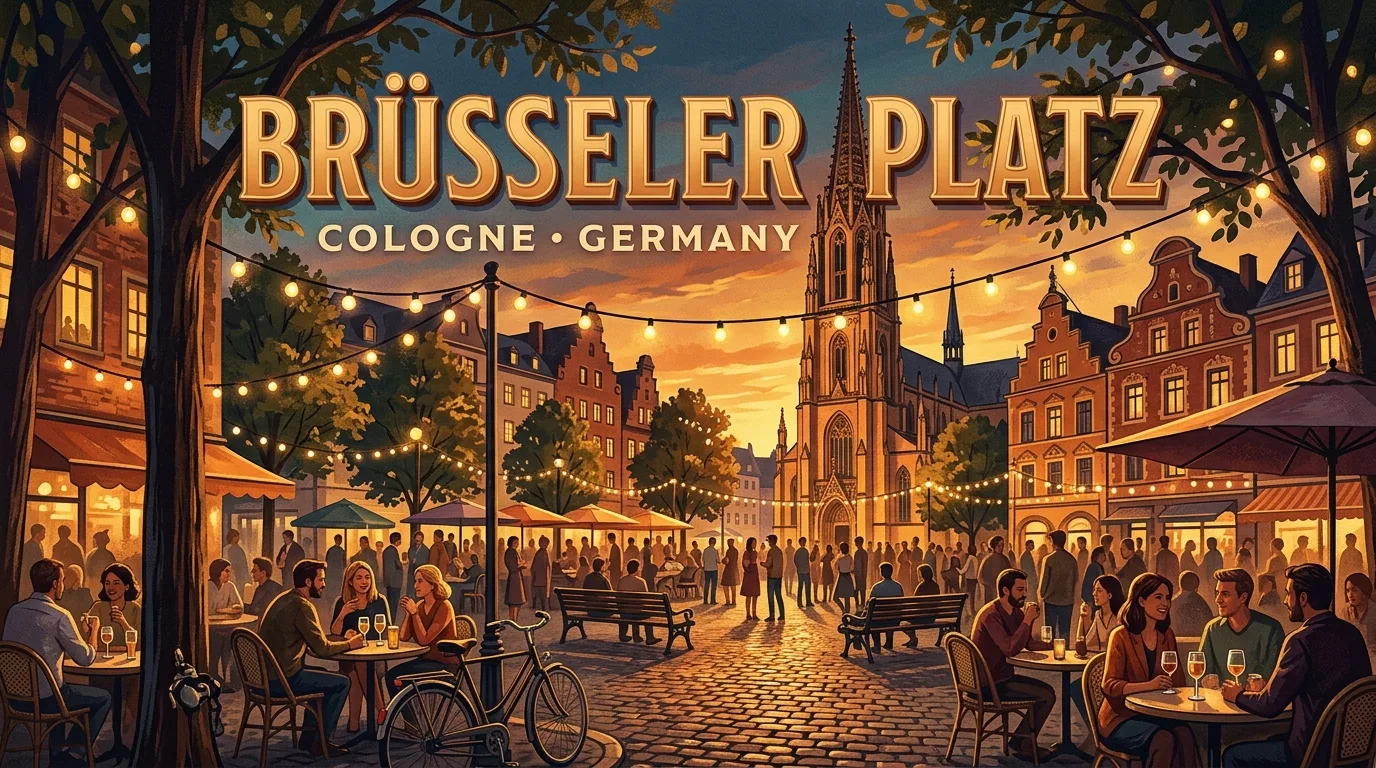
Brüsseler Platz is considered the beating heart of the Belgisches Viertel, one of Cologne's trendiest neighborhoods, which owes its name to the practice of naming its streets and squares after Belgian cities. Framed by the striking neo-Romanesque church of St. Michael and lined with plane trees, the square has evolved over the past two decades from a quiet churchyard into one of the liveliest meeting points in the entire city. During the day, cafés with outdoor seating, small boutiques, and urban flair dominate the scene, while in the evening, especially on warm weekends, the square turns into a densely packed open-air living room for Cologne residents of all generations. For visitors wanting to experience the modern, hip side of Cologne beyond the classic sights, Brüsseler Platz is a must-see that combines architectural history, everyday culture, and big-city flair in a tight space. The adjoining streets, such as Brabanter Straße and Aachener Straße, add further bars, delicatessens, and street-food spots to the picture, so that the entire surrounding area has long since merged into one continuous nightlife district.
History of Brüsseler Platz
The history of Brüsseler Platz begins after 1881, when Cologne's medieval city fortifications were torn down and the influential urban planner Hermann Josef Stübben designed a generous new extension district that became known as the Neustadt. As part of this development, the Archdiocese of Cologne acquired a plot of land in the newly laid-out Belgisches Viertel in 1889 to build a parish church there. A provisional brick building was consecrated as early as September 29, 1894, intended to meet the rapidly growing needs of the young parish. As the congregation continued to expand quickly, the significantly larger, neo-Romanesque church of St. Michael was built between 1902 and 1906 according to plans by architect Eduard Endler, and it remains to this day the architectural and spatial centerpiece of the square, ranking as the third-largest church in the city after Cologne Cathedral and St. Agnes. During the Second World War, the church suffered considerable damage in bombing raids in 1944 but was rebuilt by 1956. In 1995, it received a new organ with 2,300 pipes, still used for concerts today. Alongside the church's development, the surrounding Belgisches Viertel transformed from the 1990s onward into a favored residential and nightlife district for young people in Cologne, which gradually turned the once quiet churchyard into the social hub of the entire quarter. This development mirrored the broader structural change of the Neustadt itself, which evolved from a nineteenth-century residential district into one of the city's most sought-after urban neighborhoods.
Highlights of Brüsseler Platz
The undisputed visual centerpiece of Brüsseler Platz is the church of St. Michael, with its imposing neo-Romanesque facade and striking tower rising well above the rooftops of the Belgisches Viertel. Around the church stretches a square lined with old plane trees, inviting visitors to linger at one of its many café terraces during the day and transforming in the evening into one of Cologne's liveliest nightlife strips, packed tightly with pubs, bars, and small restaurants. On warm summer evenings in particular, young people from across the city gather here, sitting with drinks directly on the church steps or the lawn areas, creating an atmosphere that sometimes feels more like a southern European piazza than a traditional German churchyard. Since 2003, the Querbeet initiative has cared for the green spaces around the square and organized small gardening projects that further enhance its appearance. Numerous owner-run boutiques, galleries, and small theaters have since settled around the square, giving the Belgisches Viertel its reputation as a creative, alternative scene neighborhood. However, the square's growing popularity has also led to tensions: recurring noise complaints from residents since 2008 culminated in a 2023 court ruling requiring stricter conditions for the surrounding gastronomy. Since July 2024, restaurants and bars on the square have been required to close their outdoor areas by 10 p.m. at the latest, which has somewhat dampened the character of the place without diminishing its fundamental appeal as a meeting point.
Opening Hours, Tickets & How to Get to Brüsseler Platz
Brüsseler Platz itself, as a public square, is freely accessible at all times and free of charge, with no fixed opening hours. Since July 2024, however, a binding curfew requiring outdoor areas of surrounding cafés, bars, and restaurants to close by 10 p.m. has been in effect out of consideration for local residents. Visitors wishing to experience the square's atmosphere during the day will find it fairly quiet in the morning and early afternoon, with mostly café and shopping crowds, while it becomes noticeably livelier in the late afternoon and evening, especially on weekends and during the summer months. The church of St. Michael is generally open during regular service times and for quiet visits during the day, though exact hours vary according to the parish calendar. Getting to Brüsseler Platz is straightforward, as the Belgisches Viertel borders directly on Cologne's city center. By public transport, the Moltkestraße or Rudolfplatz light rail stops provide easy access, with the square reachable in about five to ten minutes on foot from either. Walking from Neumarkt takes roughly fifteen minutes through the bustling streets of the city center. The neighborhood is less suited to drivers due to limited parking and numerous one-way streets, so arriving by public transport or bicycle, for which there are plenty of parking options nearby, is recommended.
Attractions Near Brüsseler Platz
The entire Belgisches Viertel surrounding Brüsseler Platz rewards an extended stroll, since the neighboring streets, named after Belgian cities such as Antwerp, Liège, and Brussels, are lined with countless concept stores, vintage shops, and owner-run cafés. Just a few minutes' walk away lies the busy Rudolfplatz with its striking Hahnentorburg, a surviving remnant of the medieval city fortifications. Also nearby is Zülpicher Platz, a popular meeting point for students and an important hub during Cologne's Carnival season. Walking further toward the city center from there takes about twenty minutes to reach Neumarkt and the Hohe Straße shopping street. The Museum of Applied Arts, along with several small galleries and independent cinemas in the vicinity of the Belgisches Viertel, also makes for a worthwhile cultural detour that pairs perfectly with a visit to Brüsseler Platz. Food lovers can also explore the weekly farmers' market held nearby, which showcases regional produce and specialty foods typical of the Rhineland.
Where to stay in Cologne, Germany
Compare current hotel prices and find the right place to stay.