Blücherpark
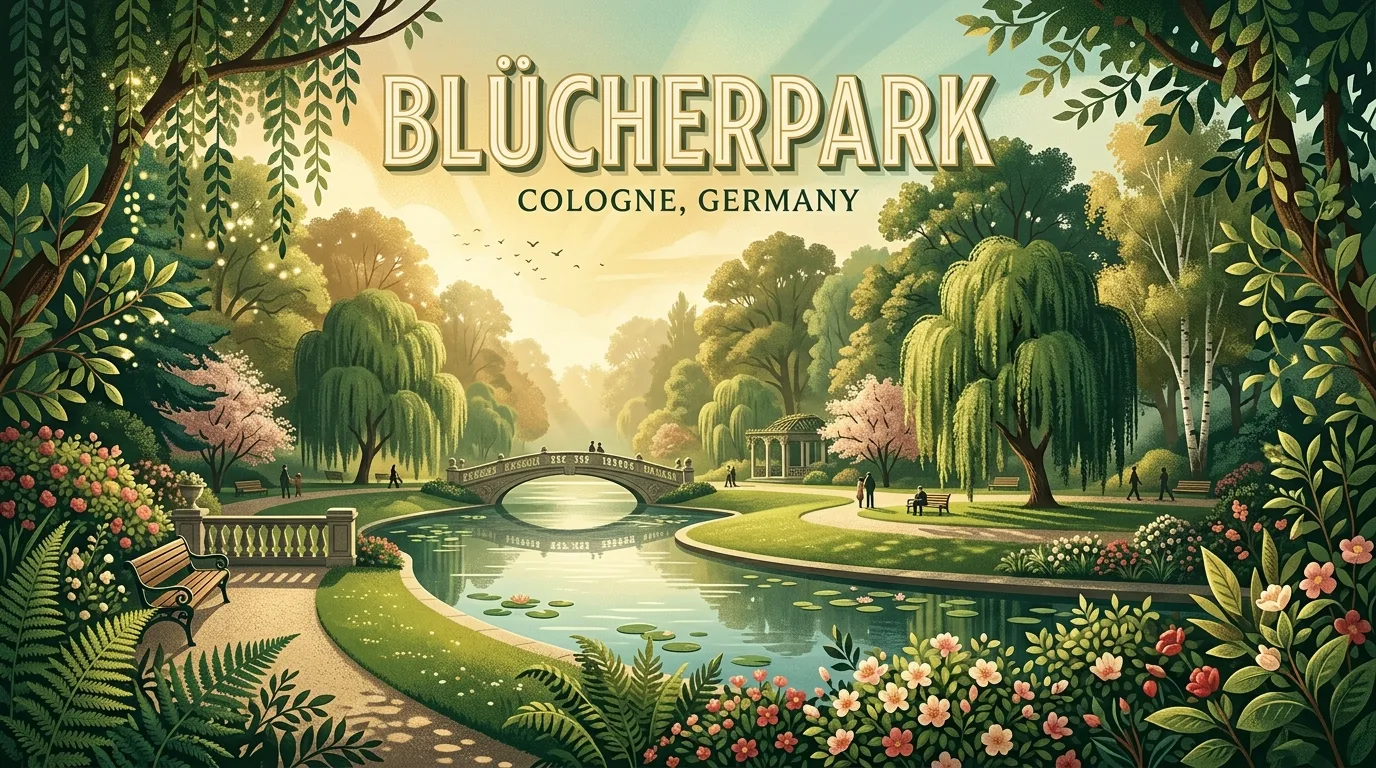
Blücherpark ranks among the most beautiful historic green spaces in northern Cologne and is located in the district of Bilderstöckchen, right on the border of the lively neighborhood of Nippes. Covering roughly 18.4 hectares, it forms an elongated, almost rectangular site measuring about 700 meters in length and 200 meters in width, framed to the south by the Parkgürtel ring road, to the west by the A57 motorway, and to the north and east by residential streets. Anyone strolling along the shaded linden avenues, lingering by the rectangular pond, or picnicking on the broad meadow quickly senses that this is a park which still preserves the strict, almost baroque formal language of its original early-twentieth-century design, created during the Art Nouveau era. Blücherpark is therefore not only a local recreation area for residents but also a remarkable example of early municipal garden art in Cologne, its history closely tied to the city's rapid growth at the turn of the 20th century.
History of Blücherpark
The origins of Blücherpark date back to 1904, when the City of Cologne began searching for suitable land in the rapidly growing northern districts for a new public park. It was not until December 9, 1910, that the city council, under Alderman Matzerath, approved the concrete plans for the new facility, meaning construction itself only took place between 1911 and 1913. The design was entrusted to the renowned garden architect Fritz Encke, who at the time already served as the city's garden director and was responsible for numerous green spaces across Cologne. Although the park was created during the Art Nouveau period, Encke chose a strictly geometric layout for Blücherpark, reminiscent of Baroque garden principles, with clear axes, rectangular water features, and symmetrically arranged paths. He placed great emphasis on practical amenities for the residents of the emerging working-class neighborhood, favoring large open lawns and sports facilities over purely decorative garden art. A representative community building known as the Volkshaus was originally planned as the social centerpiece of the park, though it was never actually built. Administratively, the park's affiliation shifted between different jurisdictions for decades until Cologne's 1975 territorial reform permanently assigned it to the district of Bilderstöckchen within the Nippes borough. In the following decades, the park's layout changed little architecturally, but it was not without technical challenges: over the years, the large pond lost enormous quantities of water through leaks, which eventually made a comprehensive renovation necessary between 2018 and 2020. During this work, the pond bed was completely rebuilt and the water depth increased from the original 1.50 meters to 2.60 meters, in order to stop annual losses estimated at around 30,000 cubic meters of water.
Highlights of Blücherpark
The centerpiece of Blücherpark is its large rectangular pond, covering around 1.5 hectares, where rowing boats can be rented from spring through autumn, departing directly from the boathouse with its attached café and restaurant. Long avenues lined with linden, plane, and chestnut trees surround the water and invite visitors to take extended walks, while two striking stone lion statues guard the western staircases and rank among the park's most popular photo spots. Along the path intersections, elegantly carved concrete spheres provide subtle decorative accents that reinforce the geometric design principles established by Fritz Encke. Families will find a well-equipped children's playground with climbing structures, while sports enthusiasts can take to the football pitch used by the SC Vorwärts Blücherpark club, or simply relax in the sun on the expansive meadow in the southern part of the grounds. In spring, the strictly geometric flower gardens with their small fountains burst into a colorful sea of blossoms, highlighting the historic, almost baroque character of the design in a particularly striking way. Heidemannstraße divides the park into a northern and a southern section, each with its own distinct atmosphere: the northern part is quieter and shaped by mature old trees, while most of the recreational facilities are concentrated in the southern section. Blücherpark is also especially popular with joggers and walkers, who make use of the well-maintained, gravel-bound paths circling the pond and running along the tree-lined avenues for their daily exercise. Throughout the year, the historic tree population reveals a different face, from delicate spring green to vivid autumn color, making the park a favorite destination for photographers and nature lovers alike.
Opening Hours, Tickets & How to Get to Blücherpark
As a public green space maintained by the City of Cologne, Blücherpark is freely accessible around the clock throughout the year, and admission is entirely free of charge. Only the boathouse, with its boat rental and gastronomy, follows seasonal opening hours, typically operating reliably in the afternoon and early evening from spring through autumn whenever weather conditions allow; visitors are advised to call ahead to confirm current hours, since these can vary depending on the operator and the weather. For travel by public transport, tram lines 5 and 13 are the most convenient options, with the Nußbaumerstraße and Escher Straße stops both located just a few minutes' walk from the park's entrances, offering a direct connection to Cologne's city center and the main railway station. By car, the park is easily reached via the Parkgürtel ring road to the south or via the A57 motorway interchange to the west, and free parking spaces can usually be found on the surrounding residential streets, although availability may be limited on sunny days. Cyclists benefit from the park's location along the Parkgürtel, an important north-south axis that links many Cologne districts to the green belt, making Blücherpark comfortably accessible by bicycle from downtown or from the northern districts. Dogs are welcome but should be kept on a leash outside designated off-leash areas, ensuring a smooth coexistence between families, athletes, and other visitors seeking relaxation.
Attractions Near Blücherpark
Just a short tram ride from Blücherpark lies the lively district of Nippes, with its traditional weekly market at Wilhelmplatz and numerous cafés, shops, and restaurants that are perfect for rounding off a visit to the park. Heading north via tram line 13, visitors can quickly reach Weidenpescher Park with its historic horse-racing track, as well as the neighboring Nordpark, another green recreational area in northern Cologne. Continuing toward the Rhine, travelers arrive at Cologne Zoo and the Flora botanical garden in Riehl, among the city's best-known attractions and an excellent complement to a visit to Blücherpark. The expansive Rheinpark along the riverbank is also within easy reach by bus or train from here, offering its open Rhine meadows as an appealing contrast to Blücherpark's geometric formality. For an excursion into the heart of Cologne, including the world-famous Cologne Cathedral, the Hohenzollern Bridge, and the historic old town, visitors typically need only about 15 to 20 minutes by tram from Blücherpark, making the park an ideal starting point for exploring the whole of northern Cologne.
Where to stay in Cologne, Germany
Compare current hotel prices and find the right place to stay.