Aachener Weiher und Hiroshima-Nagasaki-Park
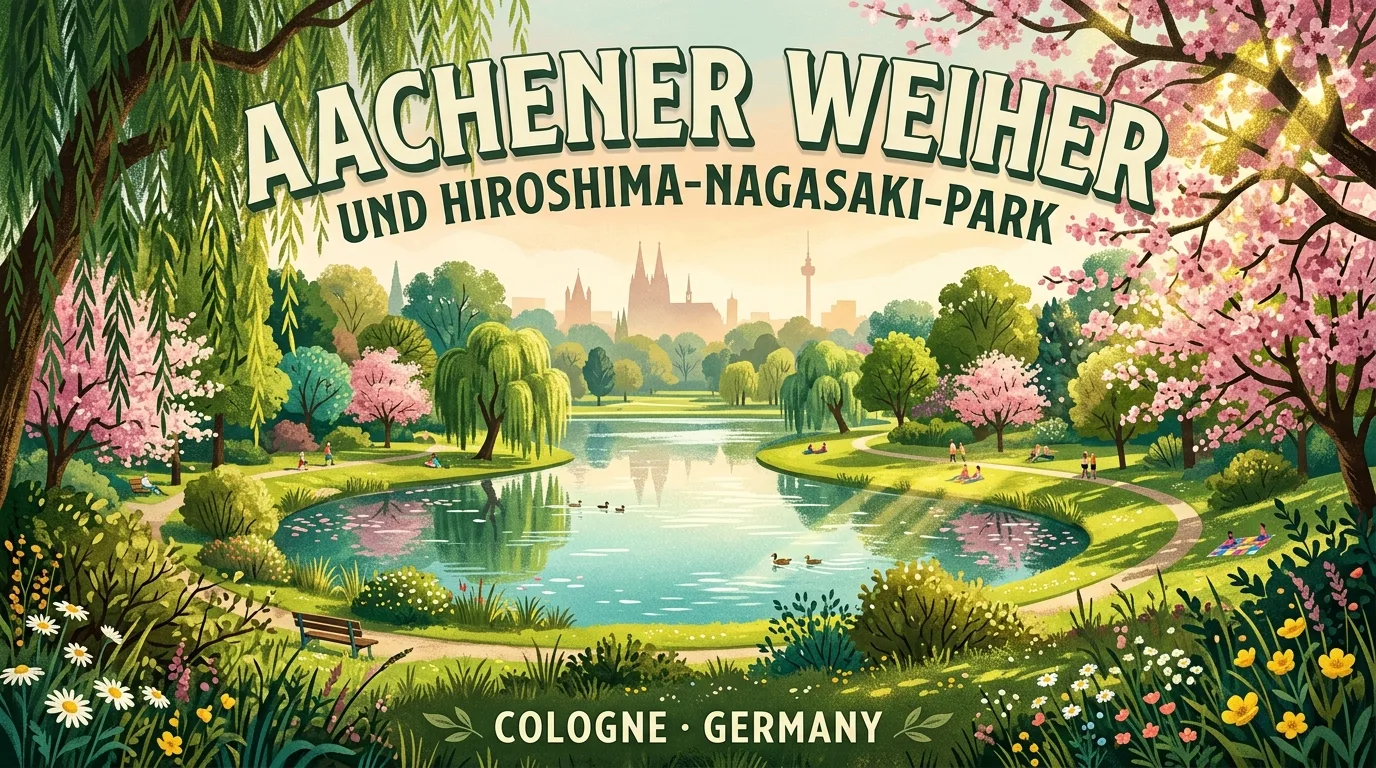
Aachener Weiher und Hiroshima-Nagasaki-Park together form one of the most popular green spaces in Cologne's Neustadt-Süd district, right at the transition to the neighbouring district of Lindenthal. The artificially created, oval-shaped lake has been part of the Inner Green Belt since the 1920s, the ring of parkland laid out on the site of Cologne's former Prussian fortifications surrounding the city centre. Immediately to the south lies Hiroshima-Nagasaki-Park, a deliberately designed memorial landscape that has commemorated the atomic bombings of Hiroshima and Nagasaki since 2004 and serves as a reminder against war and nuclear armament. By day, the shores of the lake fill with joggers, walkers, barbecue groups and slackliners, while the adjoining park invites quieter contemplation and reflection. This combination of recreational space and memorial site makes the area one of the most layered green spaces in the city.
History of Aachener Weiher und Hiroshima-Nagasaki-Park
Aachener Weiher was created in the early 1920s as part of the general development plan for Cologne drawn up by urban planner Fritz Schumacher, which envisaged transforming the city's former Prussian fortifications into a continuous inner green belt. On the initiative of the then mayor of Cologne, Konrad Adenauer, the city commissioned its garden director, Fritz Encke, to design the artificial lake, which was laid out at the junction of the historic Aachener Straße, an old Roman road, and Universitätsstraße. With a surface area of roughly 40,000 square metres and a sealed concrete bottom that prevents the water from seeping away, the lake remains one of the largest artificial bodies of still water within Cologne's inner city. Two fountains were installed to improve the water's oxygen levels, since water quality, particularly during the hot summer months, has remained an ongoing challenge.
The adjoining Hiroshima-Nagasaki-Park to the south has a completely different, and much more recent, history. During the Nazi era the site served as a so-called Maifeld, a ground for mass rallies; after the Second World War, rubble from the bombed-out city was piled up here, creating an artificial hill still known colloquially in Cologne as "Mont Klamott." Cologne has been a member of the international Mayors for Peace alliance together with Hiroshima and Nagasaki since 1985, and in 2000 the Cologne Peace Forum initiated the idea of creating a dedicated memorial park on the site. On 7 August 2004 the park was formally inaugurated by Mayor Renate Canisius in the presence of the Japanese consul general and Kazuo Soda, a survivor of the Nagasaki bombing, giving the area its own name for the first time after previously being designated simply as "green space at Aachener Weiher."
Highlights of Aachener Weiher und Hiroshima-Nagasaki-Park
Aachener Weiher itself is a lively meeting point throughout the year: on the broad lawns surrounding the water, groups barbecue on warm summer evenings, slackliners stretch their lines between the old trees, and joggers do their laps along the lakeside path. On the northern shore stands the popular Aachener Biergarten, with room for up to 900 guests, whose covered section with around 150 seats remains open year-round, offering a direct view over the water even outside the warmer months. Open-air concerts and smaller events regularly take place on the surrounding meadows, making the lake one of the most heavily used recreational spaces in Cologne's green belt.
Hiroshima-Nagasaki-Park, by contrast, relies on quiet symbolism rather than bustle. Its central element is the memorial "Abolish Nuclear Weapons," unveiled in 2007 and created by artist Hannes Helmke, which takes the shape of a paper crane, referencing the Japanese legend of Sadako Sasaki and her thousand folded paper cranes. Three symbolic trees were planted around the memorial: a ginkgo for Hiroshima, a cherry tree for Nagasaki, and a black poplar for Cologne itself, together representing the peace-themed partnership between the cities. Not far away stands the 1966 sculpture "Uralte Form" by Hungarian sculptor Lajos Barta, an abstract work that was placed here long before the park's official renaming. The artificially piled hill of the former "Mont Klamott" still shapes the park's topography today, offering a slightly elevated view over the treetops of the green belt. A children's playground rounds out the offering for families, while the nearby Museum für Ostasiatische Kunst, with its Japanese garden, provides a fitting cultural link to the memorial park's East Asian connection.
Opening Hours, Tickets & How to Get to Aachener Weiher und Hiroshima-Nagasaki-Park
Both Aachener Weiher and Hiroshima-Nagasaki-Park are public green spaces owned by the City of Cologne, freely accessible year-round and around the clock, with no admission charge for either area. The paths around the lake are lit and remain walkable in the evening, while the quieter memorial park is naturally visited mainly during the day. The adjoining Aachener Biergarten has its own seasonal opening hours, though its covered indoor section is also regularly open through the winter, making a visit for a drink by the water worthwhile outside the summer season too. Since both are freely accessible municipal parks, it is worth checking announcements from the City of Cologne or the relevant organiser for current event dates or any temporary restrictions, for instance during larger open-air concerts.
Getting to Aachener Weiher is straightforward thanks to its central location within the Inner Green Belt. Several Cologne light-rail lines stop within walking distance on Aachener Straße and Universitätsstraße, putting the site within a few minutes of the city centre, and numerous bus routes also run along the surrounding main roads. By bicycle, the lake is easily reached via the green belt's network of paths, which stretch from Lindenthal into the Südstadt. Visitors arriving by car will find on-street parking in the surrounding residential streets of Neustadt-Süd and Lindenthal, though demand can be high, particularly at weekends and in good weather, since the area is very popular with locals.
Attractions Near Aachener Weiher und Hiroshima-Nagasaki-Park
Right next door is the Museum für Ostasiatische Kunst, whose significant collection of Chinese, Japanese and Korean art, together with its own Japanese garden and café, provides a fitting cultural counterpart to the memorial idea behind Hiroshima-Nagasaki-Park. Also nearby is the Japanisches Kulturinstitut, which regularly hosts exhibitions, lectures and language courses centred on Japanese culture. Visitors wishing to explore more of the green belt can walk south towards the Südstadt to Volksgarten, with its historic pond and bridges, or head north towards Lindenthal and the Cologne Stadtwald, with its sports facilities and wildlife enclosures. The University of Cologne, with its distinctive main building, is also just a short walk away, bringing lively student life to the immediate surroundings. Cologne's city centre, with its cathedral and well-known shopping streets, is reachable from here by light rail within a few minutes, making it easy to combine a visit to the lake and memorial park with a stroll through the city.
Where to stay in Cologne, Germany
Compare current hotel prices and find the right place to stay.