Landtag Nordrhein-Westfalen
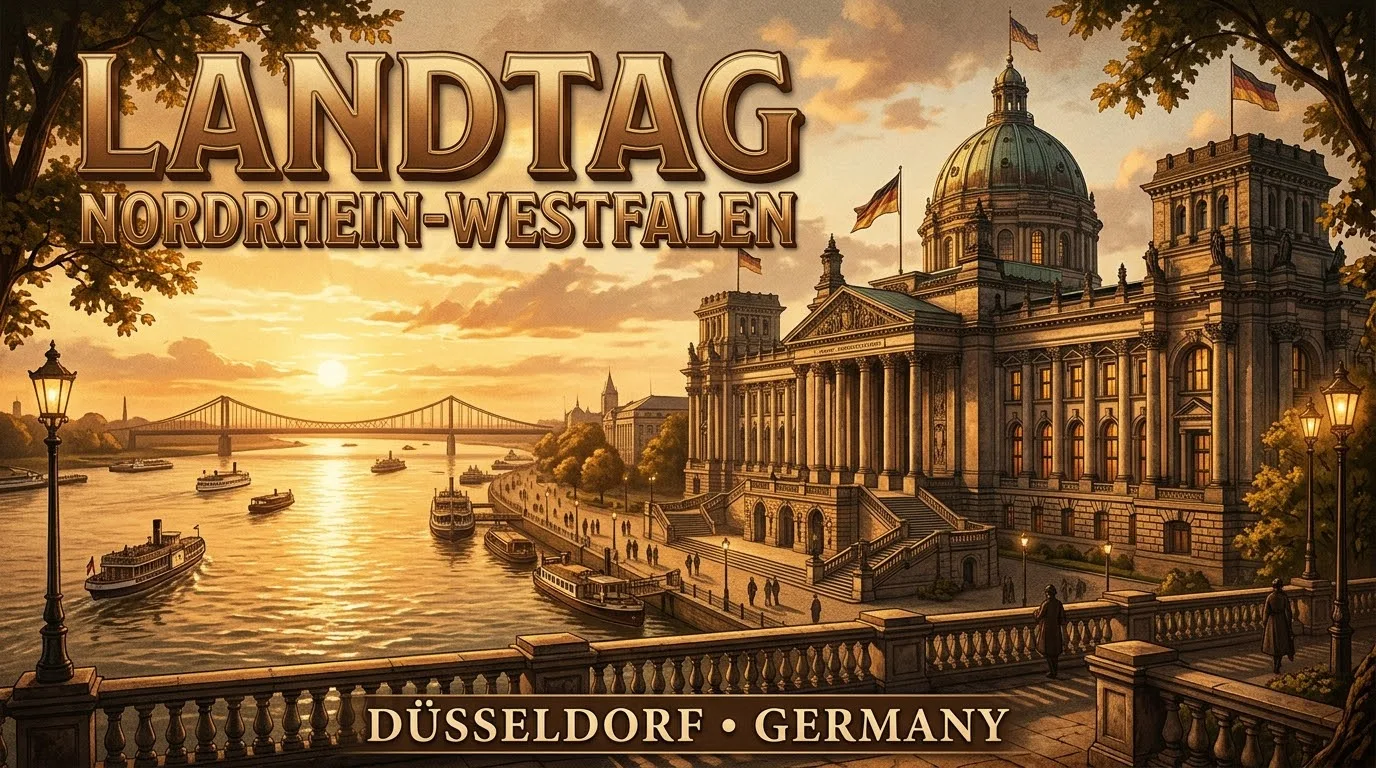
Directly on the banks of the Rhine, exactly where Düsseldorf's historic harbor landscape transitions into the modern Medienhafen district, stands the Landtag Nordrhein-Westfalen, the seat of parliament for Germany's most populous federal state. Completed in 1988, the building ranks among the most distinctive examples of modern parliamentary architecture in Germany, immediately recognizable for its unusual circular structure. Unlike many classicist state parliament buildings elsewhere in Germany, the Düsseldorf Landtag deliberately emphasizes transparency, open sightlines and a close relationship with the surrounding Rhine landscape. For visitors to Düsseldorf, the building is fascinating not only politically but also architecturally and urbanistically, since it marks the transition from the traditional harbor architecture of old Düsseldorf to the spectacular skyline of the Medienhafen, with its buildings by internationally renowned architects.
History of Landtag Nordrhein-Westfalen
Following the founding of the state of North Rhine-Westphalia in 1946, its newly formed parliament initially had to convene in makeshift locations, including an opera house and factory halls belonging to the Henkel company, before the historic Ständehaus in the Unterbilk district served as its seat from 1949 to 1988. The Ständehaus, a building dating from the Prussian era, was over time increasingly seen as too small and functionally inadequate for the growing responsibilities of a modern state parliament. In the 1980s, officials therefore decided on an entirely new building at a symbolically significant site directly on the Rhine, in the eastern part of what was then the harbor district. The architectural firm Eller, Moser, Walter und Partner was commissioned with the design, and the team developed a concept that deliberately broke with the tradition of massive, closed-off parliamentary buildings. Instead of a monumental facade, the building consists of six semicircular wings arranged like petals around a central, circular plenary chamber. This radial layout was intended to architecturally express the democratic ideals of openness, equality and transparency, a conscious counterpoint to the authoritarian representational buildings of earlier eras. Construction began in the early 1980s, and in 1988 the new Landtag building was ceremonially inaugurated. It has served continuously ever since as the seat of the North Rhine-Westphalian parliament, where elected representatives decide on legislation, the state budget and numerous fundamental political questions affecting Germany's most populous federal state. In the decades that followed, the modern Medienhafen district grew up around the Landtag building, featuring spectacular structures including works by Frank Gehry, so that the parliament building now sits in the middle of one of Düsseldorf's most architecturally interesting neighborhoods while itself being regarded as one of the older, style-defining buildings of that district.
Highlights of Landtag Nordrhein-Westfalen
The central architectural highlight of the Landtag is undoubtedly its circular plenary chamber, enclosed by a ring of surrounding rooms and flooded with natural light through large glass surfaces. The circular arrangement of the members' seats symbolizes the equal standing of all parliamentary groups and creates an atmosphere quite different from the traditional, frontally oriented chambers of older parliament buildings. From the outside, the building impresses with its clear, almost sculptural form: the six semicircular wings, housing offices, committee rooms and meeting halls, are arranged harmoniously around the central circular volume, forming a fascinating geometric pattern when seen from above, something that can be appreciated well from the opposite bank of the Rhine or from one of the river's excursion boats. The facade, combining light-colored sandstone with extensive glazing, reinforces the impression of openness and lightness, creating an appealing contrast with the postmodern and deconstructivist buildings of the neighboring Medienhafen. The view from the riverside is particularly striking, where the building's calm, horizontal lines are mirrored directly in the water. Inside, where accessible during guided tours, it is worth taking time to admire the spacious foyers and corridors, which regularly display artworks by contemporary artists engaging with themes of democracy, history and the North Rhine-Westphalia region. The immediate surroundings of the Landtag are also among the highlights of any visit: the riverside promenade in front of the building offers an excellent view of the Rheinturm tower, the Gehry buildings of the Medienhafen and passing river traffic, making a walk around the parliament building an ideal way to combine architecture with an exploration of the entire harbor district.
Opening Hours, Tickets & How to Get to Landtag Nordrhein-Westfalen
The Landtag Nordrhein-Westfalen is first and foremost a working parliament rather than a museum, though it regularly offers interested citizens the chance to get to know the building through free guided tours and information sessions. The parliament's visitor service organizes group tours through the building, which typically include the plenary chamber, the corridors and selected meeting rooms, as well as the opportunity to watch elected representatives at work live from the public gallery during open plenary sessions. Since both guided tours and access to the public gallery depend on fixed schedules, the parliament's sitting calendar and security checks, it is strongly advisable to register for a visit in advance through the Landtag's official website or by contacting the visitor service directly, and to check current information regarding dates and any closures. The exterior grounds and the riverside promenade in front of the building, by contrast, can be visited freely at any time without registration, making the building an interesting stop even on a spontaneous walk through the Medienhafen. The Landtag is well served by public transportation, with several bus and light-rail lines stopping near the Stadttor area or the Landtag/Kniebrücke stop, from where the building is only a short walk away. Visitors arriving by car will find several paid parking options in the vicinity of the Medienhafen, particularly in the parking garages around the Stadttor complex. From Düsseldorf's Altstadt, the Landtag can also comfortably be reached on foot along the Rhine promenade, a walk that simultaneously offers one of the best views of the Medienhafen skyline.
Attractions Near Landtag Nordrhein-Westfalen
The Landtag's location at the transition between the classic Rhine promenade and the modern Medienhafen makes its surroundings one of the architecturally richest areas of Düsseldorf. Just a few steps away stand the famous Gehry buildings of the Medienhafen, with their organically curved, undulating facades that rank among the most photographed modern buildings in the city. Also within walking distance is the Rheinturm, Düsseldorf's iconic landmark tower with an observation deck offering a panoramic view over the entire city and the course of the Rhine. Along the Medienhafen, numerous restaurants, bars and lounges overlooking the water invite visitors to linger, especially in the evening, when the illuminated facades of the surrounding office buildings create a particularly striking atmosphere. Following the Rhine promenade northward leads, after a pleasant walk, to the historic Altstadt with its Rathaus, the Basilica of St. Lambertus and numerous traditional breweries. The Schifffahrtsmuseum housed in the Schlossturm, as well as docks for Rhine river cruises, from which the Landtag building can be especially well admired from the water, are also within comfortable walking distance, making it easy to combine a visit to the Landtag with a broader exploration of Düsseldorf's riverfront.
Where to stay in Dusseldorf, Germany
Compare current hotel prices and find the right place to stay.