Flinger Straße
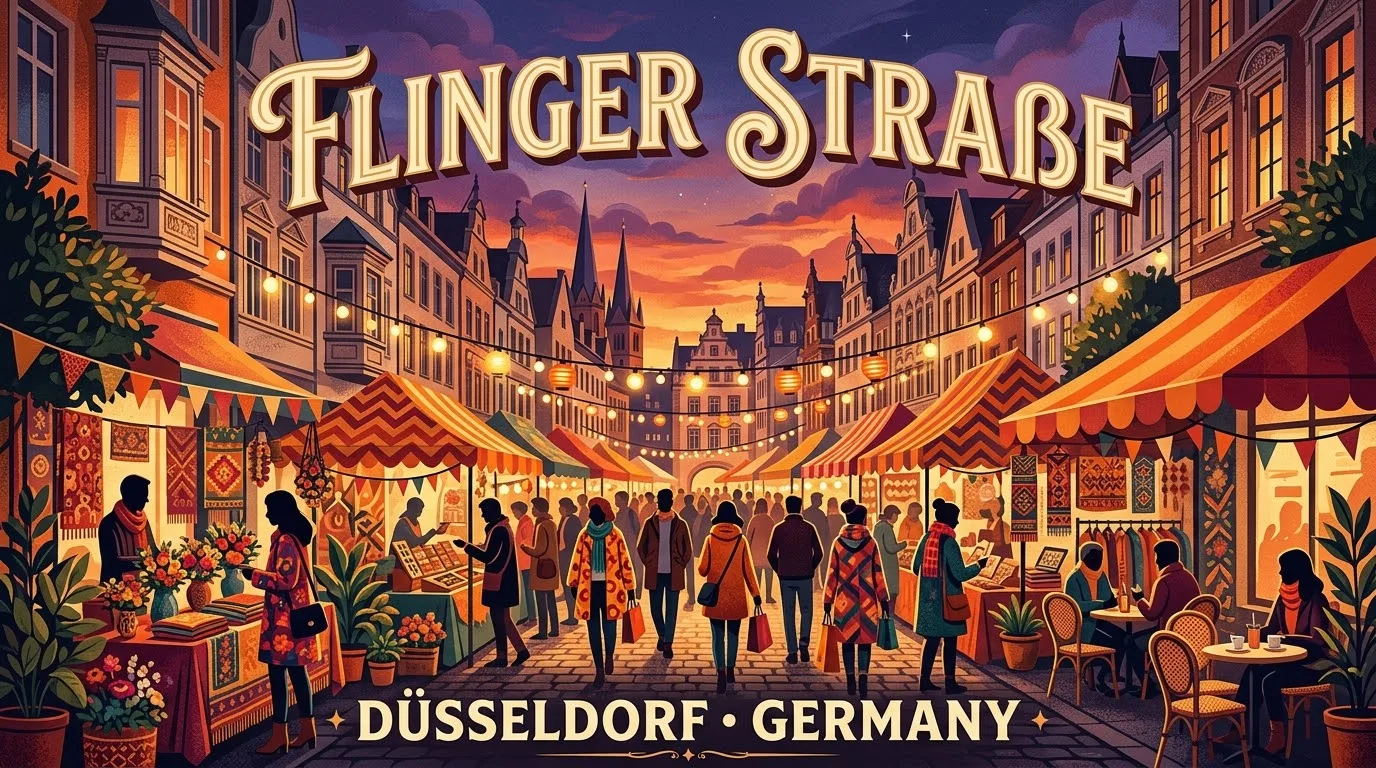
Flinger Straße is one of the busiest pedestrian zones in Düsseldorf's Old Town and, at the same time, one of the oldest streets in the city. Running for roughly 300 metres, it connects Heinrich-Heine-Allee with Markstraße and Bergerstraße, forming a central north-south axis right through the historic core. Modern fashion chains, shoe shops and drugstores line up here side by side with long-established Düsseldorf institutions, so that shopping and city history collide within a very small space. With an estimated 12,000 pedestrians passing through per hour at peak times, Flinger Straße ranks among the busiest shopping streets in Germany, making it a must for anyone wanting to combine a classic shopping stroll with a walk through the Old Town. Unlike the elegant but more reserved Königsallee, Flinger Straße feels livelier, denser and more down-to-earth, shaped by younger shoppers, snack stands and the typical buzz of the Altstadt that has earned Düsseldorf its nickname as the "longest bar in the world." It is precisely this mix of shopping, gastronomy and centuries-old city history that makes Flinger Straße one of the most authentic places to experience Düsseldorf beyond its polished facades.
History of Flinger Straße
The roots of Flinger Straße reach back to 1384, when Düsseldorf was replanned during its first major urban expansion. The street originally ran from the so-called Rhine Gate by the river to the Flinger Gate, one of the city's historic gates, from where the road toward the then-village of Flingern began, giving the street its name to this day. For centuries, Flinger Straße was one of the most important connecting routes through the Old Town, serving both trade and the everyday life of citizens who settled along the narrow lanes in craftsmen's and merchants' houses. In the late 19th century the street additionally gained political significance, hosting important gatherings of the rising social-democratic movement, which found ever more followers in the rapidly growing industrial city of Düsseldorf. The Second World War left deep scars on Flinger Straße as well: large parts of the historic buildings were destroyed by bombing raids and had to be rebuilt in the post-war years, either faithfully restored or in a contemporary style. Despite this destruction, several remarkable historic buildings survived or were reconstructed, including the so-called Haus Goldener Helm at number 1 and the Haus zum Kurfürsten at number 36, both originally dating from the 17th and 18th centuries. Over the course of the 20th century, Flinger Straße gradually lost its role as an important through-traffic route, but gained considerably in importance as a lively, densely frequented urban gathering place once the pedestrian zone was established.
Highlights of Flinger Straße
The appeal of Flinger Straße comes from the lively contrast between international retail and long-established Düsseldorf institutions. Numerous well-known fashion and textile chains have settled here, deliberately targeting a young, spending-ready audience, which makes the street a popular destination for a spontaneous shopping trip. At the same time, a handful of traditional addresses have held their ground amid this modern retail landscape, offering a genuine taste of local Düsseldorf culture: the venerable Uerige brewpub, whose spicy top-fermented Altbier is famous well beyond the city limits, draws locals and tourists alike and creates a lively atmosphere, especially in the evening. Just a few steps away, a traditional shop selling the famous Düsseldorf herbal liqueur Killepitsch invites visitors to taste and take home a genuine piece of local drinking culture. Architecturally, it is worth looking up at the surviving historic facades such as Haus Goldener Helm and Haus zum Kurfürsten, which preserve a touch of old Düsseldorf amid modern shop windows. Walking along the street, visitors quickly notice its distinctive rhythm: busy shopping activity dominates during the day, while the street gradually transforms into the pulsating nightlife district for which Düsseldorf's Old Town is world-famous as evening falls. The many small side alleys branching off Flinger Straße also invite spontaneous detours to cosy pubs, small boutiques and traditional specialty shops. Souvenir hunters will also find it worthwhile, since among the big fashion chains there are repeatedly small shops offering typical Düsseldorf specialties such as mustard, spiced biscuits or Altbier-related gifts.
Opening Hours, Tickets & How to Get to Flinger Straße
As a public pedestrian zone, Flinger Straße can be visited free of charge at any time; naturally, there is no admission fee for the street itself. The fashion shops and retailers located here generally follow standard German shop-opening hours, typically open Monday to Saturday between around 10 a.m. and 8 p.m., though some shops may close earlier on Saturdays. Restaurants, bars and the Uerige brewpub, on the other hand, stay open considerably longer, serving guests well into the evening and night. On Sundays, most retail shops remain closed in accordance with statutory regulations, while cafés, restaurants and pubs continue to welcome guests. Flinger Straße is centrally located in Düsseldorf's Old Town and is excellently connected by public transport: the nearby Heinrich-Heine-Allee underground and light-rail station is served by several Rheinbahn lines and lies just a short walk from the street's northern end. From Düsseldorf's main railway station, Flinger Straße is reachable in about ten to fifteen minutes by light rail, or roughly 25 minutes on foot. Drivers will find several parking garages in the surrounding area, since the Old Town itself is kept largely car-free. Those wishing to visit the Rhine promenade can reach it from Flinger Straße in just a few minutes' walk heading west.
Attractions Near Flinger Straße
The central location of Flinger Straße in the heart of the Old Town makes it an ideal starting point for an extended city walk. A few minutes' walk to the west lies the picturesque Rhine promenade, with views over the river and the distinctive Rheinturm tower, perfect for an unwinding stroll after shopping. Nearby stands the historic market square with Düsseldorf's town hall and the famous equestrian monument of Elector Jan Wellem, one of the most photographed sights in the city. The lively Bolkerstraße, lined with traditional brewery pubs, and the birthplace of the poet Heinrich Heine are also just a few steps from Flinger Straße. Anyone seeking more contemporary shopping afterward will find the Königsallee and the Kö-Bogen, among Germany's best-known shopping destinations, within easy walking distance, making it simple to split a day between the historic Old Town and contemporary big-city flair. The church of St. Lambertus with its characteristically twisted spire and the nearby Schlossturm museum directly on the Rhine bank can also easily be woven into a walk from Flinger Straße, allowing history, shopping and river views to be comfortably combined in a single afternoon.
Where to stay in Dusseldorf, Germany
Compare current hotel prices and find the right place to stay.