Museum Koenig
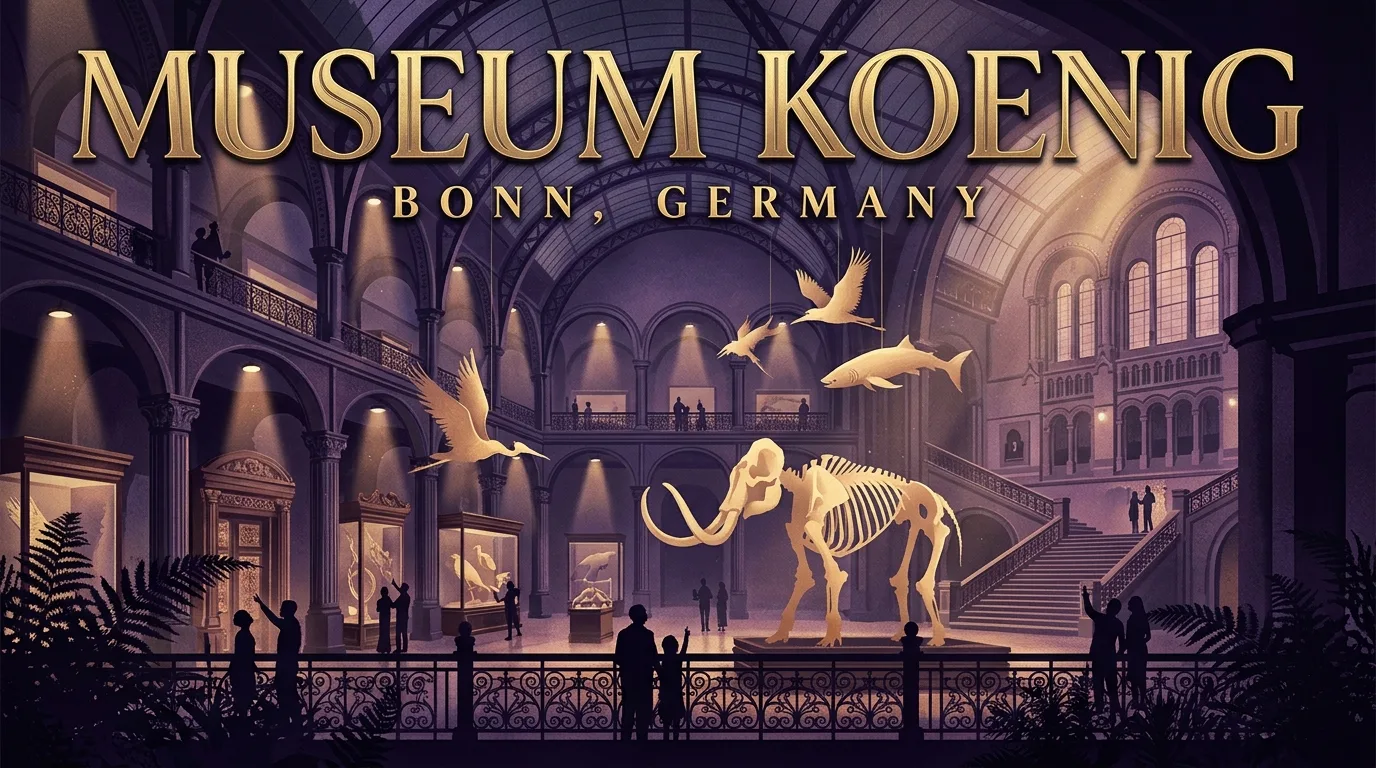
Museum Koenig in Bonn is one of Germany's most interesting natural history museums and an excellent destination for visitors interested in wildlife, biodiversity, ecology and scientific research. Located at Adenauerallee 160 in the former government district of Bonn, the museum combines historic collections with modern educational exhibitions. Its main attraction is the permanent exhibition “Our Blue Planet – The Living Network”, which takes visitors through some of the most important ecosystems on Earth. Visitors can explore an African savannah, discover the extraordinary biodiversity of a tropical rainforest, learn about wildlife in the Arctic and Antarctic, and investigate how plants and animals survive in extreme desert environments. The museum also presents the natural habitats of Central Europe and the fascinating ecosystems of rivers and freshwater environments. Its realistic habitat displays and historic dioramas are particularly impressive and provide a memorable experience for adults and children alike. Museum Koenig is more than a conventional natural history museum: it is also part of a major scientific institution dedicated to understanding biodiversity and the environmental changes affecting the planet. The building itself has an important place in German history. On 1 September 1948, the opening session of the Parliamentary Council took place in its main hall. This council subsequently prepared the Basic Law of the Federal Republic of Germany. As a result, a visit to Museum Koenig combines natural history, scientific discovery and an important chapter in the history of German democracy.
History of Museum Koenig
The story of Museum Koenig is closely associated with the life and scientific work of Alexander Koenig, a German zoologist and natural history collector. Born in 1858, Koenig developed a strong interest in animals during his childhood, particularly birds and mammals. He came from a wealthy family with business connections to the sugar trade in Russia. His family's financial resources enabled him to pursue his scientific interests, build extensive collections and organise research expeditions. Koenig studied zoology at the universities of Greifswald and Marburg and received his doctorate in 1884. His scientific activities and personal collections eventually became the foundation of the museum that bears his name in Bonn.
Koenig's ambition was to establish more than a private collection. He wanted to create an institution where scientific research and public education could take place together. He initially established a private ornithological museum to accommodate his growing collection of birds and other zoological specimens. This early museum building was completed in 1900. It primarily housed his extensive bird collections, which had grown through expeditions, scientific observations, acquisitions and donations. As the collection expanded, Koenig realised that a much larger building would be necessary. He therefore developed plans for a major natural history museum that could accommodate both public exhibitions and scientific research.
A significant milestone occurred on 3 September 1912, when the foundation stone for the main museum building was laid. The project was intended to establish Bonn as an important centre for zoological research and to provide a permanent home for Koenig's growing collections. However, the construction process faced considerable difficulties. When the First World War began in 1914, the unfinished building was requisitioned and used as a military hospital. Political instability and economic problems in the following years, particularly inflation, also affected Koenig's financial position. As a result, the completion of the museum was delayed for many years.
In 1929, Alexander Koenig transferred the museum building and its collections to the Prussian state. This agreement made it possible to secure the future of the institution and continue the construction project. After further organisational and building work, the museum was officially opened on 13 May 1934. Koenig had finally achieved his ambition of establishing a major natural history museum in Bonn. He died in 1940, but his name and scientific legacy remain central to the institution. In the following decades, its collections continued to expand and developed into an internationally recognised resource for zoological research.
The building acquired an additional historical significance after the Second World War. Bonn became the political centre of the newly established Federal Republic, and suitable venues were needed for important national events. The museum's impressive main exhibition hall provided an appropriate meeting place. On 1 September 1948, the opening session of the Parliamentary Council took place inside Museum Koenig. The council was responsible for preparing the Basic Law, which was officially proclaimed on 23 May 1949 and became the constitutional foundation of the Federal Republic of Germany. This event established a lasting connection between the museum and the birth of modern German democracy. The building was also used for political and administrative purposes during the early years of the Federal Republic. Konrad Adenauer, Germany's first post-war Federal Chancellor, temporarily used rooms in the building for official work.
Over the following decades, Museum Koenig developed from a private natural history collection into an important public research and educational institution. Historic sections of the building were preserved and modernised. The main museum building reopened in 2003 following extensive renovation work. A newer building, the Clas M. Naumann-Bau, was also constructed behind the historic structure. It accommodates important scientific facilities, including collections, laboratories, a library and working areas for researchers. Since July 2021, Museum Koenig Bonn has been part of the Leibniz Institute for the Analysis of Biodiversity Change, which also operates the Museum der Natur Hamburg. Today, research, collection management, education and public exhibitions are closely connected.
Highlights of Museum Koenig
The main attraction at Museum Koenig is the permanent exhibition “Our Blue Planet – The Living Network”. This extensive exhibition introduces visitors to some of the planet's most important ecosystems and explains how animals and other organisms adapt to their natural surroundings. Rather than simply displaying individual animal specimens, the exhibition focuses on the relationships between species, climate, vegetation, food chains and biodiversity. Visitors discover how ecosystems function and why changes to one part of the natural environment can affect many other species. Another important theme is the influence of human activities on the natural world. Through realistic habitat presentations, scientific information and interactive displays, the museum makes complex ecological subjects accessible to different age groups.
One of the most impressive areas is the African savannah. Visitors can walk through a large, carefully designed landscape that recreates important features of this natural habitat. The presentation includes original materials and characteristic vegetation, creating the impression of being inside an African ecosystem. Binoculars and identification guides help visitors examine the displayed animals more closely. The exhibition explains how animals adapt to seasonal changes, why bushfires can play a role in maintaining certain savannah ecosystems and how feeding relationships connect herbivores and predators. This combination of realistic scenery and accessible explanations makes the savannah section particularly interesting for families with children.
The tropical rainforest is another major highlight. This exhibition extends across two floors and introduces visitors to the extraordinary biodiversity of an African lowland rainforest. The experience begins in the undergrowth, where visitors can explore the lower levels of the forest. They can then move upwards through a walk-in tree trunk to discover the canopy. This arrangement demonstrates how dramatically living conditions change between the forest floor and the upper layers of the vegetation. Interactive multimedia stations provide further information about the importance of tropical rainforests for the global climate, the water cycle and biodiversity. The habitat presentation was developed using original material collected during expeditions to rainforest areas in Gabon and Ghana.
The Arctic and Antarctic exhibition provides another fascinating experience. It explores the extreme conditions found in the polar regions and introduces the animals that have adapted to these environments. One of the most impressive exhibits is a minke whale skeleton. Visitors can also discover penguins, Arctic birds and other species associated with polar habitats. A realistic presentation of a polar bear mother and her young illustrates how animals survive in an environment characterised by ice, low temperatures and limited food resources. The exhibition also explains the differences between the Arctic and Antarctic regions, including their geography, ecosystems and wildlife.
The desert section focuses on survival in some of the planet's driest environments. A landscape featuring real Sahara sand recreates the appearance of desert dunes and demonstrates that these apparently harsh habitats support a surprising variety of life. Visitors learn how animals conserve water, cope with high temperatures and survive extended periods without rainfall. Interactive stations explain the adaptations that make life possible in desert environments. The exhibition is particularly useful for understanding why deserts should not simply be regarded as empty or lifeless landscapes.
Another important section focuses on Central Europe. It introduces visitors to familiar and less familiar native animal species and explores habitats such as deciduous forests, meadows, agricultural landscapes and urban environments. The displays also address endangered species and the importance of conservation. Visitors can learn how agriculture, construction, transport and other human activities influence local ecosystems. This section is especially relevant because it connects global biodiversity issues with the natural environment that visitors may encounter in their own everyday lives.
The water exhibition, entitled “Water – Life in Flow”, explores the ecological importance of rivers. Carefully designed aquariums present tropical and Central European river environments and allow visitors to compare their different characteristics. The installation contains more than 16,000 litres of circulating water and provides near-natural habitats for over 60 aquatic animal species. The exhibition explains how water currents, changing water levels, temperature and available food influence the organisms that live in rivers. It also demonstrates how river ecosystems are constantly changing and how their inhabitants adapt to these conditions.
The historic dioramas are among the most distinctive features of Museum Koenig. For the museum's public exhibition, which opened in 1934, Alexander Koenig commissioned a total of nine permanent habitat dioramas. Eight of these displays are still presented in the public exhibition areas and extend across three floors. They depict carefully recreated natural environments, including Central European deciduous forests, coastal landscapes around the North Cape and wetlands in North Africa. Three-dimensional taxidermy specimens are combined with painted backgrounds, creating a convincing illusion of depth and natural scenery. The craftsmanship and historical significance of these dioramas make them an important part of the museum's identity. They are also a fascinating example of how natural history museums presented wildlife before modern digital exhibition technology became widely available.
Beyond its public exhibitions, Museum Koenig is also an active scientific research institution. Its researchers investigate biodiversity and the changes affecting animal and plant populations. The scientific collections provide valuable material for identifying species, studying biological relationships and understanding environmental change. Visitors can discover how modern research methods, including genetic analysis and biodiversity documentation, contribute to conservation efforts. Temporary exhibitions, educational programmes, guided tours and special events provide additional opportunities to explore the natural world. These changing programmes mean that a return visit can offer new subjects and perspectives even for people who have already explored the permanent exhibition.
Opening Hours, Tickets & How to Get to Museum Koenig
Museum Koenig is located at Adenauerallee 160, 53113 Bonn, Germany, in the southern part of the city centre and within the former government district. It is easy to reach by public transport and can also be visited by car. The regular opening hours are Tuesday to Sunday from 10:00 am to 6:00 pm. Wednesday is the exception, with extended opening hours until 9:00 pm. The museum is generally closed on Mondays, although it may open on official public holidays in North Rhine-Westphalia. Regular closing days include Rose Monday, Christmas Eve on 24 December, Christmas Day on 25 December and New Year's Eve on 31 December. Visitors should check the official website for any temporary changes before planning their trip.
Admission is relatively inexpensive compared with many major museums in Germany. A standard day ticket costs €6.00, while the reduced admission price is €3.00. A family ticket costs €15.00, and a mini family ticket is available for €10.00. According to the museum's visitor information, the family ticket is designed for two adults and up to three children aged 14 or younger. The mini family ticket is intended for one adult and up to two children aged 14 or younger. Reduced prices may be available for eligible groups, including children, school pupils, students, senior visitors and other qualifying categories. Since ticket conditions and prices can change, checking the current official admission information before travelling is advisable.
Public transport is one of the easiest ways to reach the museum. The underground and Stadtbahn stop called “Museum Koenig” is located directly outside the building. It is served by lines 16, 63 and 66. Visitors travelling from Bonn Central Station can use one of these lines towards Bad Godesberg or Bad Honnef and get off at the Museum Koenig stop. The walking distance from the station to the museum entrance is very short. This makes the museum particularly convenient for travellers who are exploring Bonn without a car.
Visitors arriving by regional or long-distance train should first travel to Bonn Hauptbahnhof. From there, the Stadtbahn provides a straightforward connection to the museum. Taxis and bicycles are also practical options for reaching the site. The museum's location on Adenauerallee makes it easy to combine a visit with a walk through Bonn's former government district.
For visitors arriving by car, there is a small parking area behind the museum building. However, the number of spaces is limited, and parking can be difficult during weekends and public holidays. Some nearby streets are reserved for residents, so it is important to observe local parking signs. An alternative is to use a parking garage in the area of the Bundeskunsthalle. From there, Museum Koenig can be reached with a walk of approximately ten minutes. Travellers using the A565 motorway can consider the Bonn-Poppelsdorf exit and follow signs towards the Museumsmeile.
Museum Koenig is also a suitable destination for visitors with reduced mobility. Access to the museum and its exhibition areas is largely barrier-free. Facilities are available for visitors with special requirements, and accessible toilets are located on the ground floor. The museum also offers specially adapted guided tours for visitors with visual impairments. Workshops and tours in easy language are available, and sign-language interpretation can be arranged on request. These services make the museum an inclusive destination for a wider range of visitors.
Most visitors should allow approximately two to three hours to explore the permanent exhibition. Families with children and visitors who want to spend time at the interactive stations may prefer to stay longer. Wednesday is particularly convenient for people who want to avoid a rushed visit because of the extended opening hours. Cloakroom facilities and lockers are available on the ground floor. Visitors may consume their own food and drinks in the designated break room, but eating and drinking are not permitted inside the exhibition areas. Photography without flash is generally permitted for private, non-commercial purposes. Current opening times, admission information and educational programmes are available through the official museum website.
Attractions Near Museum Koenig
Museum Koenig is located in an attractive part of Bonn that offers several other cultural and historical attractions. One of the most worthwhile places to visit nearby is Haus der Geschichte. This museum explores German history since 1945, including the development of the Federal Republic, the division of Germany and reunification. The two museums offer very different experiences and can easily be combined during the same day. Museum Koenig focuses on wildlife, biodiversity and natural ecosystems, while Haus der Geschichte provides a detailed introduction to Germany's political and social history.
Another excellent destination is the Bundeskunsthalle, located on Bonn's Museumsmeile. This major exhibition centre hosts changing programmes covering art, culture, history and science. Its exhibitions attract visitors with a wide range of interests and provide a useful addition to a cultural itinerary in Bonn.
The Kunstmuseum Bonn is also worth visiting. Its collection includes important works of German art after 1945, as well as paintings associated with August Macke and Rhenish Expressionism. Visitors interested in modern and contemporary art will find it an interesting contrast to the natural history displays at Museum Koenig.
The surrounding former government district, known as the Bundesviertel, is another attraction in its own right. During Bonn's years as the capital of West Germany, this area was home to important political institutions and government buildings. The Kanzlerbungalow and Villa Hammerschmidt are among the best-known historic sites associated with the former capital. Exploring the district on foot offers a better understanding of Bonn's political importance during the Cold War and the early decades of the Federal Republic.
Visitors who would like to enjoy some time outdoors after their museum visit can walk towards the Rhine or travel to the extensive green spaces of Rheinaue Park. This large urban park features walking paths, lawns, water features and peaceful places to relax. It is particularly suitable for families, cyclists and visitors looking for a break from indoor sightseeing. The Rhine riverfront also provides an enjoyable setting for a leisurely walk.
Bonn's historic city centre is another excellent addition to a sightseeing itinerary. Among its best-known attractions are Beethoven-Haus, the Old Town Hall on the market square and Bonn Minster. The city centre also offers numerous cafés, restaurants and shopping streets. Visitors planning a full day in Bonn can start at Museum Koenig, continue to Haus der Geschichte and the Bundeskunsthalle, and finish with a walk along the Rhine or an exploration of the historic centre. This combination provides an excellent introduction to Bonn as a city of science, culture and German political history.
Where to stay in Bonn, Germany
Compare current hotel prices and find the right place to stay.