Kunstmuseum Bonn
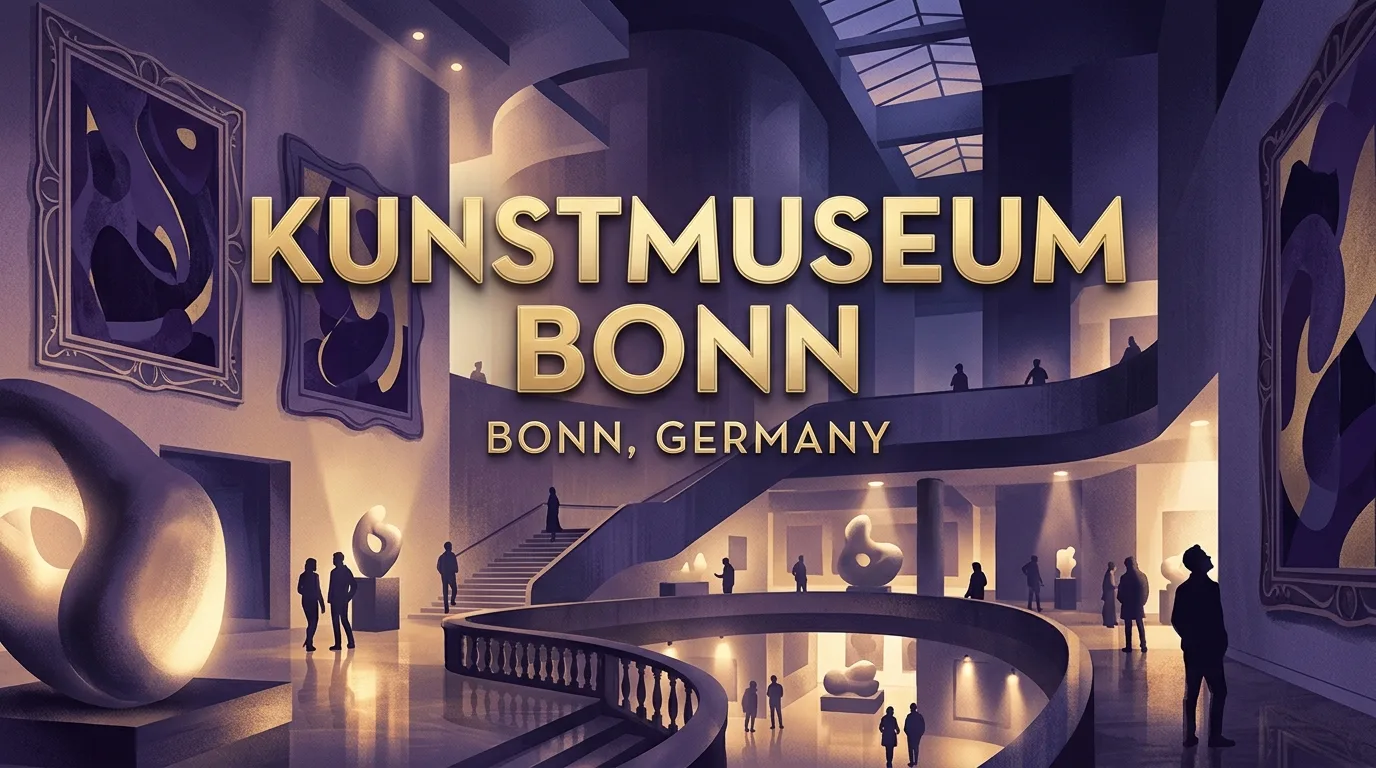
Kunstmuseum Bonn in Bonn, Germany, is one of the leading museums for modern and contemporary art in North Rhine-Westphalia. Situated along the city's famous Museumsmeile, it offers visitors an impressive collection of German art after 1945 as well as important works from classical modernism. The museum is particularly renowned for its paintings by August Macke and its collection of Rhenish Expressionism. Visitors can also discover works by internationally recognised artists such as Joseph Beuys, Georg Baselitz, Anselm Kiefer, Sigmar Polke and Gerhard Richter. The distinctive museum building opened in 1992 and is itself an important example of modern museum architecture in Germany. Its exhibition spaces present painting, photography, sculpture, installations and time-based media. Alongside its permanent collection, the museum regularly organises temporary exhibitions featuring artists and themes from Germany and around the world. Whether you are interested in Expressionism, post-war German art, contemporary artistic experiments or architecture, Kunstmuseum Bonn offers an engaging cultural experience. Its location near several other major museums also makes it easy to include in a full day of sightseeing in Bonn.
History of Kunstmuseum Bonn
The history of Kunstmuseum Bonn dates back to the years following the Second World War. Its institutional origins are connected with an art collection that originally developed from the private Obernier Collection. The museum's development began under director Walter Holzhausen in 1947. During its early years, the institution concentrated on building a collection of regional and German art. Bonn's cultural and political position played an important role in this process. From 1949 until 1990, the city served as the seat of government of the Federal Republic of Germany, creating a distinctive cultural environment in which the museum gradually developed an important national profile.
A decisive moment in the museum's collecting history came in 1949, when it acquired two significant paintings by August Macke: “Turkish Café” and “Tightrope Walker”, both dating from 1914. These early acquisitions became the foundation of one of the museum's most recognisable collection areas. August Macke was closely associated with the Rhineland and is considered one of the leading figures of German Expressionism. His paintings are known for their vibrant colours, simplified forms and sensitive observations of modern everyday life. His work remains central to the artistic identity of the museum.
Over the following decades, the collection continued to expand under successive directors. Walter Holzhausen led the institution from 1947 to 1961, followed by Eberhard Marx between 1962 and 1976. Dierk Stemmler served as director from 1977 to 1985, and Katharina Schmidt took over from 1985 until 1992. During this period, the museum developed into an important centre for twentieth-century art. Alongside Macke, it acquired works by other artists associated with Rhenish Expressionism. The collection of Max Ernst, who was born in nearby Brühl, also became an important part of its artistic profile.
Another major development was the gradual expansion of the museum's artistic focus beyond traditional painting. Until the 1990s, the collection was primarily centred on painting. Later, photography, sculpture, video and other time-based media became increasingly important. This broader approach enabled the museum to represent the changing nature of artistic production during the second half of the twentieth century and into the contemporary period.
The opening of a new museum building was another important milestone. The architectural project was developed by the Berlin-based BJSS team, consisting of Dietrich Bangert, Bernd Jansen, Stefan Scholz and Axel Schultes. Planning began in the mid-1980s, and the new Kunstmuseum Bonn building opened in June 1992. It is regarded as one of Germany's notable museum buildings from this period. Its architectural design combines a distinctive visual identity with exhibition spaces specifically developed for the presentation of art.
Dieter Ronte became director in 1993 and remained in the position until 2008. During his leadership, the museum strengthened its international exhibition programme and broadened its artistic perspective. Stephan Berg succeeded him in 2008 and continued developing the collection and temporary exhibition programme until 2025. Since 2025, Claudia Emmert has served as director. The changes in leadership reflect the museum's continuing ambition to preserve important historical works while responding to new artistic developments.
Today, the collection contains approximately 9,000 works. It brings together classical modernism, Rhenish Expressionism and significant examples of German art created after 1945. This combination gives Kunstmuseum Bonn a distinctive position within Germany's museum landscape. Its regional foundations are closely connected with the Rhineland, while its collection and exhibition programme maintain an international perspective.
Highlights of Kunstmuseum Bonn
One of the main highlights of Kunstmuseum Bonn is its collection of works by August Macke and the Rhenish Expressionists. Macke is among the most recognised artists of German Expressionism. His work is characterised by expressive colours, carefully balanced compositions and an interest in modern urban life. Two particularly important paintings are “Turkish Café” and “Tightrope Walker”, both created in 1914. These works are historically significant parts of the museum's collection and provide insight into Macke's artistic development before his death during the First World War.
The classical modernism collection also includes works by other artists associated with the Rhineland. These include Heinrich Campendonk, Franz Seraph Henseler, Franz M. Jansen, Helmuth Macke, Carlo Mense, Heinrich Nauen, Paul Adolf Seehaus and Hans Thuar. Together, these artists represent an important regional movement within early twentieth-century modern art. Their works demonstrate that the Rhineland developed a distinctive artistic scene alongside the better-known centres of Berlin and Munich.
Works by Max Ernst are another important part of the museum's identity. Born in Brühl near Bonn, Ernst became an internationally influential artist and a major figure in Dadaism and Surrealism. His work connects the artistic history of the Rhineland with broader European and international avant-garde movements. For visitors interested in the development of modern art, this collection provides an opportunity to explore different artistic approaches and historical contexts.
Another major focus is German art after 1945. The collection includes significant works by artists such as Joseph Beuys, Georg Baselitz, Gotthard Graubner, Anselm Kiefer, Imi Knoebel, Palermo, Sigmar Polke, Gerhard Richter and Ulrich Rückriem. The diversity of these artists makes this collection particularly interesting. Some developed new approaches to painting, while others explored conceptual art, sculpture, social questions and experimental materials.
Joseph Beuys is represented through works known as multiples. These pieces illustrate his expanded understanding of art and his belief that artistic expression should not be limited to traditional paintings and sculptures. Gerhard Richter and Sigmar Polke offer different perspectives on the transformation of German painting after the Second World War. Anselm Kiefer's work frequently engages with history, memory and cultural identity. Together, these artists provide an impressive overview of the development of German art during the second half of the twentieth century.
The museum building is another attraction in its own right. Designed by the BJSS architectural team and opened in June 1992, it is characterised by open spaces, carefully controlled natural light and interconnected exhibition areas. Its flowing spatial arrangement creates interesting perspectives and allows artworks to be displayed in generous galleries. Visitors can therefore appreciate not only the art itself but also the architectural environment in which it is presented.
The museum is not limited to traditional painting. Photography, sculpture, installations and video works are also important components of its collection. The presentation of time-based media demonstrates how artistic production has changed since the second half of the twentieth century. Visitors can discover different forms of artistic expression and understand how contemporary artists combine traditional techniques with experimental approaches.
Temporary exhibitions provide further reasons to visit. The museum regularly organises exhibitions devoted to individual artists, historical movements and contemporary cultural questions. Its 2026 programme includes “Aki Inomata. Becoming-With” and “FORCE FIELDS. New Perspectives from the Collection”, alongside the presentation dedicated to August Macke and the Rhenish Expressionists. The exhibition “Herlinde Koelbl. Crosshairs for Life” is also scheduled from November 2026 until May 2027. As exhibition dates and programmes may change, visitors should consult the museum's official calendar before planning their trip.
Education and public engagement are also important parts of the museum's work. Guided tours, workshops and educational programmes introduce different audiences to the collection and its artistic background. These activities make the museum accessible to visitors with varying levels of knowledge and experience. For anyone who wants to understand modern and contemporary art beyond simply looking at individual paintings, Kunstmuseum Bonn offers a particularly rewarding experience.
Opening Hours, Tickets & How to Get to Kunstmuseum Bonn
Kunstmuseum Bonn is located at Helmut-Kohl-Allee 2, 53113 Bonn, Germany, in the Museumsmeile district. Regular opening hours are Tuesday to Sunday from 11:00 a.m. to 6:00 p.m. On Wednesdays, the museum stays open later, from 11:00 a.m. until 7:00 p.m. It is closed on Mondays. Special opening arrangements apply on certain public holidays, while the museum is closed on Christmas Day, Christmas Eve and New Year's Eve. Since opening hours can occasionally change because of public holidays, special events or renovation work, checking the official visitor information before travelling is recommended.
The standard admission price is €10 for adults. Reduced admission costs €5. Children and young people up to and including the age of 18 can enter free of charge. Certain additional visitor groups are also eligible for free or reduced admission, including school groups and some accompanying persons of visitors with disabilities. The museum also offers free admission on the first Sunday of every month. This is particularly useful for families and travellers who want to explore Bonn's cultural attractions on a limited budget.
From 2 to 25 November 2026, reduced admission prices are scheduled because of renovation work. During this period, the standard ticket costs €7 and the reduced ticket costs €3.50. Group ticket prices may also differ. Visitors should check the current ticket information before purchasing their admission.
Public transport is one of the easiest ways to reach the museum. Stadtbahn lines 16, 63, 66, 67 and 68 stop at Heussallee/Museumsmeile. From the station, the museum can be reached with a short walk. Bus lines 610, 611 and 634 also serve the surrounding area. Visitors arriving by regional train can use Bonn UN Campus station, which is served by several regional services, including RE 5, RB 26, RB 30 and RB 48.
Travelling from Bonn Central Station is straightforward. Visitors can take a Stadtbahn towards the Museumsmeile and get off at Heussallee/Museumsmeile. This connection is particularly convenient for anyone planning to visit several museums in the same district during one day.
Visitors travelling by car can use the A555, A565 or A59 motorways. For the A555 and A565, the Poppelsdorf exit is a convenient option, while the Bad Godesberg exit can be used when approaching via the A59. The B+B Parkhaus Museumsmeile is located next to the museum at Emil-Nolde-Straße 11, 53113 Bonn. This makes access by car relatively convenient.
The museum is largely accessible to visitors with reduced mobility. An elevator connects the different exhibition levels, while wheelchairs and pushchairs can be borrowed from the cloakroom subject to availability. Accessible toilets are also available. Visitors with specific accessibility requirements can contact the museum in advance to make suitable arrangements.
Allow approximately two hours for a general visit. Art enthusiasts who want to explore the collection in detail and spend time in the temporary exhibitions may prefer to stay longer. The museum also has a café with an outdoor terrace and a bookshop in the entrance area. These facilities make it easy to enjoy a coffee break or browse art books and exhibition catalogues after exploring the galleries.
Attractions Near Kunstmuseum Bonn
Kunstmuseum Bonn is situated in one of the city's most important cultural districts. The Museumsmeile contains several major institutions that can easily be combined into a full day of sightseeing. One of the closest attractions is Haus der Geschichte, located at Willy-Brandt-Allee 14. This museum explores German history since 1945, including the development of the Federal Republic, the division of Germany and reunification. It is an excellent complement for visitors who want to combine art with modern history.
The Bundeskunsthalle is also just a short walk away. This major exhibition centre presents changing programmes covering art, culture, science and society. Its exhibitions range from international art and historical subjects to interdisciplinary projects. Because of its proximity, visiting both institutions on the same day is particularly convenient.
Another interesting attraction is Museum Koenig Bonn, located on Adenauerallee. This zoological research museum explores wildlife, biodiversity and the different habitats found around the world. Its educational exhibitions make it especially appealing to families with children and provide a completely different experience from the art collections.
The former government district is also worth exploring. The Bundesviertel recalls the period when Bonn served as the capital of the Federal Republic of Germany. Historic government buildings and political institutions illustrate the city's importance during the decades of German division. Walking through the district provides a fascinating perspective on Bonn's political and architectural heritage.
For visitors looking for outdoor relaxation after spending time in the galleries, Rheinaue Park is an excellent destination. Its extensive green spaces, walking paths and water features provide a pleasant environment for a relaxing afternoon. The banks of the Rhine are also worth visiting, offering attractive views and opportunities for a leisurely riverside walk.
Bonn's historic city centre is another worthwhile destination. Highlights include Beethoven-Haus, the Old Town Hall, Münsterplatz and numerous historic buildings. The centre also offers cafés, restaurants and independent shops where visitors can relax after a cultural day. A particularly enjoyable itinerary combines Kunstmuseum Bonn with the Bundeskunsthalle and Haus der Geschichte before continuing towards the Rhine or the historic city centre.
Where to stay in Bonn, Germany
Compare current hotel prices and find the right place to stay.