Pfaueninsel Berlin
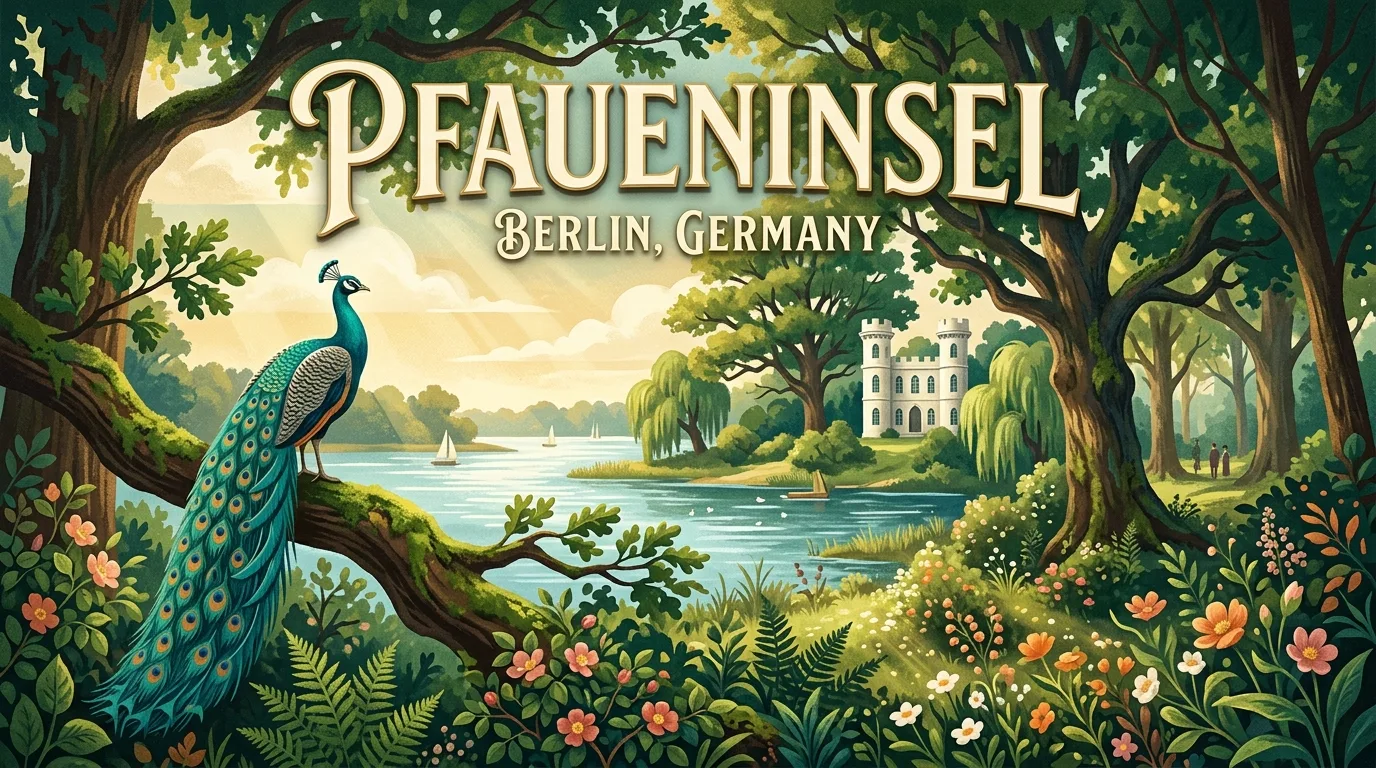
Pfaueninsel, also known as Peacock Island, is one of Berlin’s most romantic and nature-focused day-trip destinations. Located in the Havel River in the Wannsee district, the roughly 67-hectare island combines Prussian history, landscape garden design and undisturbed nature in a unique way. Free-roaming peacocks, centuries-old oak trees and a small palace built in the style of a romantic ruin create an atmosphere that feels far removed from the city’s hustle. Since 1990 Pfaueninsel has been part of the UNESCO World Heritage site “Palaces and Parks of Potsdam and Berlin.” Anyone seeking nature, architecture and history in a single day will find one of Berlin’s most atmospheric places here.
History of Pfaueninsel
Long before it received its current name, the island was known as Kaninchenwerder (Rabbit Island). King Frederick William I kept a rabbit warren there. Archaeological finds show that people settled on the island around 2,500 years ago. In the 17th century the Great Elector established a glassworks on the island where the alchemist and glassmaker Johannes Kunckel conducted experiments. After a fire and the death of his patron, the island fell into disuse for about a hundred years.
In 1793 King Frederick William II acquired the island and between 1794 and 1797 had a small pleasure palace built for himself and his confidante Wilhelmine Enke, later Countess Lichtenau. Master carpenter Johann Gottlieb Brendel constructed a timber-frame building designed to look like a ruined Roman country house – the walls of painted wood imitated marble. The island took its name from the peacocks that were introduced and whose descendants still roam freely today.
Under Frederick William III and Queen Luise the island was further developed. From 1818 landscape gardener Peter Joseph Lenné transformed it into an English-style landscape park. In 1821 he laid out Berlin’s oldest rose garden. In the 1820s and 1830s additional buildings were added, including the Cavalier House designed by Karl Friedrich Schinkel and the Palm House, which burned down in 1880. A menagerie housing hundreds of exotic animals later formed the nucleus of the Berlin Zoological Garden. The island has been a nature reserve since 1924 and a UNESCO World Heritage site since 1990.
Highlights of Pfaueninsel
Schloss Pfaueninsel is the architectural centrepiece. The white building with its towers and connecting bridge looks like a fairytale stage set. The early neoclassical interiors are largely original and can only be visited as part of guided tours. After extensive restoration between 2021 and 2025 the palace is open to the public again.
Peter Joseph Lenné’s landscape park features open meadows, groups of trees and carefully framed views across the Havel. Around 400 ancient oaks dominate the scenery, many of them hollow trees that provide habitat for rare beetles and birds. The rose garden from 1821 bursts into colour in summer. Free-roaming peacocks appear along the paths and lawns and are among the island’s most photographed features.
Other notable structures include the Cavalier House with its Gothic façade, the dairy building designed to resemble a monastery ruin, and the Luisen Temple. Water buffaloes graze as natural lawnmowers on the meadows. The island is both a nature reserve and an FFH site, so flora and fauna receive special protection. Dogs and bicycles are not permitted, which helps preserve the quiet atmosphere. A circular path of about 2.5 kilometres leads around the island and continually opens new perspectives on water, woodland and architecture.
Opening Hours, Tickets & How to Get to Pfaueninsel
Pfaueninsel can only be reached by ferry. The ferry operates daily from 10:00 to 18:00 between March and October and from 10:00 to 16:00 between November and February. On New Year’s Day the hours are 11:00 to 16:00. The last crossing to the island departs 45 minutes before closing. The palace is open from April to October, Tuesday to Sunday, 10:00 to 17:30, and closed on Mondays. Guided tours take place only on selected dates and often sell out early.
A ferry ticket including the island day pass costs €6 for adults and €5 reduced. A family ticket for two adults and up to four children under 18 is €12. Palace tickets (€8 / €6 reduced) are sold only on the day at the ferry house. Online advance purchase for the ferry is available and saves waiting time. Dogs and bicycles are not allowed.
Public transport: Take S-Bahn S1 or S7 to Wannsee station, then bus 218 to the final stop Pfaueninsel. The bus ride takes about ten minutes. Public parking is available on Nikolskoer Weg. The ferry “Luise” crosses the Havel in just a few minutes. The address is Pfaueninsel, 14109 Berlin.
Attractions Near Pfaueninsel
Immediately nearby is Schloss Glienicke with its park, also part of the UNESCO World Heritage site. The Glienicke Bridge, once famous for spy exchanges, links Berlin and Potsdam. Park Babelsberg and Schloss Babelsberg lie only a few kilometres away and offer further Prussian landscape gardens. The Wannsee with its beaches and the Villa am Wannsee invite walks and boat trips. Nikolskoe with the Church of St. Peter and Paul and the restaurant of the same name is close to the ferry landing and offers views over the Havel. The Grunewald Tower and Teufelsberg are within easy reach for walks and panoramic views. Visitors wishing to explore more of the royal cultural landscape can continue conveniently to Potsdam and Sanssouci.
Where to stay in Berlin, Germany
Compare current hotel prices and find the right place to stay.