Strandbad Wannsee
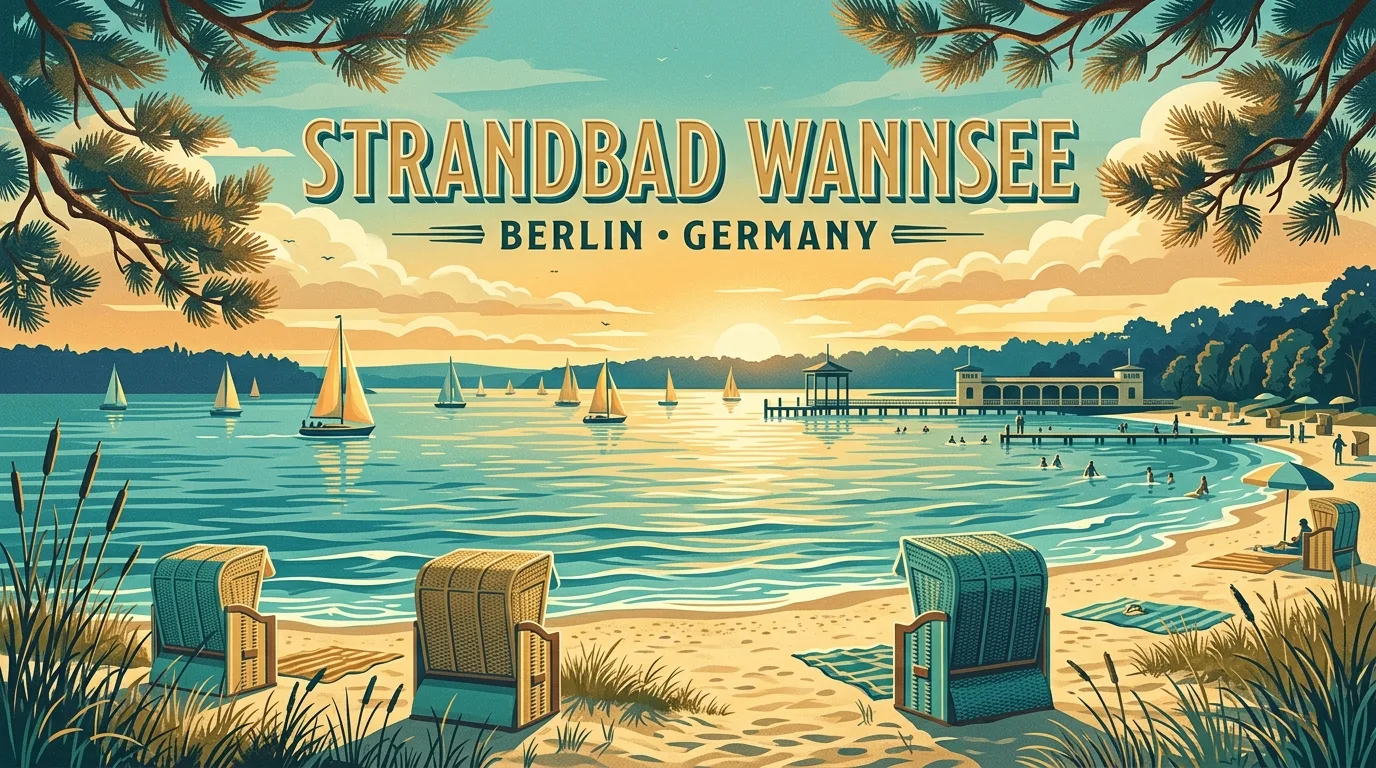
On a hot summer day, escaping the bustle of central Berlin almost inevitably leads to Strandbad Wannsee. Located in the southwest of the city, in the district of Zehlendorf, this historic lido sits directly on the shore of the Havel river, which widens here into the lake known as the Wannsee. The fine, light-colored sandy beach stretches for roughly 1.2 kilometers along the water, making the site one of the largest inland lidos on the entire European continent. On warm weekends, well over ten thousand visitors can pass through the gates, yet the sprawling grounds rarely feel overcrowded, since the crowds spread out across an area of about 125,000 square meters of beach, lawns, and meadows. Between families with children, sunbathers, swimmers, and beach volleyball players, a small summer world of its own takes shape here every year from May to September, one that many Berliners have known since childhood and continue to return to decade after decade.
History of Strandbad Wannsee
The origins of Strandbad Wannsee date back to 1907, when the first simple changing cabins and jetty structures appeared along the shore to meet the growing demand of Berlin's population for recreation by the water. As industrialization accelerated and inner-city housing grew increasingly cramped, more and more residents sought fresh air and relief from the heat outside the city on weekends, and the Wannsee, conveniently connected by a newly built railway line, proved an ideal destination. Through the 1920s the facility expanded rapidly, and many of the buildings still standing today, designed in the functionalist style associated with the New Objectivity movement, date from this major period of expansion, when Berlin was rising to become one of the most modern metropolises in Europe. The long facade of the Wandelhalle promenade hall, with its distinctive arches, along with several of the historic changing-room wings, are now protected as architectural landmarks and serve as a reminder of the bathing culture of the Weimar Republic era. During the Nazi period and the Second World War the lido, like many other public facilities, suffered setbacks, but it was rebuilt after 1945 and remained one of the most important recreational destinations for the population of West Berlin throughout the city's division, since the Wannsee lay entirely within the American sector. In the following decades the infrastructure was modernized repeatedly without fundamentally altering the historic character of the buildings. Since the 1990s the public utility Berliner Bäder-Betriebe has operated Strandbad Wannsee and has continuously invested in restoring the landmarked structures, improving water quality, and upgrading general infrastructure, so that the site today offers both historic charm and contemporary comfort.
Highlights of Strandbad Wannsee
The central highlight is, of course, the long, fine-sand beach itself, divided into several sections that offer both quiet stretches for lying out and livelier zones near the changing rooms and snack stands. The water quality of the Havel is regularly tested by the relevant Berlin authorities and usually receives good to very good ratings during the summer months, making swimming safe even for families with young children. A separate, roped-off shallow-water area is reserved for non-swimmers and small children, and several playgrounds are scattered across the grounds, while more athletically inclined visitors can head to the numerous beach volleyball courts, which host both casual games and organized tournaments throughout the season. Water lovers also appreciate the option of renting pedal boats, kayaks, or stand-up paddleboards from nearby rental stations and setting off to explore the Havel and its wooded shoreline. Architecturally, the most striking feature is the historic Wandelhalle, an elongated building in a style close to Bauhaus from the 1920s, whose slender columns and symmetrical facade create a clear contrast to the beach itself and attract many visitors looking for a memorable photo. Along the promenade, a row of food stalls offers everything from classic currywurst and fries to ice cream stands, so an entire day by the water is easily possible without ever leaving the grounds. Those seeking a quieter experience will find plenty of space on the extensive lawns set back from the immediate beachfront, perfect for reading a book or simply soaking up the sun while sailboats and excursion ships glide across the Wannsee in the background.
Opening Hours, Tickets & How to Get to Strandbad Wannsee
Strandbad Wannsee traditionally opens from early May through mid or late September, though exact dates vary slightly each year and are published in advance by the public operator, Berliner Bäder-Betriebe. During peak season the gates typically open in the morning and remain open until early evening, allowing even those with regular working hours to enjoy a few hours by the water after work. Admission is tiered by category, with separate rates for adults, children, teenagers, and those eligible for reduced fares, and generally falls within the modest range typical of Berlin's public lidos, amounting to just a few euros, while young children often enter free of charge. Getting there is particularly convenient thanks to direct public transport connections: the S1 and S7 suburban train lines stop at Nikolassee station, from which a signposted fifteen-minute walk through a wooded area leads directly to the lido, while Wannsee station offers additional bus connections. During the summer months, additional bus routes run even closer to the entrance area, which is especially practical for families with children or visitors carrying a lot of gear. Drivers will find a limited number of paid parking spaces nearby but should expect delays and full lots on nice weekends, which is why arriving by public transport is generally recommended. Cyclists benefit from the well-developed paths along the Havel shoreline, which connect the lido with much of southwestern Berlin.
Attractions Near Strandbad Wannsee
The area surrounding Strandbad Wannsee offers far more than just swimming and makes an excellent base for a full day exploring southwestern Berlin. Just a few minutes away lies Pfaueninsel, a car-free island on the Havel featuring a romantic palace, expansive parkland, and peacocks that roam freely, reachable by a small ferry. Also nearby is the Grunewald, one of Berlin's largest contiguous forested areas, offering numerous hiking and cycling trails ideal for a stroll after a swim. History-minded visitors should consider a visit to the House of the Wannsee Conference memorial and educational site, which addresses the history of National Socialism and offers an impressive view over the lake from its villa setting. Glienicke Park and the nearby Glienicke Bridge, which famously served as a crossing point between East and West during the Cold War, are also within walking or short cycling distance and combine well with a visit to the lido. Culturally inclined travelers might also consider a short side trip to the nearby city of Potsdam, home to Sanssouci Park and its palaces, just a short S-Bahn or regional train ride away.
Where to stay in Berlin, Germany
Compare current hotel prices and find the right place to stay.