Großer Müggelsee
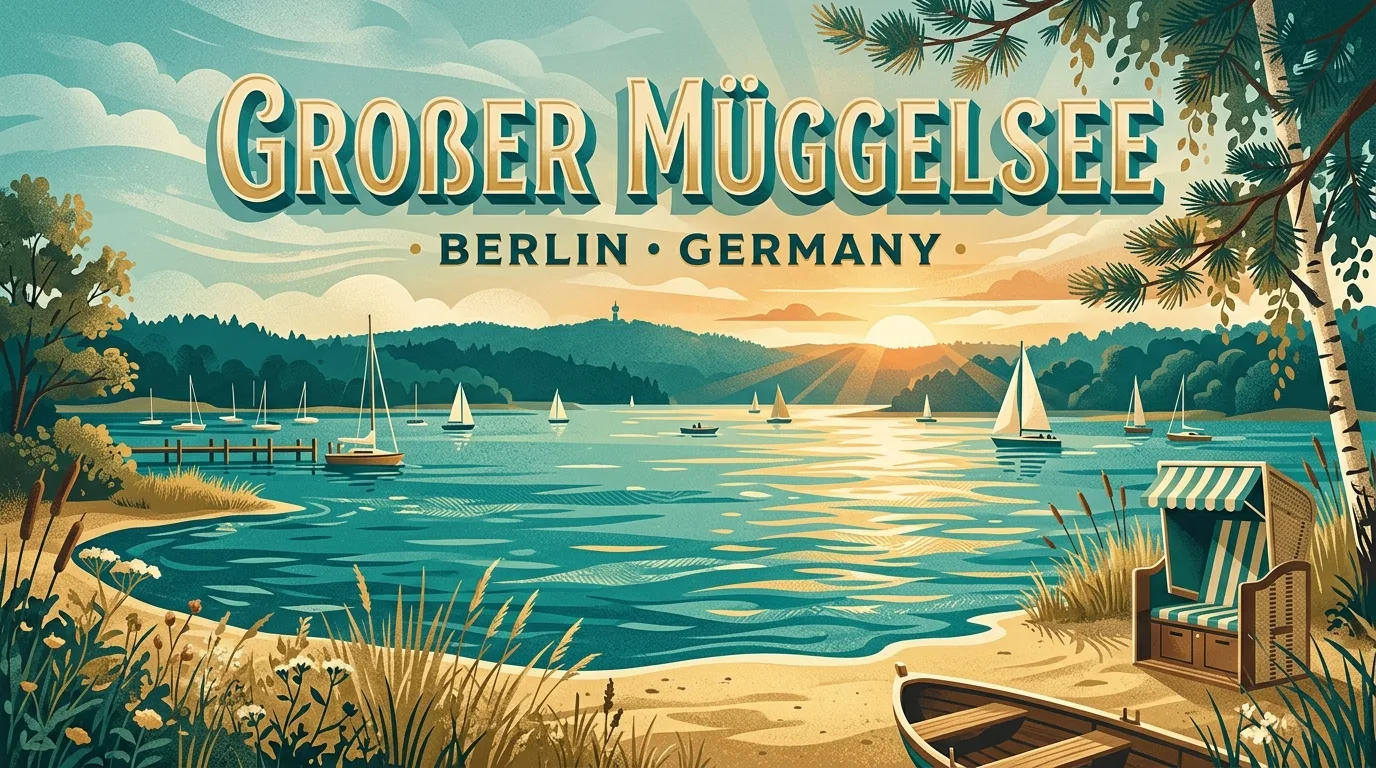
In the far southeast of Berlin, where the city gradually gives way to the lake-studded landscape of Brandenburg, lies Großer Müggelsee, the largest body of water in the German capital by surface area. Covering roughly 7.4 square kilometers, it even surpasses the better-known Wannsee and, together with the surrounding forests, meadows, and hills, forms one of the most popular recreational areas in the district of Treptow-Köpenick. The lake is fed by the Spree river, which finds one of its widest and calmest stretches here on its journey through Berlin before winding further toward the city center. Surrounded by the neighborhoods of Köpenick, Friedrichshagen, Rahnsdorf, and Müggelheim, Großer Müggelsee offers a remarkable variety of leisure activities, from expansive lidos and sailing and rowing clubs to hiking trails through the adjacent Müggelberge hills, crowned by the Müggelturm tower, which marks Berlin's highest natural point. Anyone looking to combine a day by the water with a taste of nature will find here one of the most authentic and relaxed sides of Berlin, far from the bustle of the tourist centers.
History of Großer Müggelsee
Like most of Berlin's lakes, Großer Müggelsee formed during the last ice age as a so-called channel lake, when meltwater from retreating glaciers carved deep depressions into the landscape that gradually filled with water over the following millennia. The name Müggelsee likely has Slavic origins and is tied to the surrounding region, which was already inhabited by Slavic settlers in the Middle Ages before German colonists moved into the area during the 12th and 13th centuries. The lake gained economic importance chiefly through fishing and later through the expansion of shipping along the Spree, which turned Köpenick and Friedrichshagen into significant trading posts on Berlin's outskirts. With industrialization in the 19th century and the construction of the Friedrichshagen waterworks on the northern shore, which to this day supply a significant portion of Berlin's drinking water, the region gained even greater importance. At the same time, the Müggelsee had already developed into a popular excursion destination for Berlin's growing population by the late 19th century, with steamships of the so-called White Fleet carrying visitors from the city center out to the lake district in the southeast. This tradition of excursion boat trips continues to this day and ranks among the oldest continuously operated tourist offerings in Berlin. During the period of German division, the Müggelsee lay entirely within East Berlin and served the population of the GDR as an important recreational area, with several vacation camps and company-run holiday retreats springing up along its shores. After reunification, many of these facilities were modernized or replaced with new leisure offerings, while the natural shoreline landscape was largely preserved and today falls under various nature conservation regulations.
Highlights of Großer Müggelsee
Perhaps the best-known highlight at Großer Müggelsee is Strandbad Friedrichshagen, a popular bathing spot on the northern shore with fine sand, grassy lawns for sunbathing, and a gentle entry into the water, making it especially suitable for families with children, and staffed by lifeguards throughout the summer months. Not far away, the Müggelseeperle, a time-honored lakeside restaurant, has been treating generations of Berliners to coffee and cake on its terrace while offering sweeping views across the water. Water sports enthusiasts appreciate the numerous sailing and rowing clubs along the shore, which offer boat rentals and training opportunities to visiting sailors and hobbyists alike, while stand-up paddlers and kayakers favor the calmer bays of the lake for longer excursions. A particularly memorable experience is a ride aboard one of the historic excursion steamers of the White Fleet, which regularly travel from the Müggelsee along the Spree to Köpenick or even further into the wider lake district, offering a relaxed view of the wooded shores and the many weekend cottages along the way. Hiking enthusiasts should not miss the climb up the Müggelberge on the southern shore, a forested range of hills that, at just over 115 meters above sea level, forms Berlin's highest natural elevation and is crowned by the striking Müggelturm tower, whose observation platform offers an impressive panorama over the lake and surrounding forests. Nature lovers will also find rare bird species in the area around the lake, as the shoreline zones and adjacent wetlands serve as important breeding and resting grounds for numerous waterfowl.
Opening Hours, Tickets & How to Get to Großer Müggelsee
As a natural body of water, Großer Müggelsee itself is freely accessible at no charge; only the official Strandbad Friedrichshagen lido on the northern shore charges a modest admission fee during the bathing season from May to September, within the usual range for Berlin's public lidos and discounted for children. The surrounding hiking and walking paths along the shore and through the Müggelberge hills are open around the clock, year-round, and free of charge, which makes the lake an attractive destination even outside the classic bathing season. The easiest way to get there is via the S3 suburban train line, which runs to Friedrichshagen station, from where an approximately fifteen-minute walk through the historic Bölschestraße, lined with cafés and shops, leads directly to the shore. Alternatively, visitors can reach the southern shore and the Müggelberge via Köpenick station and connecting bus routes, which is especially convenient for a hike up to the Müggelturm. For those arriving by car, both Friedrichshagen and Müggelheim offer a mix of free and paid parking options, though increased traffic should be expected on sunny weekends. Cyclists benefit from a well-developed network of shoreline paths connecting the Müggelsee with other nearby bodies of water, such as the Dämeritzsee and the Langer See, making it an excellent route for a multi-hour tour through Berlin's lake district.
Attractions Near Großer Müggelsee
Close to Großer Müggelsee lies the historic town center of Köpenick, with its imposing town hall, famously linked to the tale of the Captain of Köpenick, and Köpenick Palace, situated on a small island in the Dahme river and today home to parts of the Museum of Decorative Arts. The charming district of Friedrichshagen, with its landmarked Bölschestraße, invites a stroll past historic Wilhelminian-era buildings and offers numerous cafés, restaurants, and small shops away from the tourist mainstream. Nature lovers should visit the Krumme Lake nature reserve and its surrounding forests, ideal for extended walks and birdwatching. Not far away lies the Dämeritzsee with its tranquil bays, connected to the Müggelsee via the Spree and equally well suited to boat trips. Visitors looking to combine the area with another cultural highlight can conveniently explore the historic old town of Köpenick from there, with its baroque buildings ranking among the oldest preserved settlement cores within Berlin's city limits.
Where to stay in Berlin, Germany
Compare current hotel prices and find the right place to stay.