Friedrichstraße
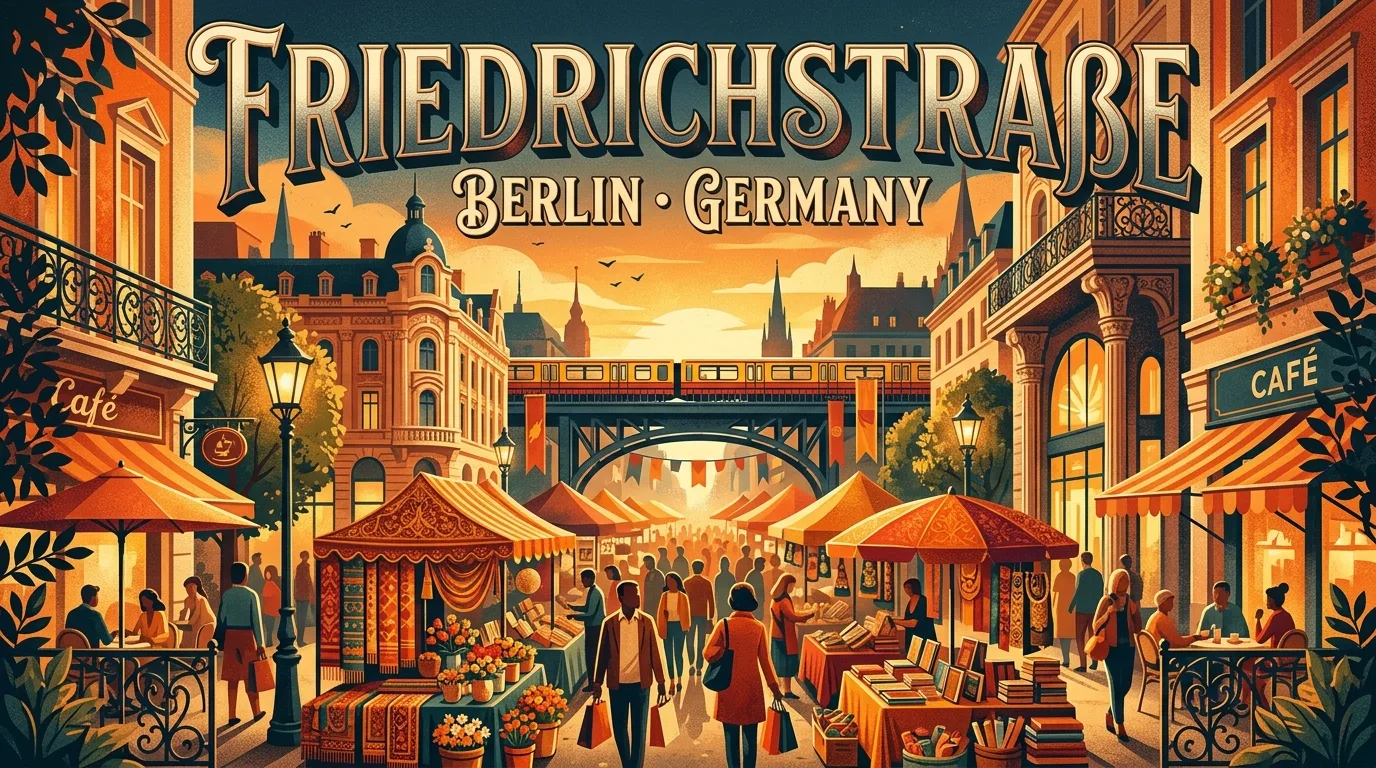
Friedrichstraße is one of Berlin's best-known and most historically layered streets, running for roughly 3.3 kilometers through the district of Mitte from north to south. It crosses the world-famous boulevard Unter den Linden at almost a right angle, forming one of the central reference points of Berlin's inner city for centuries. Along the street, international fashion houses, traditional department stores, office buildings, theaters, and historic structures stand side by side, including the striking glass facades of the Friedrichstadt-Passagen and the famous Galeries Lafayette Berlin department store. Few other streets in the city reflect Berlin's turbulent history as clearly as Friedrichstraße: from a baroque boulevard, through the glittering theater and cabaret years of the 1920s, to a divided city with a border crossing at Bahnhof Friedrichstraße, and finally to today's mix of shopping street, business district, and site of historical memory.
History of Friedrichstraße
Friedrichstraße was laid out from 1688 onward as part of the baroque urban expansion known as Friedrichstadt, planned under Elector Friedrich III of Brandenburg, who became King Friedrich I in Prussia in 1701 and gave the street its name. Originally designed as a wide, perfectly straight axis within the grid of the new district, Friedrichstraße developed over the 18th and 19th centuries into one of Berlin's most important commercial and traffic arteries. Its greatest heyday came in the 1920s, when numerous theaters, variety halls, cabarets, hotels, and department stores settled along the street, turning the area into a symbol of the vibrant nightlife of the so-called Golden Twenties, with the Friedrichstadt-Palast as one of its most famous venues. After Germany's division, Friedrichstraße ran right through the middle of the divided city, and Bahnhof Friedrichstraße became one of the most important border crossings between East and West Berlin. In the so-called Tränenpalast, a processing building directly at the station, families and friends said goodbye to one another for decades before travelers from the West had to return home, while East Berliners were not allowed to cross the border. After the fall of the Wall in 1989 and German reunification, the middle section of Friedrichstraße was comprehensively redeveloped. The 1990s saw the construction of the so-called Friedrichstadt-Passagen, consisting of three quarters known as Quartier 205, 206, and 207, designed by internationally renowned architecture firms, including the office of I. M. Pei for Quartier 206 and Jean Nouvel for the Galeries Lafayette Berlin department store in Quartier 207, which opened in 1996 and remains, with its spectacular glass light cone, one of the architectural highlights of the street.
Highlights of Friedrichstraße
The architectural centerpiece of Friedrichstraße is the Friedrichstadt-Passagen in the middle section of the street, home to the Galeries Lafayette Berlin department store with its glass cone designed by Jean Nouvel, which narrows downward through the building's central courtyard and channels light all the way to the lower floors, making it one of the most photographed interiors in Berlin's retail scene. In the neighboring Quartier 206, several floors are lined with international luxury brands and designer labels, while Quartier 205 offers a mix of fashion, dining, and services. North of the intersection with Unter den Linden, the character of the street changes noticeably: historic buildings, embassies, office blocks, and the rebuilt publishing quarter dominate, while in the southern section toward Checkpoint Charlie, the contrast between modern office architecture and preserved traces of Germany's division becomes especially visible. Theater lovers will find Europe's largest theater stage at the Friedrichstadt-Palast, known for its elaborate revue and show productions, along with several other historic venues nearby. Bahnhof Friedrichstraße itself, with the attached Tränenpalast museum documenting the history of German division right at this location, is a destination in its own right for visitors interested in history. Along the entire length of the street, international flagship stores of well-known fashion brands alternate with smaller specialty shops, bookstores, cafés, and restaurants, so that Friedrichstraße can be experienced both as a classic shopping street and as a historically charged walk through the center of Berlin.
Opening Hours, Tickets & How to Get to Friedrichstraße
Friedrichstraße itself, as a public street, can be walked freely and free of charge at any time; only the opening hours of the individual shops, museums, and theaters along the street need to be kept in mind. Most fashion stores and department stores, including Galeries Lafayette Berlin, are generally open Monday to Saturday between 10:00 and 20:00, and sometimes on designated shopping Sundays as well. The Tränenpalast museum at Bahnhof Friedrichstraße is usually open Tuesday to Sunday from 9:00 to 19:00 and offers free admission, while tickets for performances at the Friedrichstadt-Palast are priced separately depending on the production. Getting to Friedrichstraße is especially easy thanks to several central transport hubs: Bahnhof Friedrichstraße is served by the S-Bahn, the U6 subway line, and numerous regional and long-distance trains, and sits directly on the street. The stations Französische Straße and Stadtmitte on the U6 and U2 lines are also within easy reach of the middle sections around Unter den Linden and the Friedrichstadt-Passagen. Traveling by car is only moderately recommended due to the inner-city location and periods of pedestrian-friendly restrictions, though parking is available in several garages along the street and in the side streets of Mitte.
Attractions Near Friedrichstraße
Thanks to its central location in the heart of Mitte, Friedrichstraße connects several of Berlin's best-known sights. At the intersection with Unter den Linden, visitors can reach both the Brandenburg Gate and Pariser Platz to the west and Gendarmenmarkt, with the German and French Cathedrals and the Konzerthaus, to the east of Friedrichstraße within a few minutes' walk. Heading south, the street leads directly to the historic site of the former Checkpoint Charlie border crossing, one of the most visited locations related to the history of Germany's division. North of the Spree lies the area around Oranienburger Tor, with the Neue Synagoge and the adjoining Scheunenviertel, known for its small galleries and cafés. Museum Island, with the Pergamon Museum and the Neues Museum, is also reachable on foot from Friedrichstraße within a few minutes, making it easy to combine a visit to the street with a walk through Berlin's historic center.
Where to stay in Berlin, Germany
Compare current hotel prices and find the right place to stay.